青岛浪潮大数据中心 / 北建院马泷工作室
设计团队凭借多年设计现代科技总部的经验,在充分满足办公园区使用需求和使用效率的同时,将城市与建筑的规划限制条件转化为特有的建筑造型语素,同时融入新的设计理念,赋予艺术化的建筑处理,最终将建筑幻化为一个趣味无穷的独特形象,为使用者和观者都带来无限惊喜和愉悦,正是本建筑的设计精髓。
Drawing upon years of experience in designing modern technology headquarters, the design team not only fully meets the functional and efficiency demands of the office campus, but also transforms the planning constraints of the city and architecture into distinctive architectural expressions. Infused with fresh design philosophies and artistic sensibilities, the building takes shape as a unique and captivating form—an architectural presence full of delight and surprise. It is this seamless blend of function, form, and imagination that defines the true essence of the design, offering endless inspiration and joy to both its users and passersby.
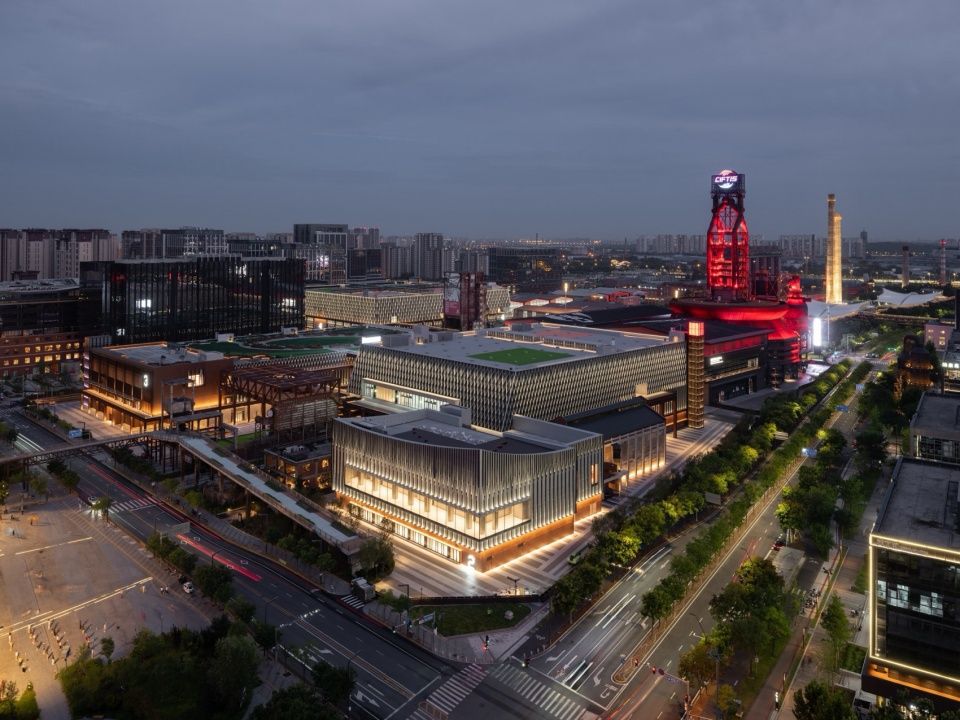
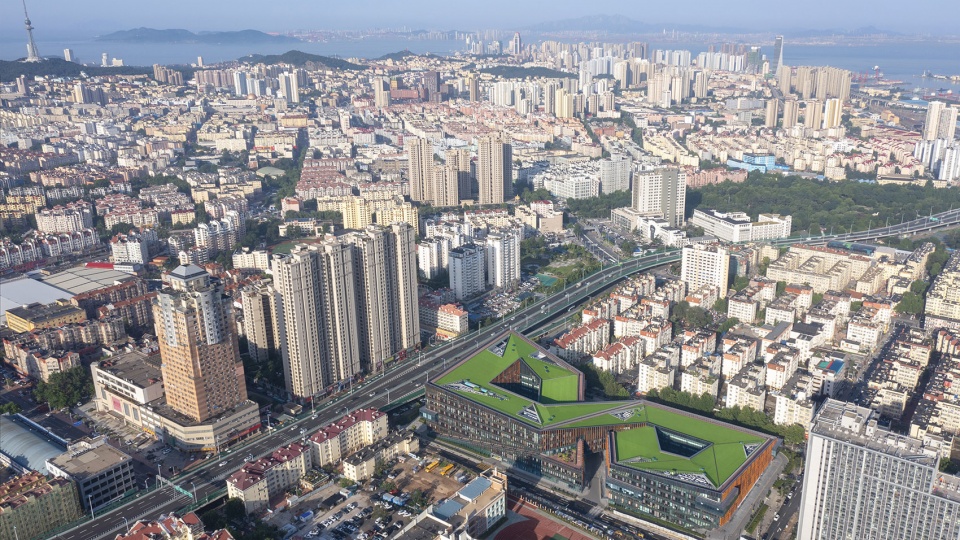
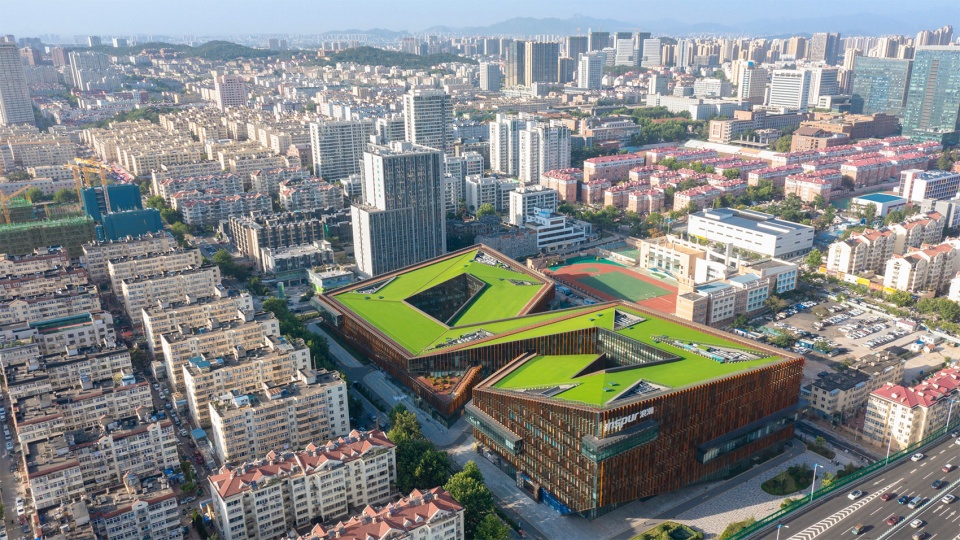
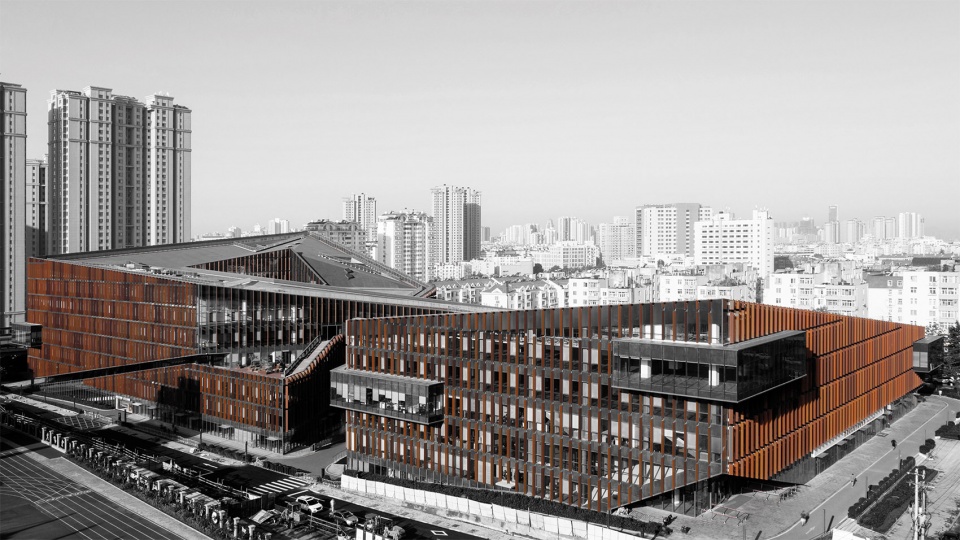
▼东侧鸟瞰,aerial view from the east side
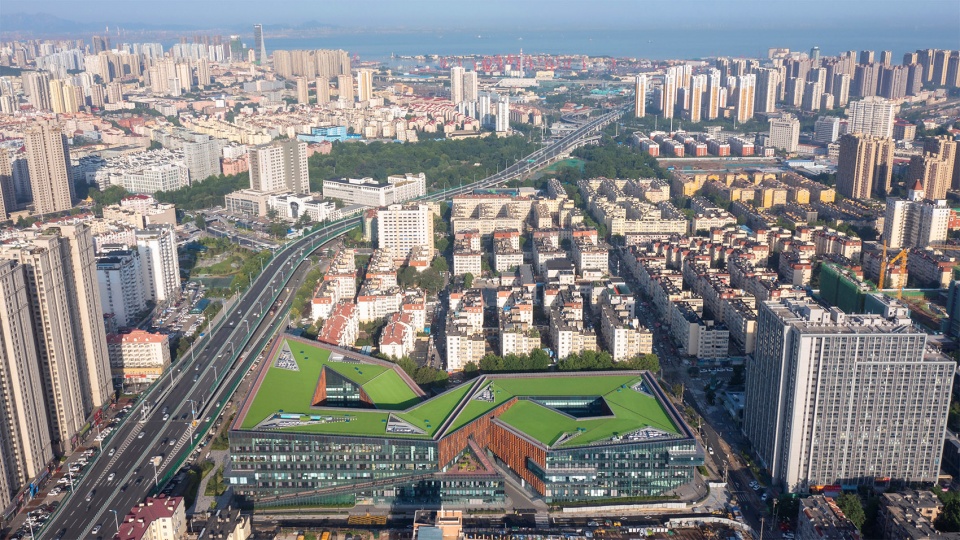
▼从大数据中心北望传统居住区,Looking north from the big data centre to traditional residential areas
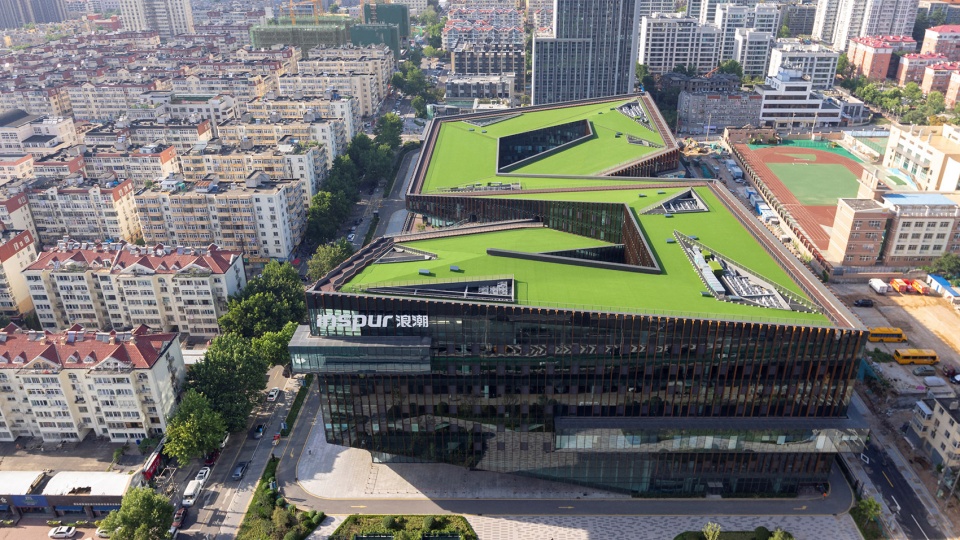
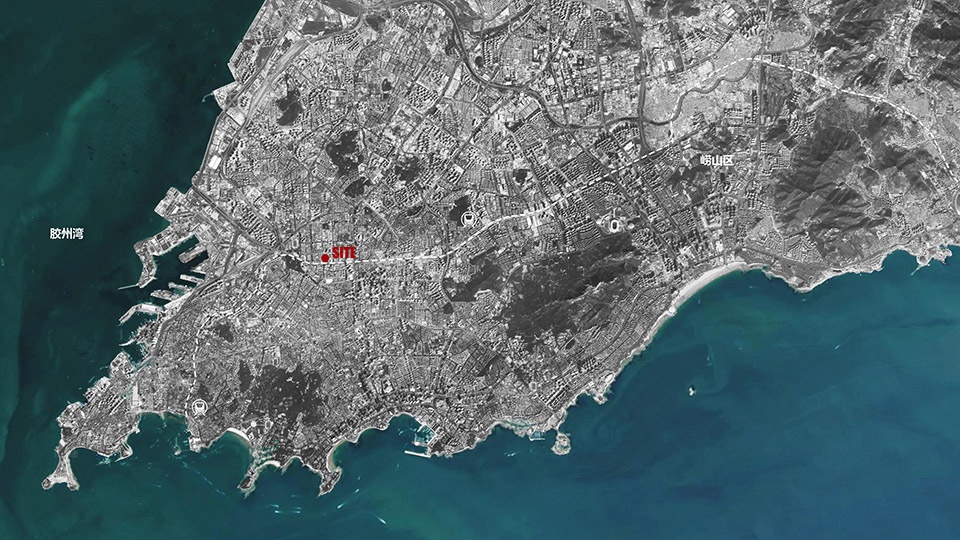
青岛浪潮大数据中心位于青岛市核心区的老城中心,地块周边充斥着老旧住宅小区、学校、沿街店铺等传统生活形态,因此设计对新建筑的密度、交通、日照、噪音提出了苛刻的控制条件。项目的使用性质虽然为现代科技的大数据研发中心,但必须与周边居民和谐友好地相处,同时肩负着振兴老旧街区的重任,设计团队也希望把种种制约条件,通过艺术化的建筑语言统筹成为项目制胜的核心理念。
The Qingdao Inspur Big Data Center is located in the heart of Qingdao’s historic urban core. Surrounded by aging residential neighborhoods, schools, and traditional street-front shops, the site is embedded within a landscape of longstanding urban life. As a result, the design faced stringent constraints regarding building density, traffic flow, sunlight exposure, and noise control. While the project functions as a cutting-edge research hub for big data technology, it also carries the responsibility of coexisting harmoniously with the surrounding community and revitalizing the aging district. The design team embraced these limitations as an opportunity, seeking to transform them through an artistic architectural language into a unifying vision—one that ultimately becomes the project’s greatest strength.
▼从大数据中心东望崂山,Looking east at Laoshan from the Big Data Centre
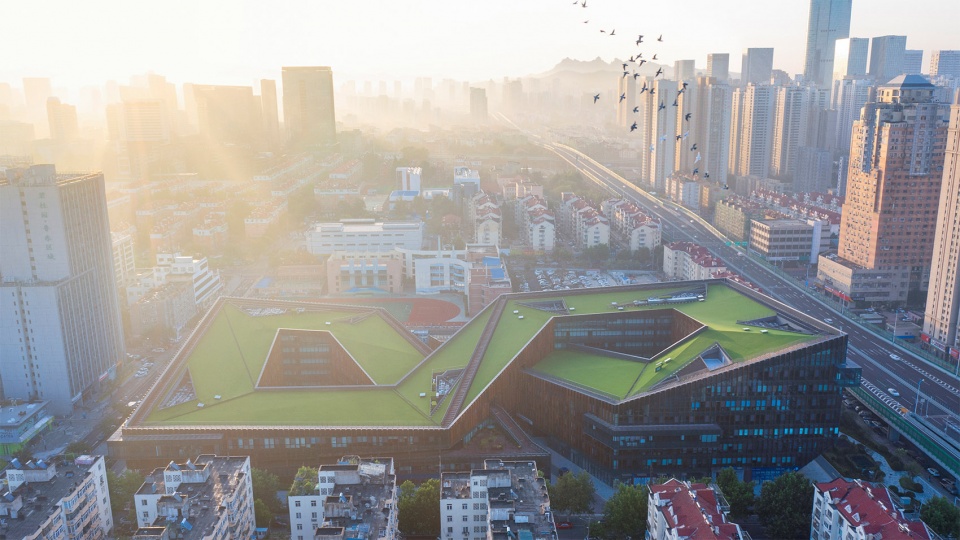
浪潮青岛大数据园区试图创造一座互联互通、年轻生动、界面友好、低碳绿色、可持续发展的高科技研发中心。建筑造型基于周边异常复杂的日照限高条件和交通条件,以及在居住城市环境中如何赋予大型建筑宜人的尺度。建筑通过一系列理性分析和艺术化处理,在符合规划对建筑高度、退线距离、空间形态、交通组织、市政设施、功能布局等方面的设计要求的同时,恰当地平衡了本项目以人为本,环保绿化及低碳办公的原则,把地块的最大潜能发挥出来。
The Qingdao Inspur Big Data Campus aspires to create a high-tech research center that is interconnected, vibrant, community-friendly, low-carbon, and sustainably developed. The architectural form is shaped in response to the site’s exceptionally complex constraints—ranging from stringent sunlight exposure and height limits to challenging traffic conditions—while also addressing the need to humanize the scale of a large building within a residential urban context. Through a combination of rigorous analysis and artistic interpretation, the design fulfills planning requirements related to height, setbacks, spatial configuration, traffic flow, municipal integration, and functional layout. At the same time, it thoughtfully balances the project’s core principles of human-centered design, ecological greenery, and low-carbon operation, ultimately unlocking the site’s fullest potential.
▼从大数据中心南望现代城市区,Looking south from the big data centre to the modern city district
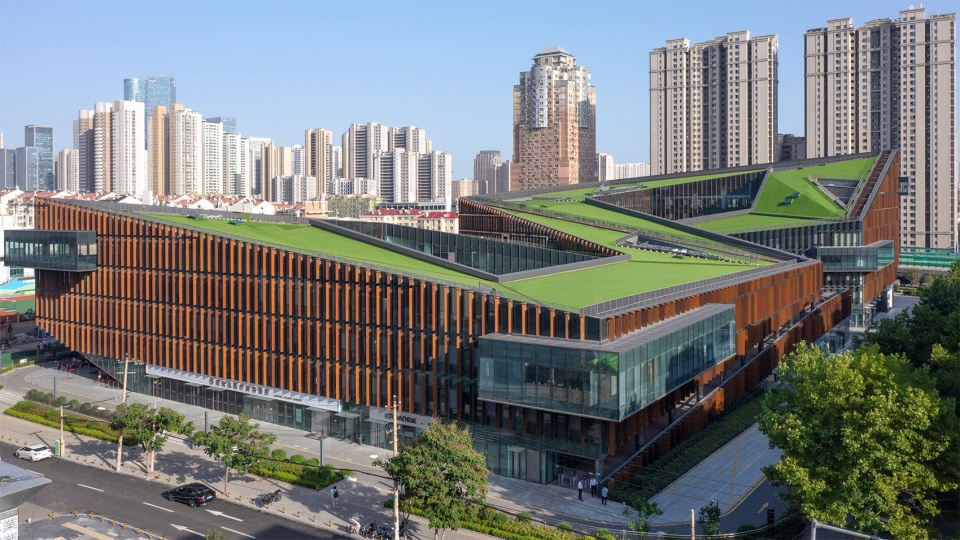
建筑尊重城市肌理,适当控制建筑高度,降低鞍山高架路引起的声光污染,最大化减少对周边现状居住区的影响。同时将地块不利因素变为设计特色,在满足日照条件的基础上形成连续起伏的屋面,体现对比、序列、节奏的美感。
The architecture respects the fabric of the city, carefully controlling building height to reduce light and noise pollution from the Anshan elevated roadway, and minimizing its impact on the surrounding residential areas. At the same time, it transforms site constraints into defining design features. By responding to stringent sunlight requirements, the roofline evolves into a dynamic, undulating form—expressing a sense of contrast, sequence, and rhythm that imbues the building with a unique and poetic architectural character.
▼从大数据中心东望崂山山脉,Looking east at the Laoshan Mountains from the Big Data Centre
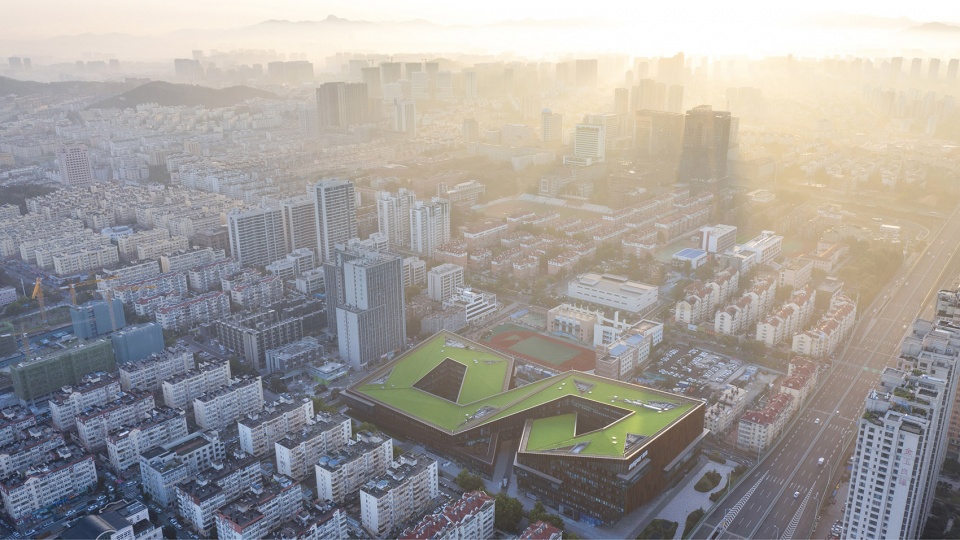
建筑灵感源自从地面到屋面循环往复的运动生态环路“无限环”。员工可以从建筑的两个起点沿着室外台阶到达每一片屋面绿化景观和室内办公场所,并不断升高直至建筑西南角的最高点,在这里人们可以眺望胶州湾海景和崂山山景。
The architectural inspiration stems from the concept of an “infinite loop”—a dynamic ecological circulation that flows seamlessly from ground to rooftop and back again. Employees can begin their journey at either of the building’s two starting points, ascending a series of outdoor steps that lead to each rooftop garden and interior workspace. This continuous path gradually rises, culminating at the southwest corner of the building, where sweeping views of Jiaozhou Bay and the distant peaks of Mount Laoshan unfold. It is a spatial experience that intertwines movement, landscape, and architecture into a harmonious whole.
▼从大数据中心西望胶州湾,Looking west at Jiaozhou Bay from the Big Data Centre
建筑的交通组织力求清晰简洁,并将人行通道与车行通道分流。设计在符合城市控规及整体路网规划的前提下,主动优化区内道路结构,通过合理设置机动车和人行出入口,减少大量机动车对地块内部和周边社区的交通压力。
The circulation strategy of the building emphasizes clarity and simplicity, with a clear separation between pedestrian and vehicular traffic. While adhering to the city’s planning regulations and the broader urban road network, the design proactively optimizes the internal road layout. By thoughtfully positioning vehicle and pedestrian entrances and exits, it significantly reduces traffic pressure within the site and on the surrounding neighborhoods, creating a more efficient and harmonious urban interface.
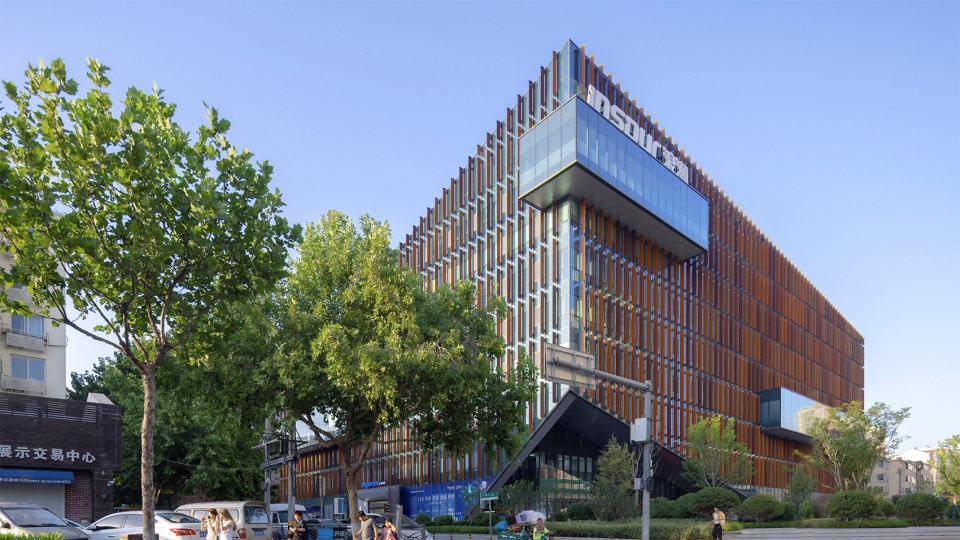
▼大数据中心主入口与城市街角的呼应关系,The relationship between the main entrance and the city street corner
城市设计限制 Urban design constraints
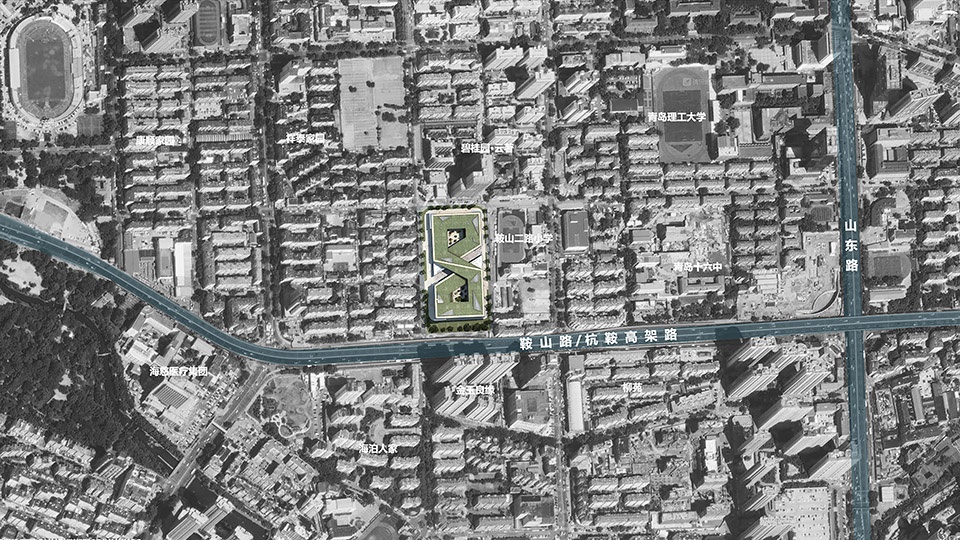
建筑南北长度超过200米,东西长度100米,在城市设计中在用地中央位置规划了一条斜穿步行街以连接东西两侧居民,客观上把用地划分为两个梯形平面,也客观形成了建筑间的密度街区。如何用好这组总图上的锐角用地,并与不规则起伏的空间日照界限相匹配,成为设计构思的关键问题。
▼大数据中心城市形态分析,urban form analysis
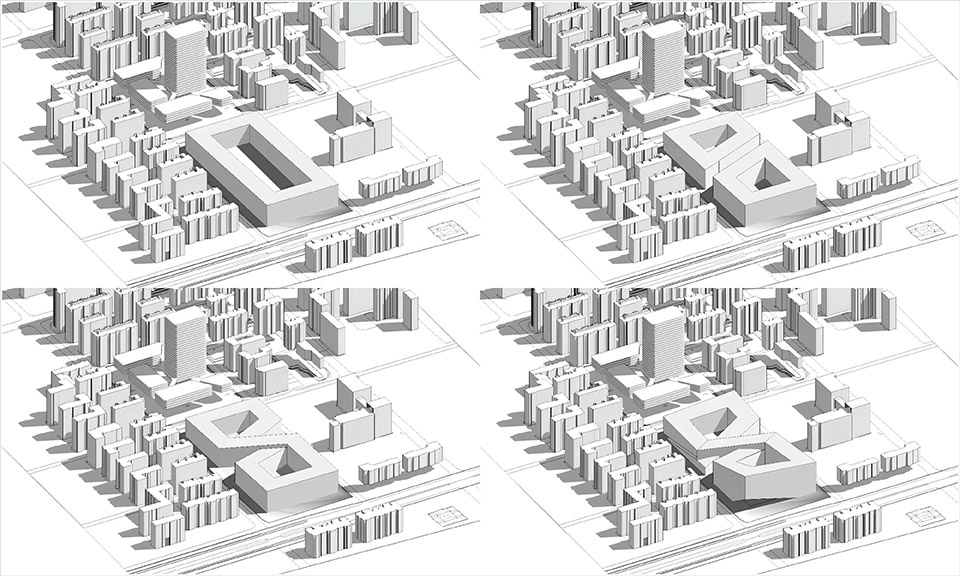
The building stretches over 200 meters from north to south and 100 meters from east to west. As part of the urban design, a diagonal pedestrian street is planned through the center of the site to connect residential areas on the east and west sides. This intervention effectively divides the plot into two trapezoidal zones and introduces an urban block pattern defined by building density. A key challenge of the design lies in how to make effective use of these sharp-angled spaces within the master plan, while also responding sensitively to the irregular and undulating sunlight setback boundaries—turning constraints into opportunities for spatial innovation.
▼大数据中心城市空间关系,urban space relationship
建筑日照限制
Building dailight limits
建筑总体地形北高南低,南北高差达到7.5米,东西高差1.5米,两侧城市道路自身也存在明显坡度。这种在青岛市区特有的地形条件是非常有趣味的建筑素材,我们借助地形变化设计了双首层平面,提供出更多的地面公共交流空间。建筑的两个内庭院通过斜穿步行街相连,自然解决了南北首层的高差变化。
Based on a detailed sunlight analysis of the surrounding residential buildings, the roofline of the architecture was carefully sculpted to comply with daylight access requirements. Strict height limitations imposed by the residential community to the west and the elementary school to the east made the site’s sunlight conditions particularly complex. As a result, the building could only reach its highest point at the southwest corner, with the height gradually stepping down along a diagonal axis toward the northeast, southeast, and northwest. This diagonally descending pattern established the formal logic of the undulating roofscape and became the foundational rule governing its architectural expression.
▼大数据中心城市空间关系,urban space relationship
交通环境限制
Transportation constraints
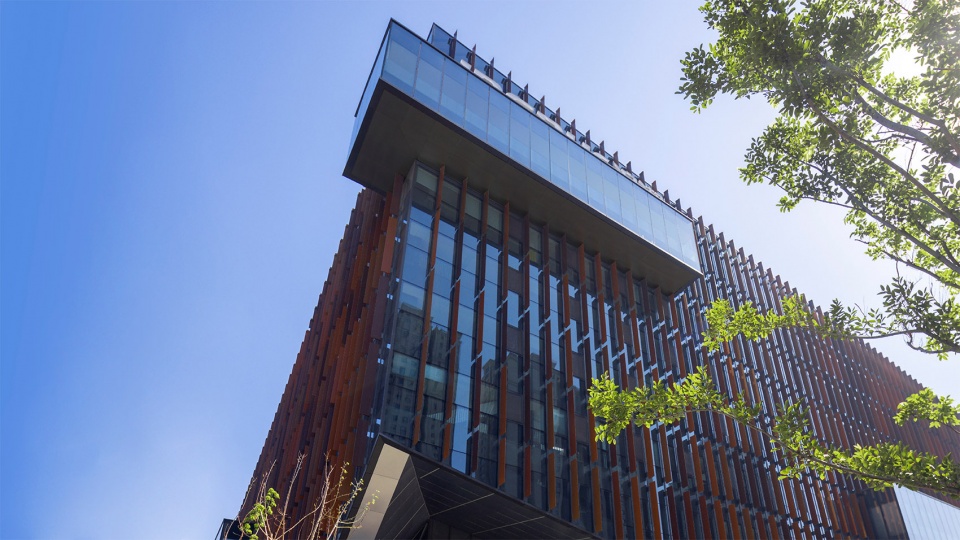
建筑用地南侧紧邻地铁出口和一条重要的高架桥匝道,再一次给建筑设计提出挑战。建筑师将建筑主体由东南向西南顺势抬起,使得办公空间获得了更多的阳光和城市视野。同时其下部两层采用后退且通透的玻璃隔断设计,室外自然形成建筑的主入口广场,人们的视线可以在室外广场、迎客大厅、景观庭园之间连通,并通过高大乔木绿化的介入使得高科技园区的紧张感得以舒缓,也柔和了建筑与道路之间的临近关系。
To the south of the site, the building is closely adjacent to a subway exit and an important elevated highway ramp, which posed a significant challenge for the architectural design. In response, the architects lifted the building mass from the southeast to the southwest, thereby allowing the office spaces to receive more sunlight and offering expansive views of the city. The lower two floors are set back and designed with transparent glass partitions, creating an outdoor public plaza that serves as the main entrance to the building. This design connects the plaza, the welcoming lobby, and the landscaped courtyard visually, while the intervention of tall trees and greenery alleviates the tension typical of a high-tech campus, softening the building’s proximity to the roadway.
▼大数据中心主入口退让地铁出口,Main entrance set back from metro exit
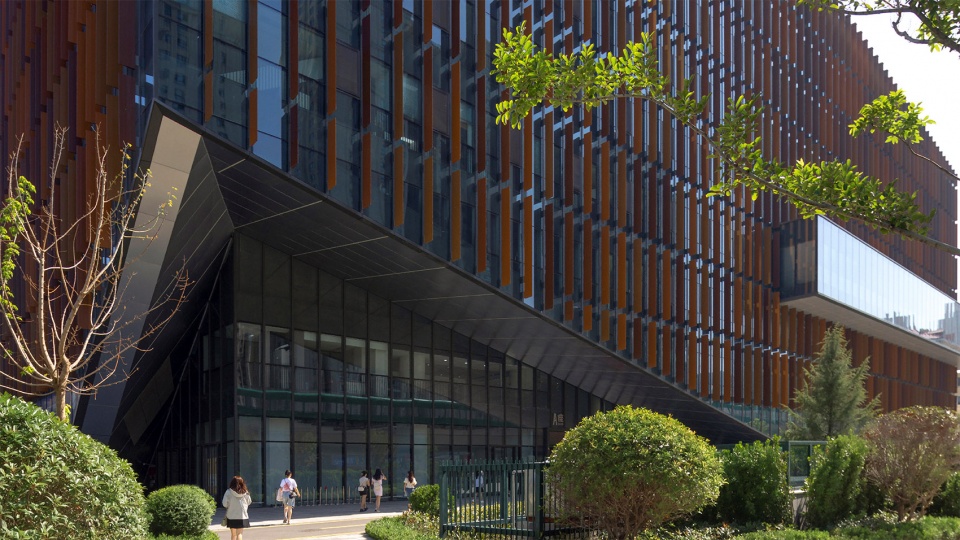
▼大数据中心主入口向上抬起,Main entrance to the big data centre raised upwards
使用功能限制Functional use restrictions
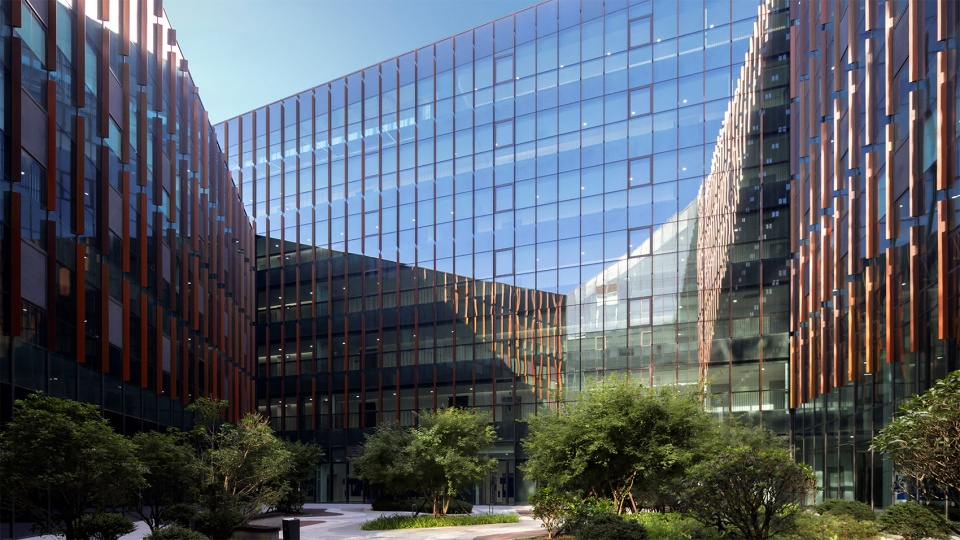
大开间连续办公建筑室内合理宽度为30米,而本建筑的总体尺度接近100米,因此需要设置内庭院以增加自然采光通风,将建筑设计为围绕内庭院展开的环形布局,并将两组环形布局通过空中连接区彼此沟通,使建筑总体造型自然形成无限符号的形态。
The optimal interior width for open-plan office buildings is typically around 30 meters, while the overall scale of this building approaches 100 meters. To address this, courtyards are incorporated into the design to enhance natural light and ventilation. The building is organized in a circular layout around these courtyards, with two such circular formations connected by an elevated bridge, allowing the two sections to interact. This design approach naturally shapes the building’s overall form into the symbol of an infinite loop.
▼围绕内庭院展开的环形布局,Circular layout around an inner courtyard
立体景观步道Three-dimensional landscape pathway
建筑中因势利导,设计了一条1000米长的健康步道。它自东南角部地坪逐层升高,串联起每个楼层,直至景观屋面的最高点。在这里向西可以眺望大海,向东可以平视群山。越过西南角的建筑最高点步道开始逆向依屋面走势逐渐下降,再从斜穿道路上空连接到北侧办公区景观屋面,并沿着起伏的地形逐层缓步下行,其间我们特意在主楼的一半高度设计了两组室外平台,既可以作为室内公共空间的室外延伸,也成为运动步道张弛有度的舒缓区,巧妙地运用总图规划中的锐角空间,形成特别的屋面体验,甚至还可以成为家长们俯瞰校园操场的最佳去处,最终室外步道会由西北角部返回北侧地面。
▼立体景观步道与地面步行街的呼应,Three-dimensional landscaped walkway echoing the at-grade pedestrian street
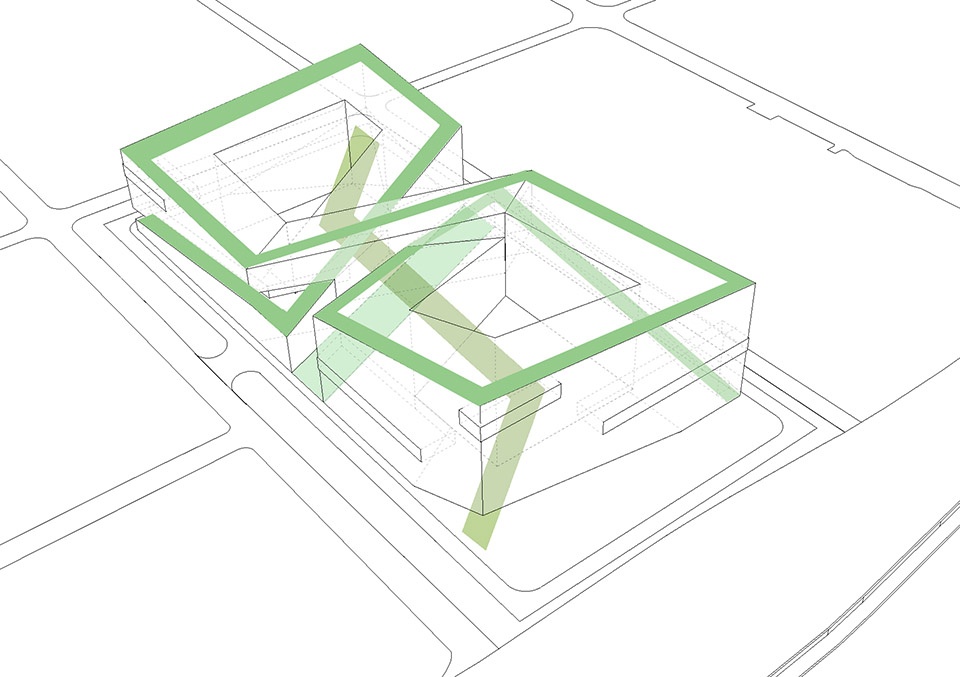
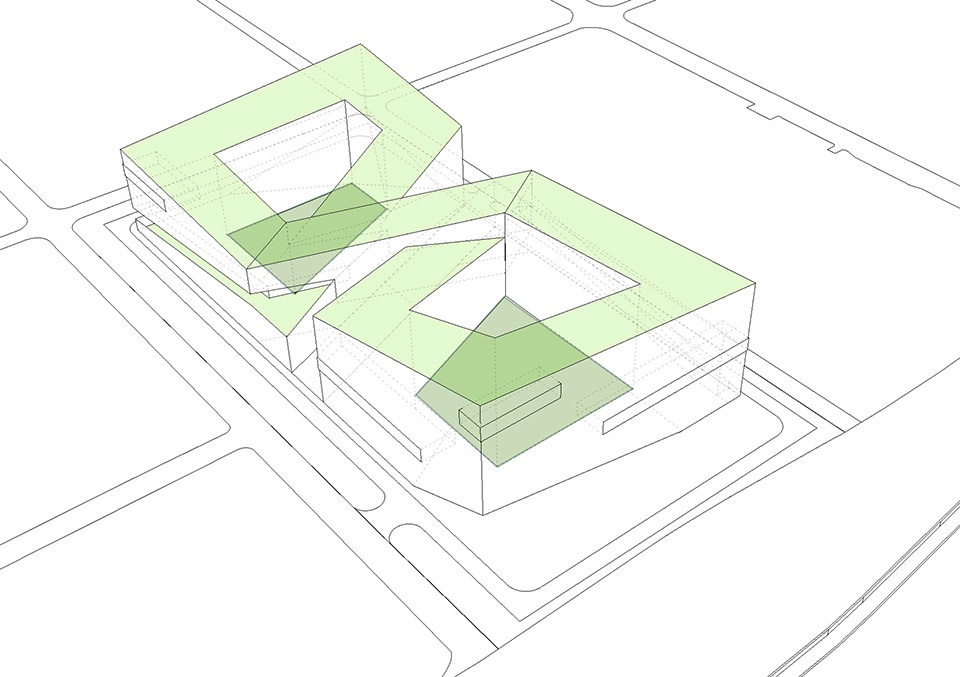
Taking advantage of the site’s natural topography, a 1,000-meter-long wellness pathway has been designed within the building. Starting from the southeast corner at ground level, it gradually rises, connecting each floor and culminating at the highest point of the landscaped rooftop. From this vantage point, one can gaze westward toward the sea and eastward for a panoramic view of the surrounding mountains.Beyond the highest point at the southwest corner, the walkway begins to descend in reverse, following the contours of the roofline. It then crosses over the diagonal road to connect with the landscaped rooftop of the northern office area, gradually stepping down along the undulating terrain. Along the way, we’ve designed two outdoor platforms at half the height of the main building. These serve not only as extensions of the indoor public spaces but also provide relaxing zones along the wellness path, balancing the flow of movement. The sharp-angled spaces in the master plan are cleverly utilized, creating a unique rooftop experience. These platforms can also serve as ideal spots for parents to overlook the campus playground. Ultimately, the outdoor walkway returns to the northern ground at the northwest corner, completing the circuit.
▼立体景观步道串联起各个外部空间,可以作为紧急疏散通道,
Three-dimensional landscaped walkways connect the various exterior spaces and can be used as emergency evacuation routes
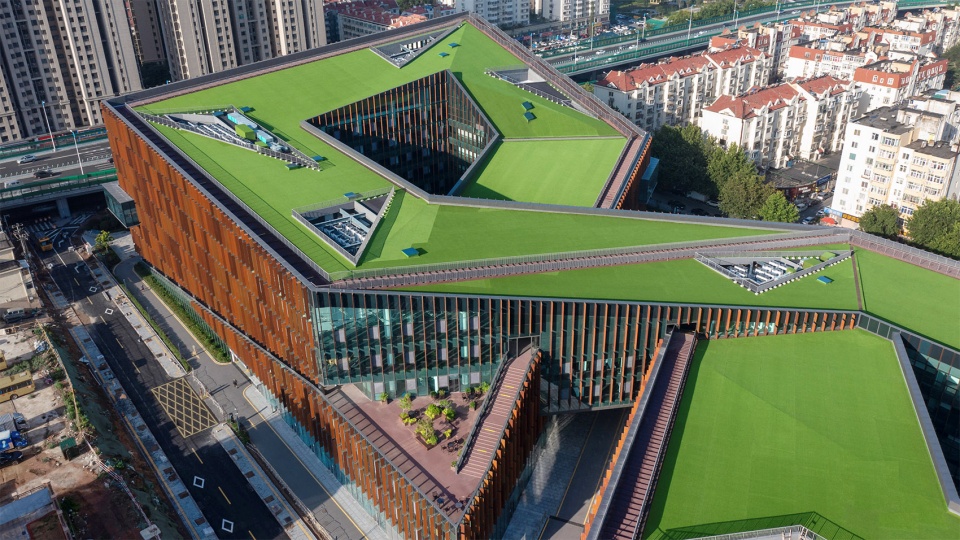
建筑的两组地下汽车坡道也刚好利用斜向步道下侧设置,使得这一无限循环的理念继续向地下延伸。这不仅是一条独特的健康步道,还可以作为楼层间最便捷的联络方式以及消防疏散通道,更是未来极具网红气质的城市风景线,成为本项目独特的空间组织脉络。
The two underground car ramps are strategically positioned beneath the sloping walkway, extending the concept of the infinite loop into the subterranean levels. This pathway is not only a unique wellness route but also serves as the most convenient connection between floors and as an emergency evacuation passage. Moreover, it is poised to become a future iconic city landmark, with a strong social media presence, adding a distinct spatial rhythm to the project’s overall organization. This clever integration of function and design makes it a key feature of the building’s identity.
▼规划中要求保留的穿行步行街,The plan calls for the preservation of walk-through streets
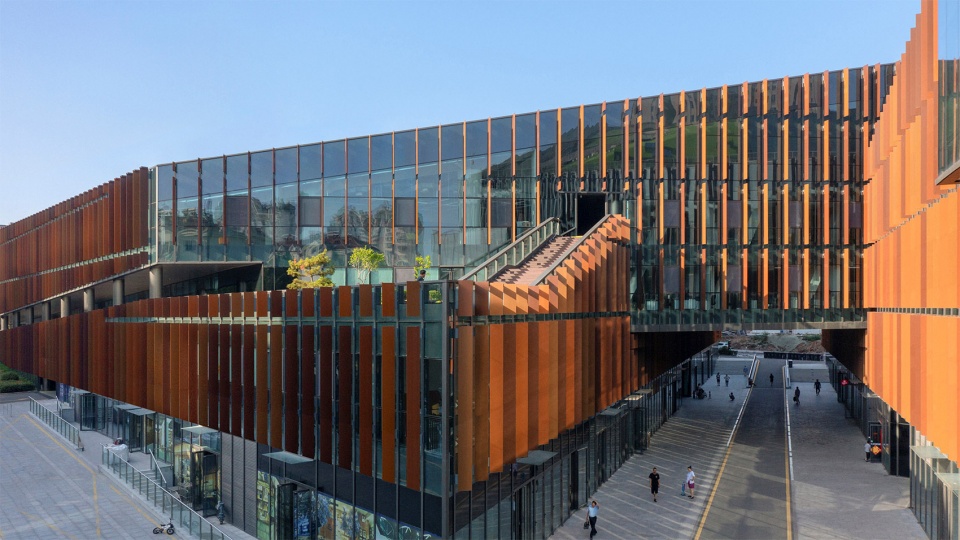
▼大数据中心地势东高西低,The topography of the Big Data Centre is high in the east and low in the west
超长平面设计
Extra-long plan design
建筑内部平面的错层处理结合立体步道和斜向造型展开,空间自然而丰富。在这一超长的平面构型之中,建筑师首先思考的是高效的平面布局、建筑不同区域之间的互联互通、建筑层间共享空间的有节奏出现和适当合理的功能分区布置。
▼总平面图,site plan
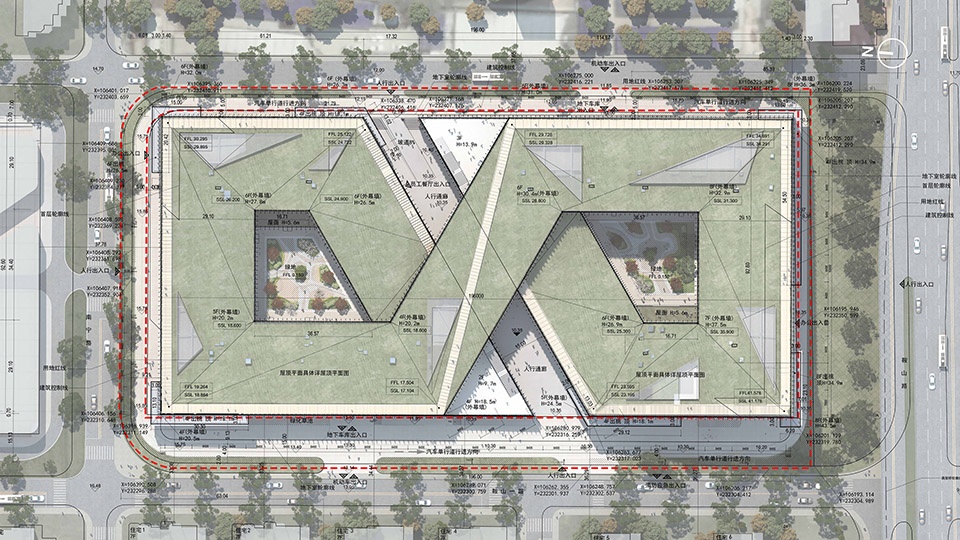
The interior floor plan is designed with staggered levels that integrate the elevated walkway and sloping forms, creating a space that is both natural and rich in character. Within this expansive floor plan, the architects’ primary focus was on an efficient layout, ensuring seamless connectivity between different areas of the building. The rhythmic appearance of shared spaces between floors and the thoughtful zoning of functional areas were also key considerations, optimizing the overall flow and usability of the design.
▼室内中庭,indoor atrium
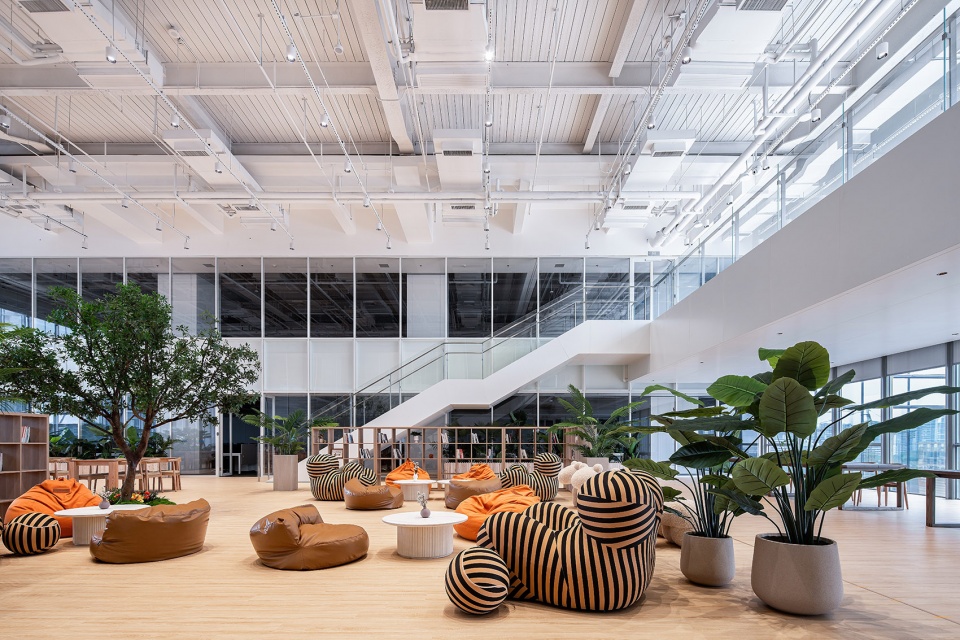
同时将最适合本项目的标准核心筒设计推敲到极致,然后制定模式标准化使用。柱网设计在整体红线内根据建筑布局、办公排布、停车效率统筹设置,并增加装修控制界面和PG网格模数系统,这种精细化的设计逻辑和组织方式,使得平面空间的均好性和标准化率大大提高,也为建筑品质的高完成度奠定了基础。
At the same time, the most suitable standard core design for the project was meticulously refined and standardized for consistent use. The column grid layout was strategically organized within the overall boundary, taking into account the building’s layout, office arrangement, and parking efficiency. Additionally, the design incorporates control interfaces for finishes and a PG grid modulus system. This refined approach to design logic and organization significantly enhances the uniformity and standardization of the floor plan, laying a strong foundation for the high-quality completion of the building.
▼室内公共区,indoor public area
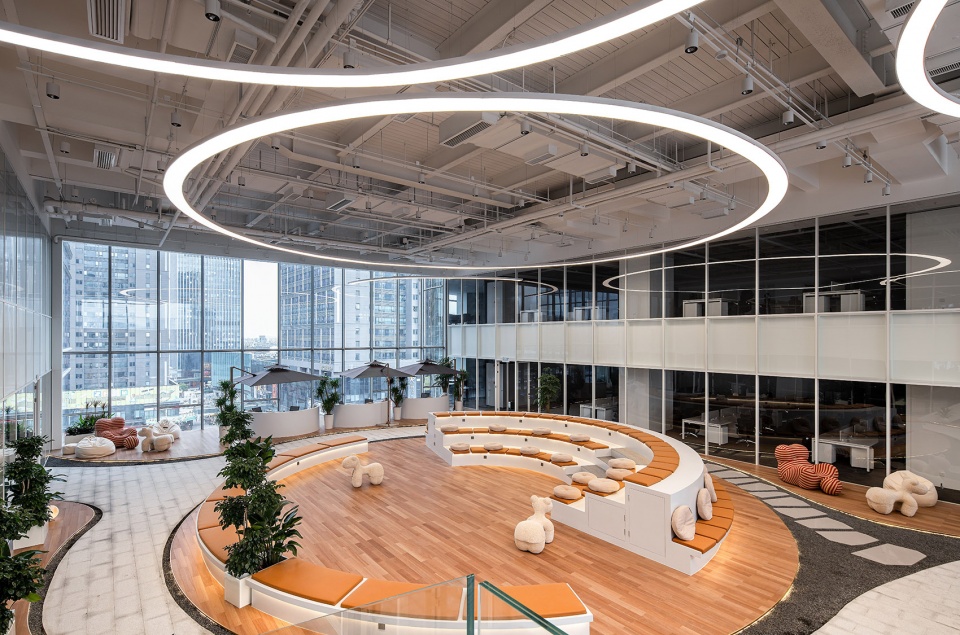
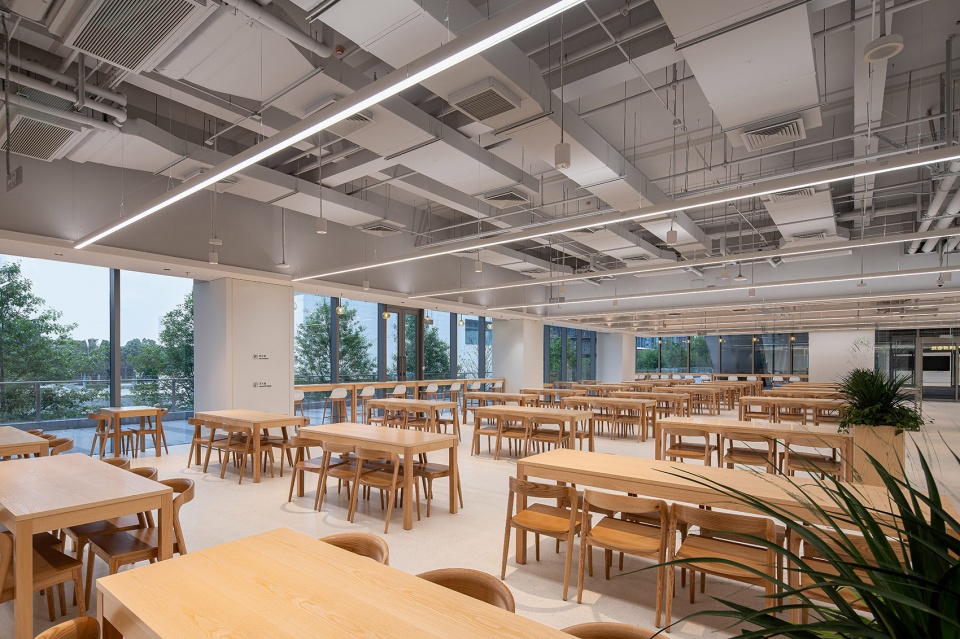
▼餐厅,dining hall
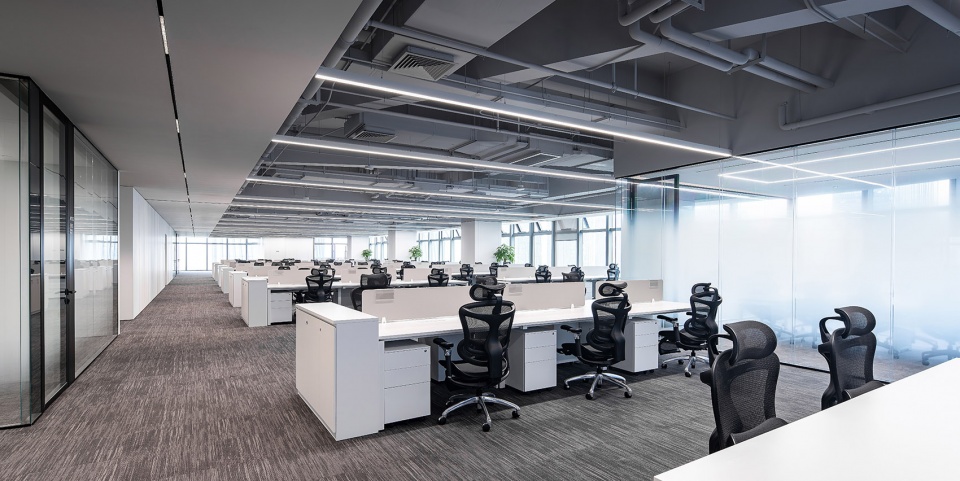
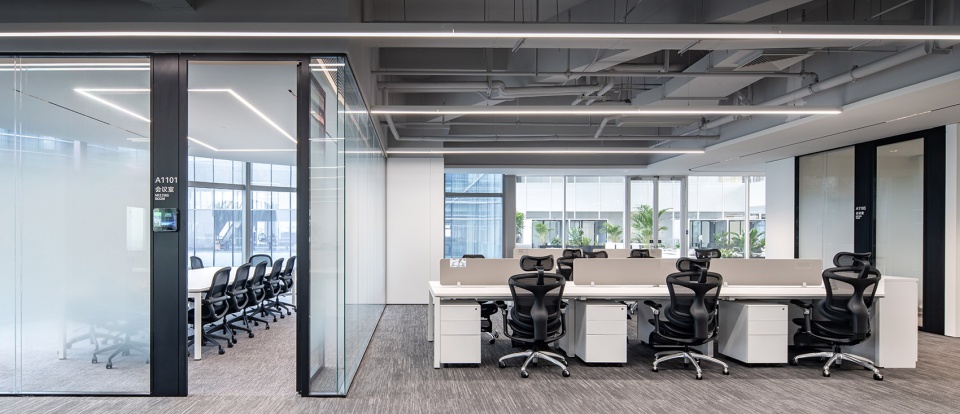
▼办公区,office area
智慧幕墙设计 Intelligent curtain wall design
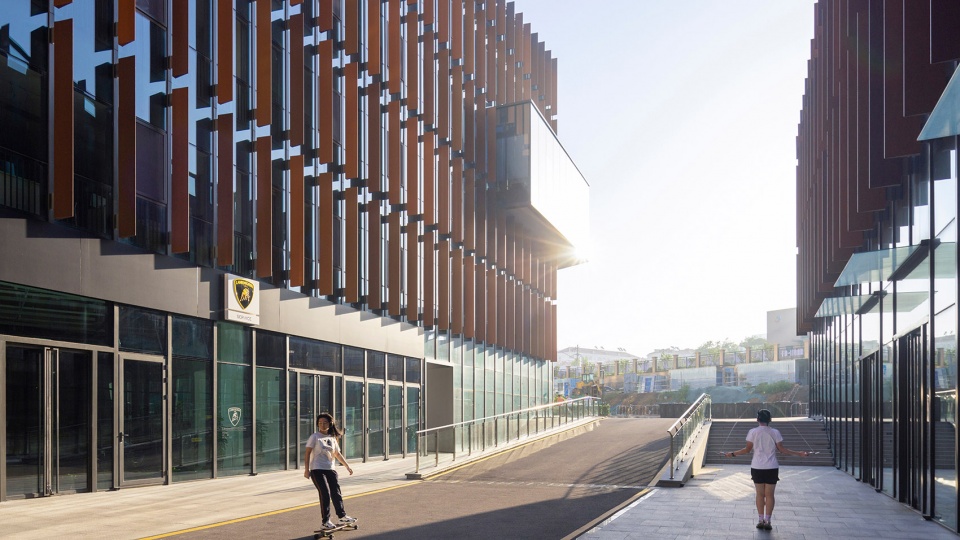
建筑幕墙的绿色节能设计是我们的初衷。建筑师通过玻璃背部釉面层的特殊处理,使建筑获得充足自然采光和视野的同时,也布置了消隐的水平实体墙,窗墙比控制在60%。同时幕墙外部设计了竖向外遮阳百叶,并与玻璃间保留适当空隙,使得立面获得最佳的外遮阳节能系统,也可以保证自然通风的畅通。
▼建筑立面外遮阳系统,building facade shading system
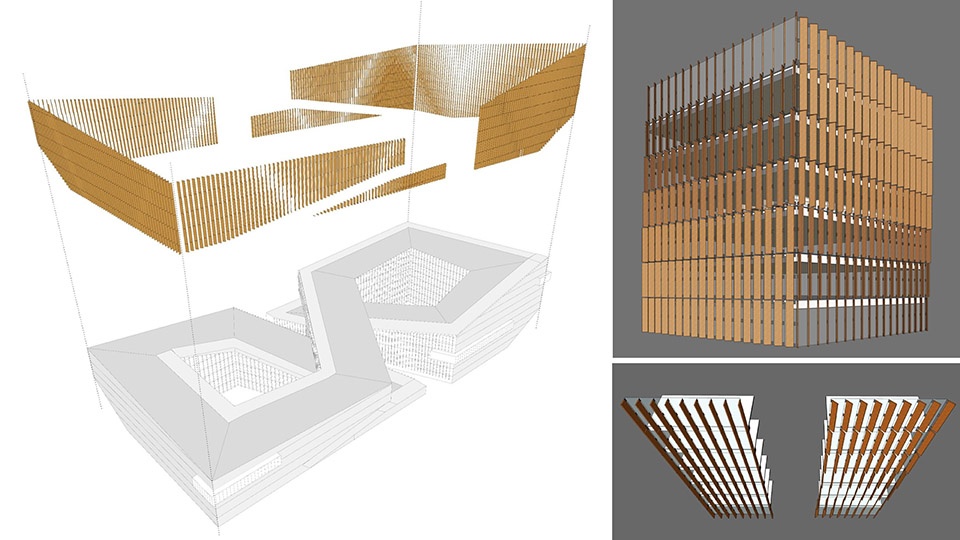
The green energy-saving design of the building’s façade was a primary objective. The architects utilized a special treatment on the glazed layer at the back of the glass to ensure ample natural light and views while incorporating discreet horizontal solid walls. The window-to-wall ratio is controlled at 60%. Additionally, vertical external shading louvers were integrated into the façade, with appropriate gaps between the glass, creating an optimal exterior shading and energy-saving system. This design also ensures the free flow of natural ventilation, contributing to both environmental performance and occupant comfort.
▼施工照片,construction photo
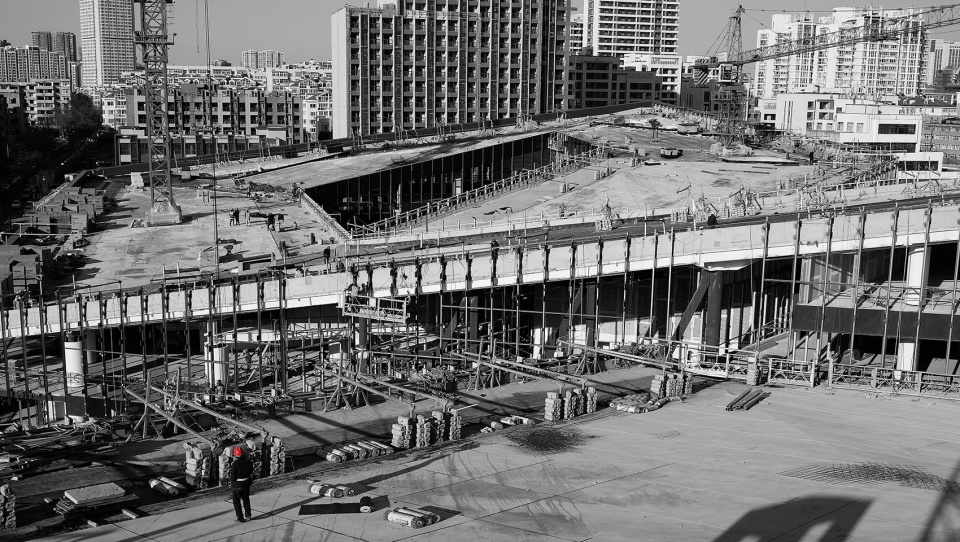
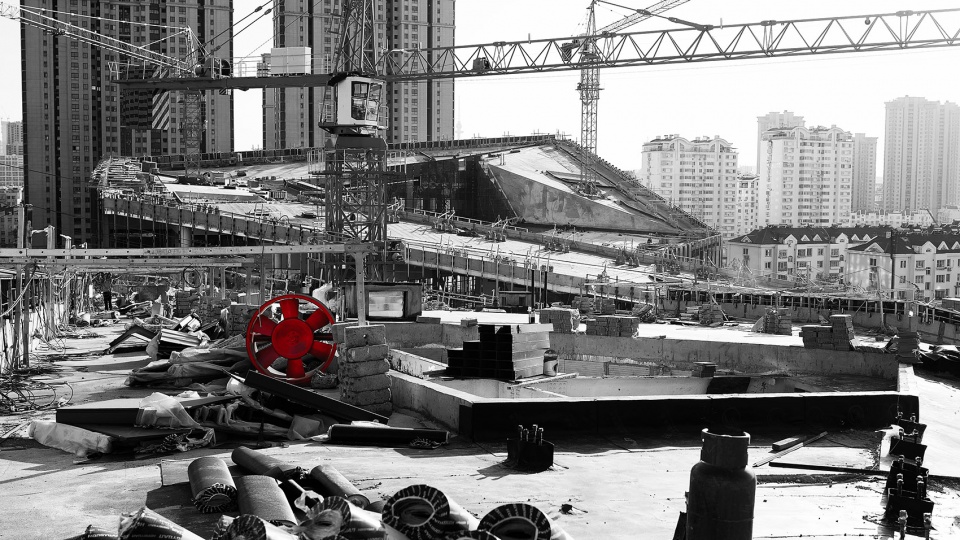
百叶采用四种渐变的棕色面板混搭而成,用抽象现代的手法模仿木质表面的观感,这是中国人长久以来对建筑的审美喜好,同时青岛城市历史建筑均以暖色调的色彩为主体,因此我们的建筑与整个城市环境十分和谐。由于本建筑与周边老旧小区距离较近,所以我们又赋予遮阳百叶另外两个重要作用。一是减小建筑的观感尺度,让建筑和城市尽可能和谐共处。二是作为研发建筑适当遮挡办公场所与邻近居民的对视可能。建筑的外表皮延展面长达800米,除了立体步道在幕墙组织中的重要作用,建筑师还在每层的不同位置设计了橱窗式的会议空间,使建筑造型更加生动自然。
The louvers are composed of four different shades of brown panels, arranged in a gradient pattern to abstractly mimic the texture of wood. This design reflects a long-standing aesthetic preference in Chinese architecture, evoking the warmth and natural feel of wood surfaces. Additionally, since Qingdao’s historical buildings predominantly feature warm tones, the façade of our building harmonizes seamlessly with the surrounding urban fabric. Given the building’s proximity to the surrounding older residential neighborhoods, the shading louvers serve two additional important functions. First, they reduce the perceived scale of the building, allowing it to coexist more harmoniously with the city. Second, they provide appropriate privacy by blocking direct sightlines between the office spaces and the nearby residents, ensuring a considerate relationship between the building and its neighbors. The building’s exterior envelope extends over 800 meters in length. In addition to the significant role played by the elevated walkway within the curtain wall organization, the architects have designed display-like meeting spaces at various locations on each floor. These windows of opportunity not only enhance the functionality of the building but also bring a dynamic and natural character to the overall architectural form.
▼区位位置图,site location
▼环境关系图,building environment
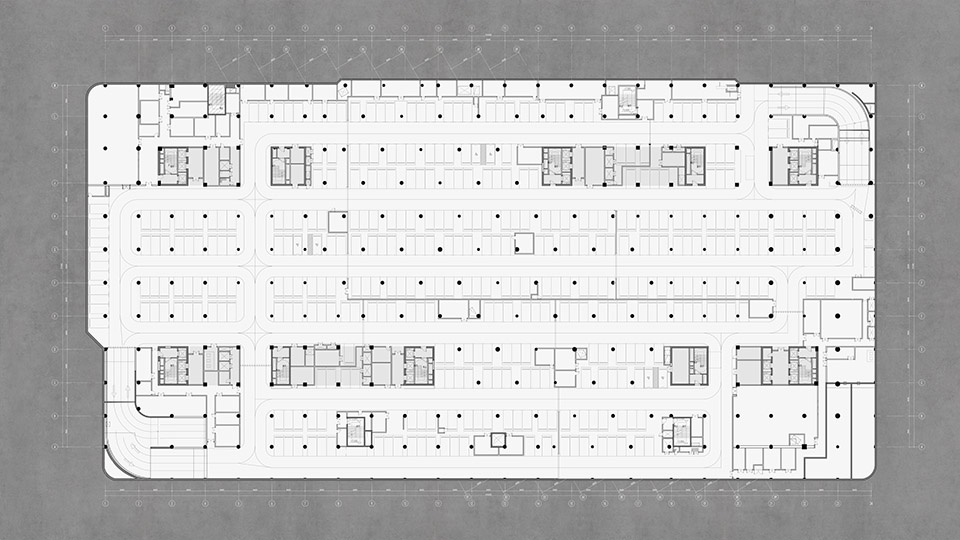
▼地下一层平面,basement plan
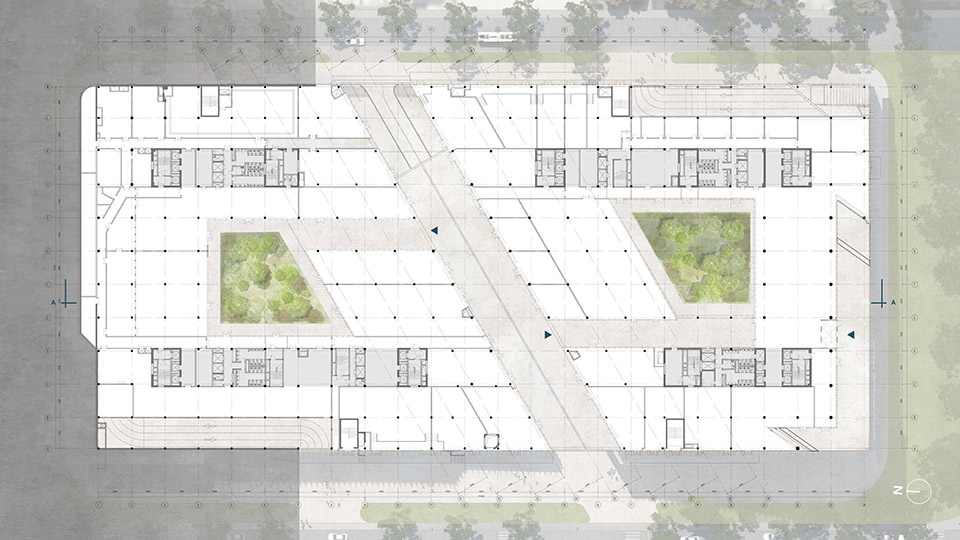
▼首层平面,ground floor plan
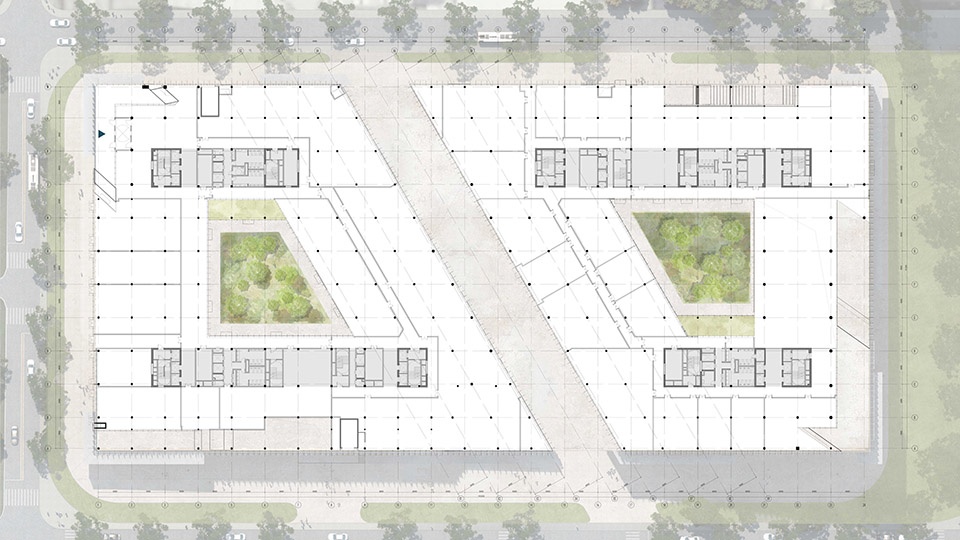
▼二层平面,first floor plan
▼东立面,East elevation
▼西立面,West elevation
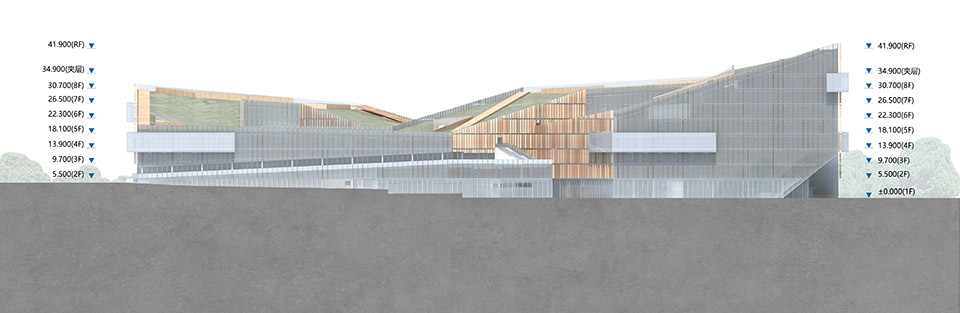
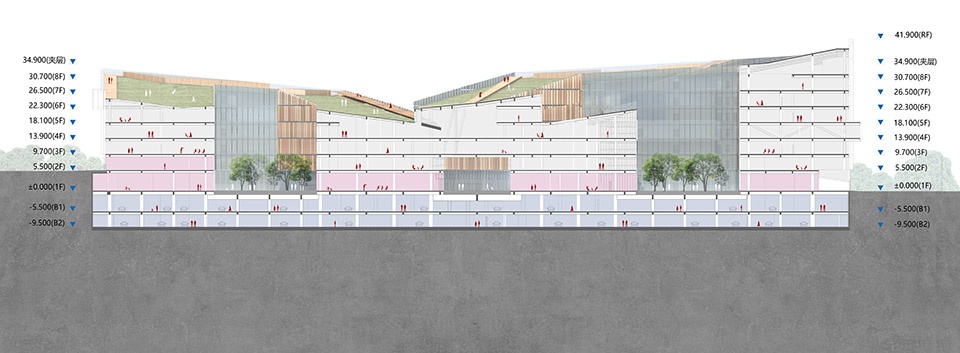
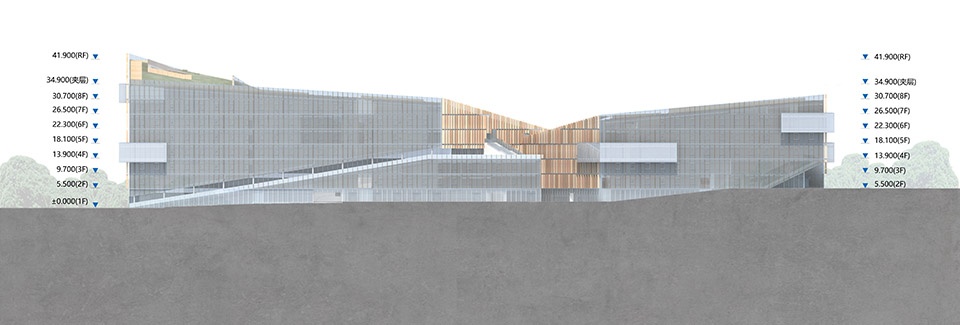
▼剖面,section