西华大学宜宾产教融合实训基地 / 非常建筑
基地 Site
西华大学宜宾产教融合实训基地项目位于四川省宜宾市临港经济开发区,是大学城和科技创新城“双城”规划的重要组成部分,为西华大学宜宾校园的二期工程。
Phase II of Xihua University’s Yibin Campus is located in Lingang Economic Development Zone, Yibin City, Sichuan Province. It forms part of the 12 km² masterplan for the first phase of the “Twin-cities” initiative—a University Town and Sci-Tech Innovation Hub.
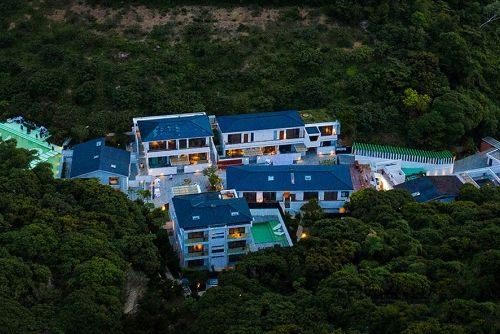
▼从山上鸟瞰校区,Overlook the campus from the mountain
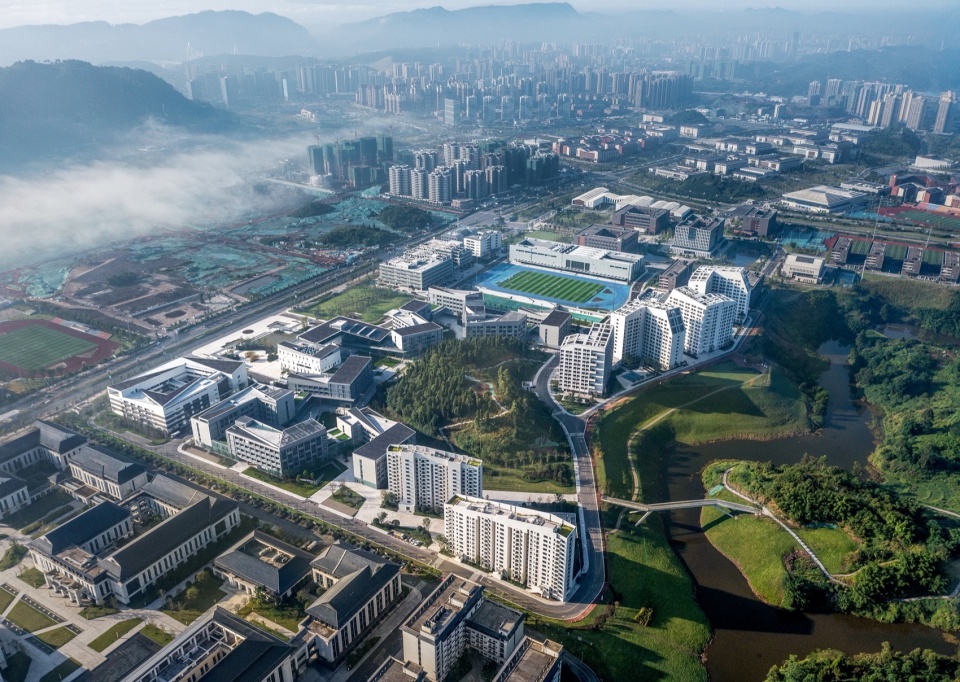
▼二期校园整体鸟瞰,Bird’s-eye view of the Phase II campus
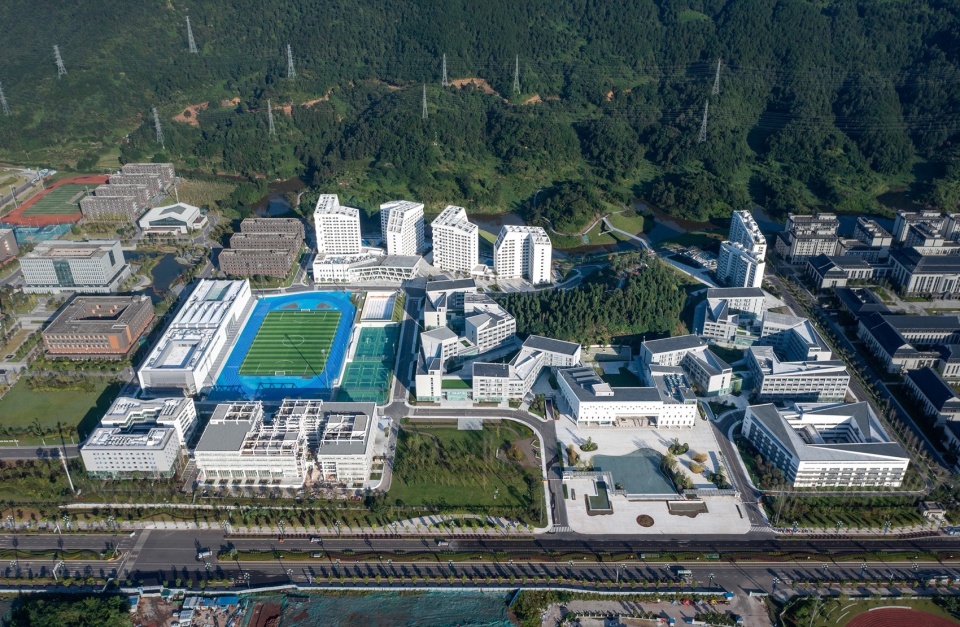
▼L型的教学楼间通过连廊和公共平台串联,The L-shaped buildings in the Teaching Cluster are linked in sequence via connecting corridors and shared terraces
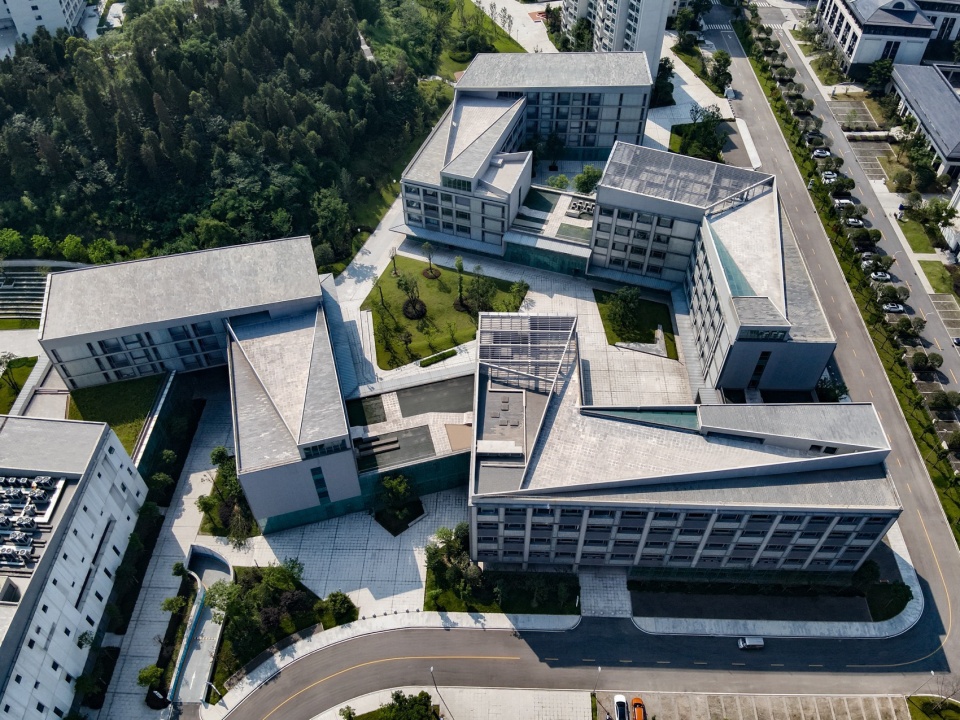
▼围绕保留小山布局、向景观开放的校园,Campus layout embracing the preserved hill with outward-oriented landscape
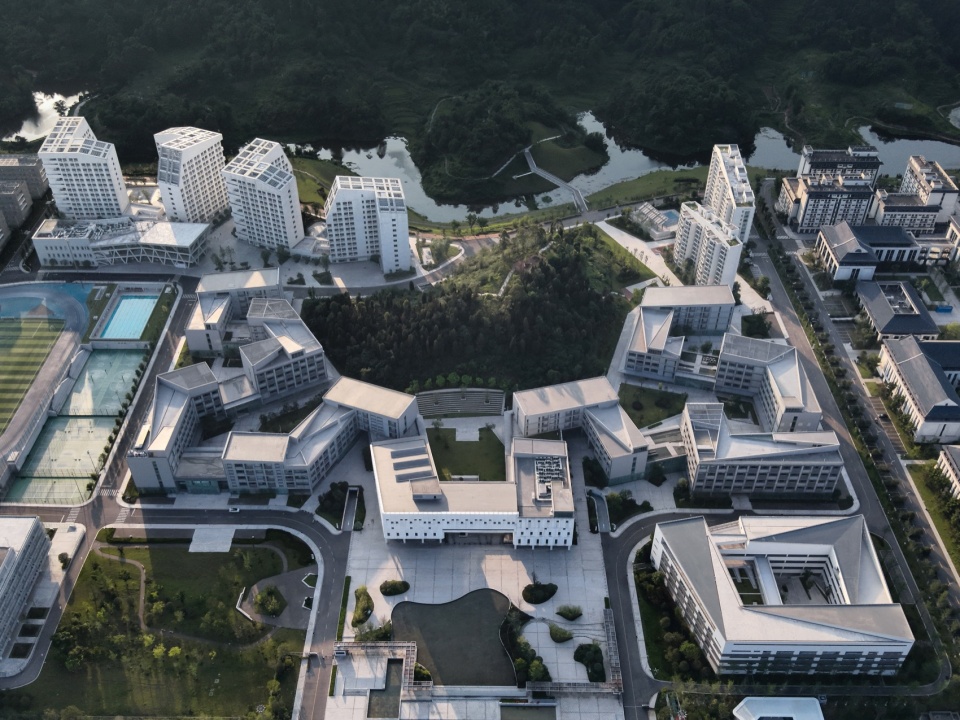
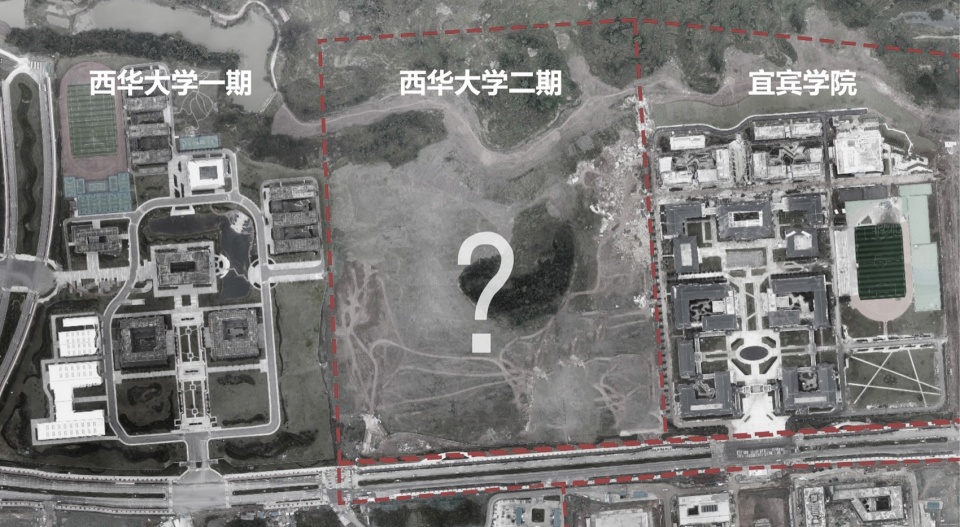
基地西北接临观斗山,形成优美的丘陵背景。但由于基地内坡度较陡,不适宜建设,开发难度较大;山脚下又有深20米的排洪沟,因此红线内的可建设用地限制在排洪沟的东南部,较为平整的区域。其中,场地中部约30米高的小山丘作为校园核心景观予以保留。
▼基地原状鸟瞰,Bird’s-eye view of the original state of the site
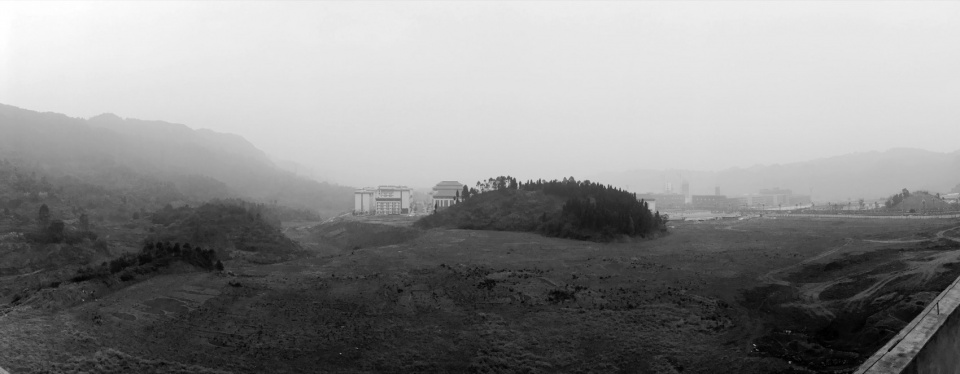
▼场地原状全景,Panoramic view of the original state of the site
▼排洪沟西侧与北侧,West side and North side of the flood drainage ditch
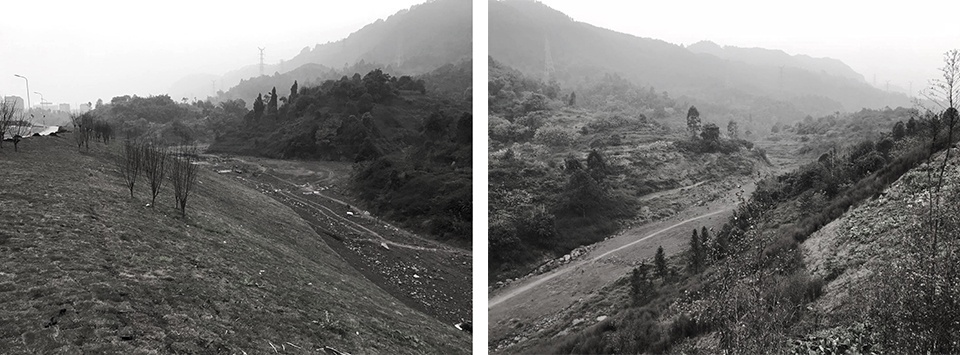
The Phase II site area spans approximately 390,000 m² including reserved land from Phase I. The site adjoins Guandou Mountain to the northwest, forming an undulating mountainous backdrop. The significant gradient of the terrain within the site post substantial challenges to construction. A 20m-deep stormwater drainage ditch at the mountain’s base further restricts developable areas within the site to a relatively flat southeastern zone. A 30m-high hill in the centre is preserved and celebrated as the campus’s core landscape feature.
▼从校门前广场看向近山和远山,View of the preserved hill and distant mountains from the square in front of the school gate
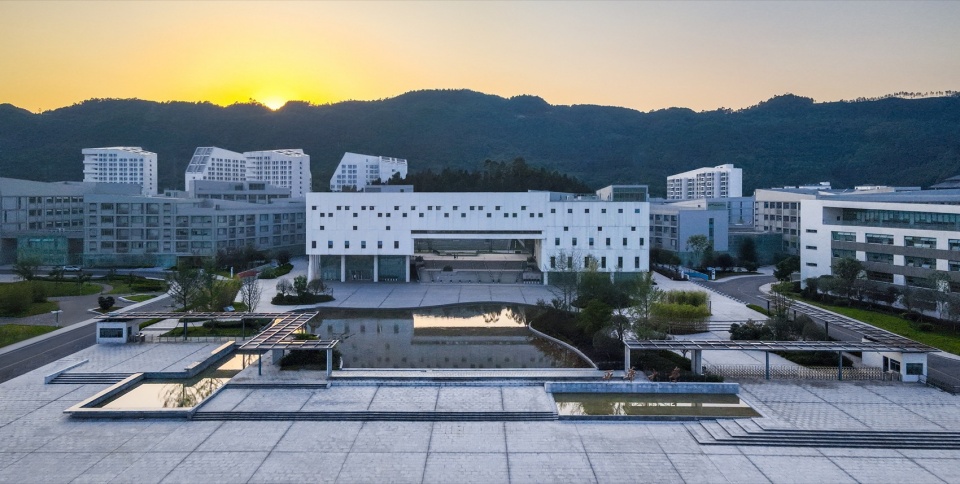
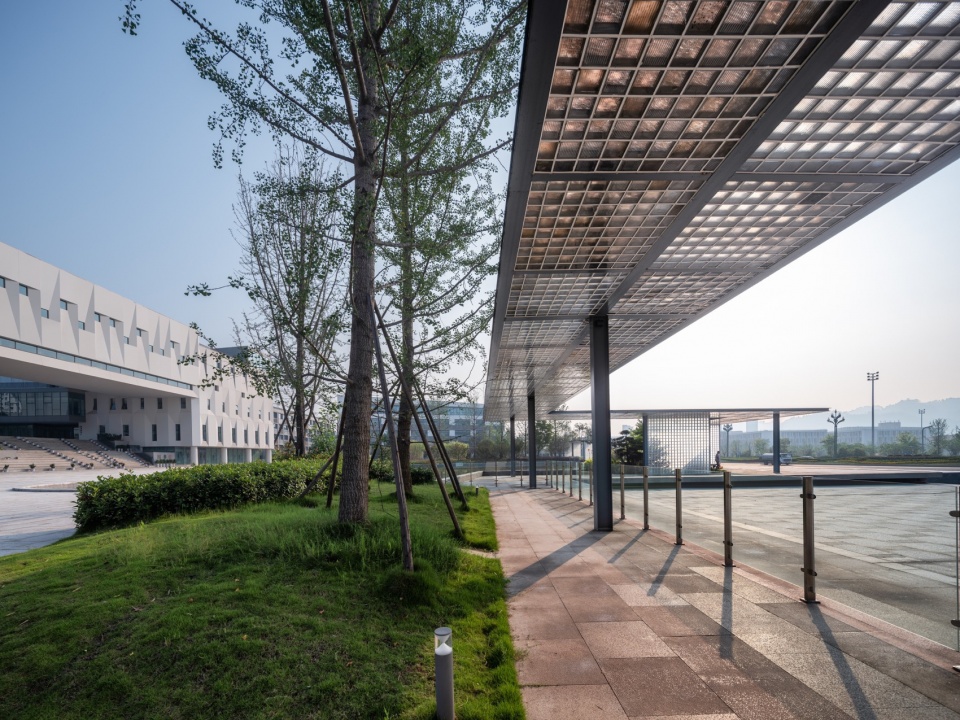
▼入口广场玻璃砖长廊,The glass brick corridor in the Entrance Square
二期用地约390,000平方米(含部分一期预留用地)。总建筑面积为261558平方米,其中地上总建筑面积为152353平方米,地下总建筑面积10305平方米。容纳学生总数6200人。
Total floor area is 261,558 m², with 152,353 m² above ground, and 10,305 m² below ground. The campus accommodates 6,200 students.
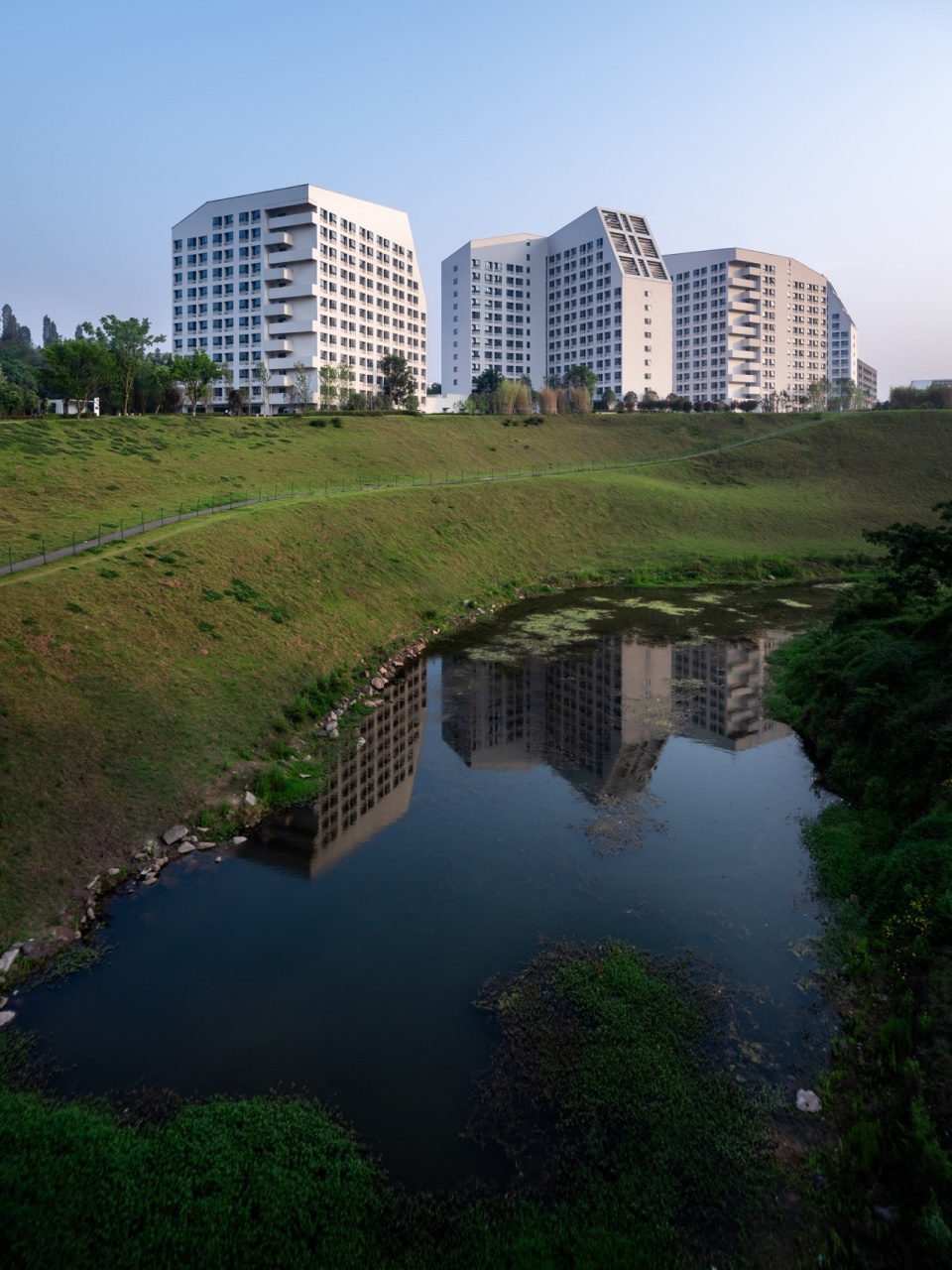
▼四栋L型高层宿舍通过坡顶和退台减少长边的遮挡,改善日照条件,The back-set terraces on the sloped roofs of the four L-shaped High-rise Dormitories improve conditions of natural light
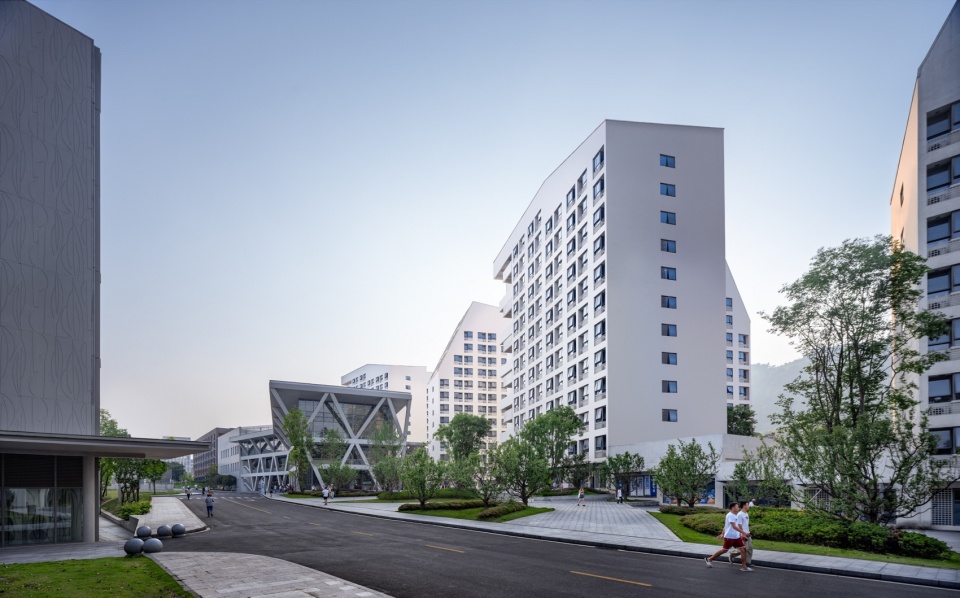
▼从山脚下看高层宿舍楼,
View the High-rise Dormitory Building from the foot of the mountain
规划 Planning & Design
规划上因地制宜,巧借山势,以“环形布局、 形态自由、景观优先、开门见山、架空穿行、风雨校园”的设计理念,建设面向未来的人性化、生态化校园。
The design provides a topographical solution to the site challenge – it comprises a circular layout that is free in configuration, landscape centric, pivot around the preserved hill, and penetrated by canopied walkways – strategies leading toward the vision of a school campus that is both human-centric and ecological.
▼图书馆与教学楼首尾相接,组成环形布局的校园核心区,The Teaching Cluster, formed by the Library, Teaching Buildings and Laboratory Buildings are interconnected, forming a ring-shaped core of the campus
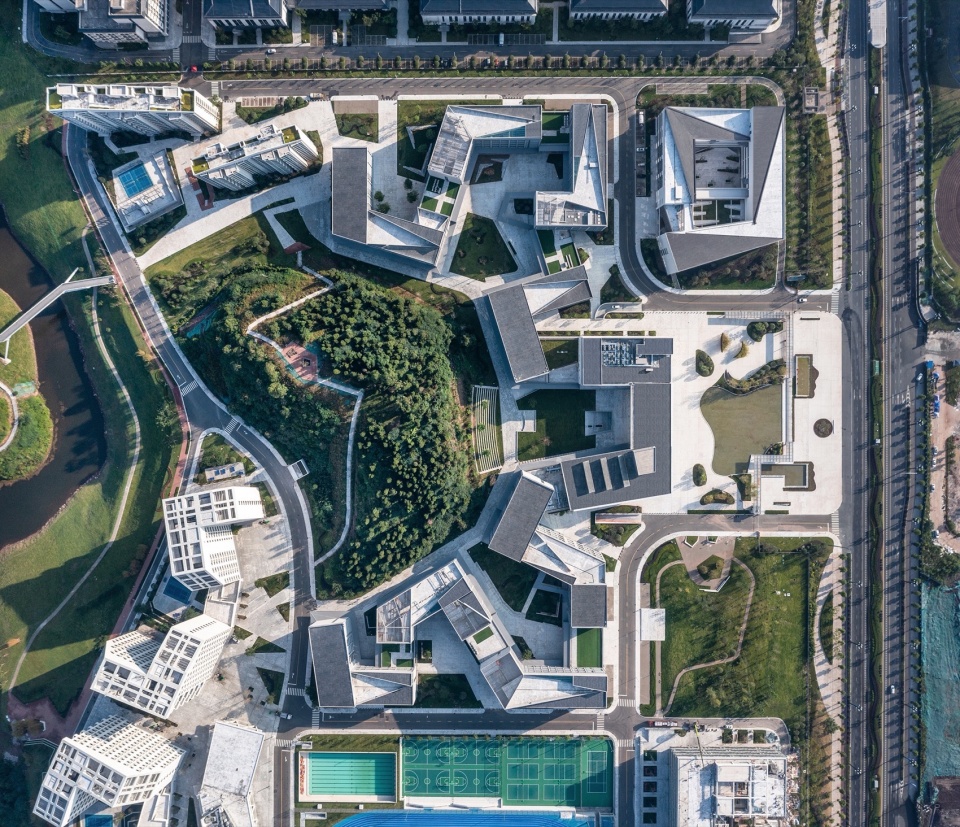
▼教学实验楼屋面设计为一角抬起的坡屋顶,设置不同朝向的高窗“取景器”,同时与屋顶楼梯或设备间结合,The roof of the Teaching and Laboratory Building is designed as a pitched roof with one corner raised, equipped with high windows
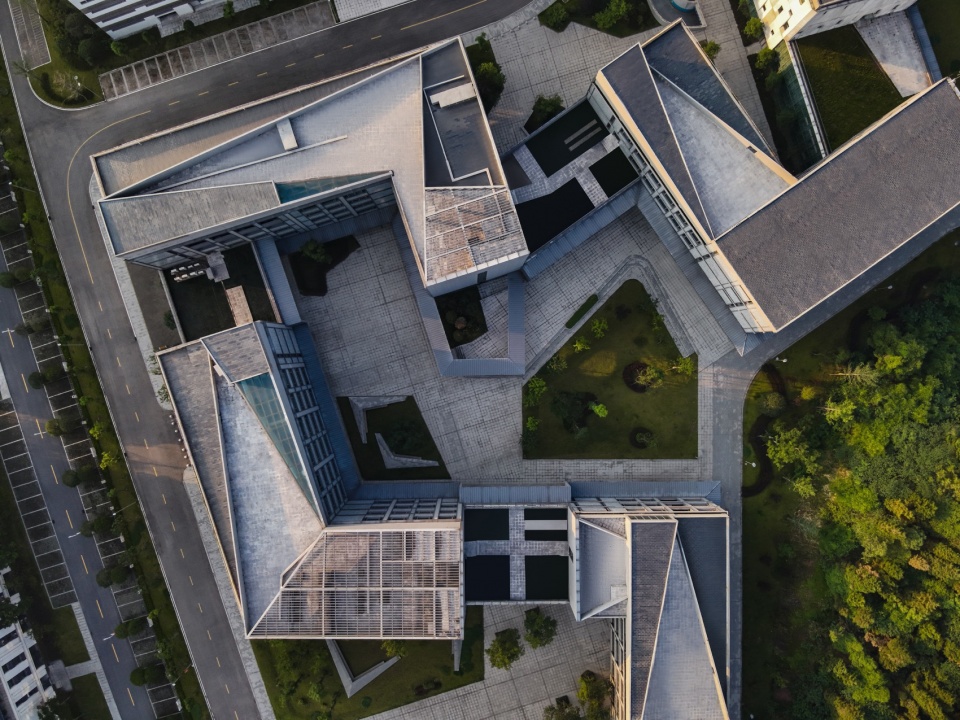
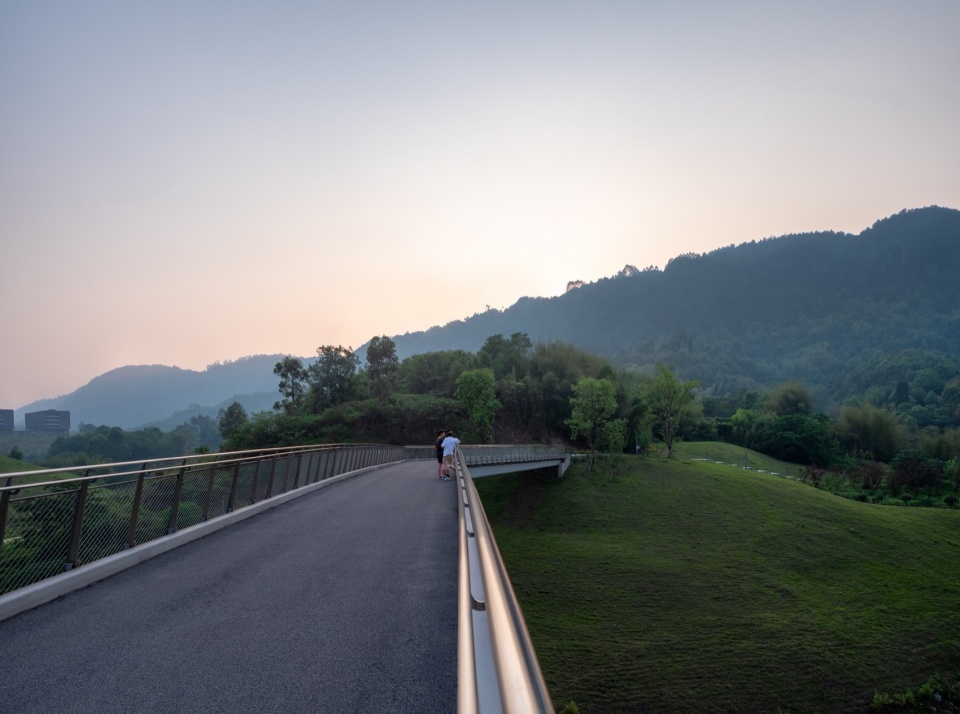
▼人行桥,Pedestrian bridge
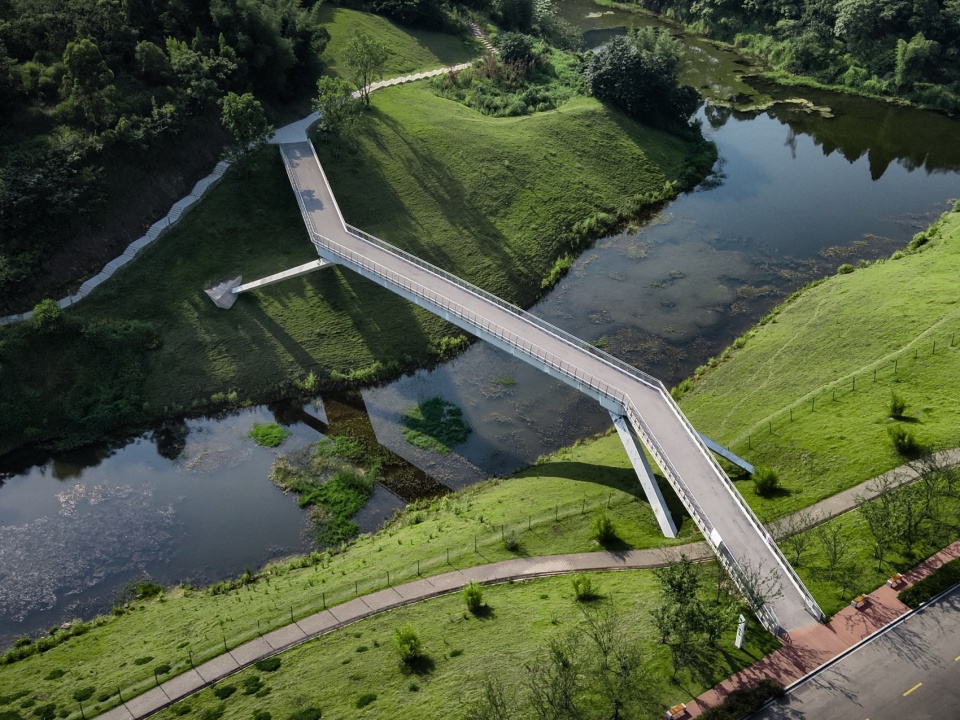
▼从人行桥上看远山,View the distant mountains from the pedestrian bridge
1. 环形布局的教学功能链|The Teaching Cluster
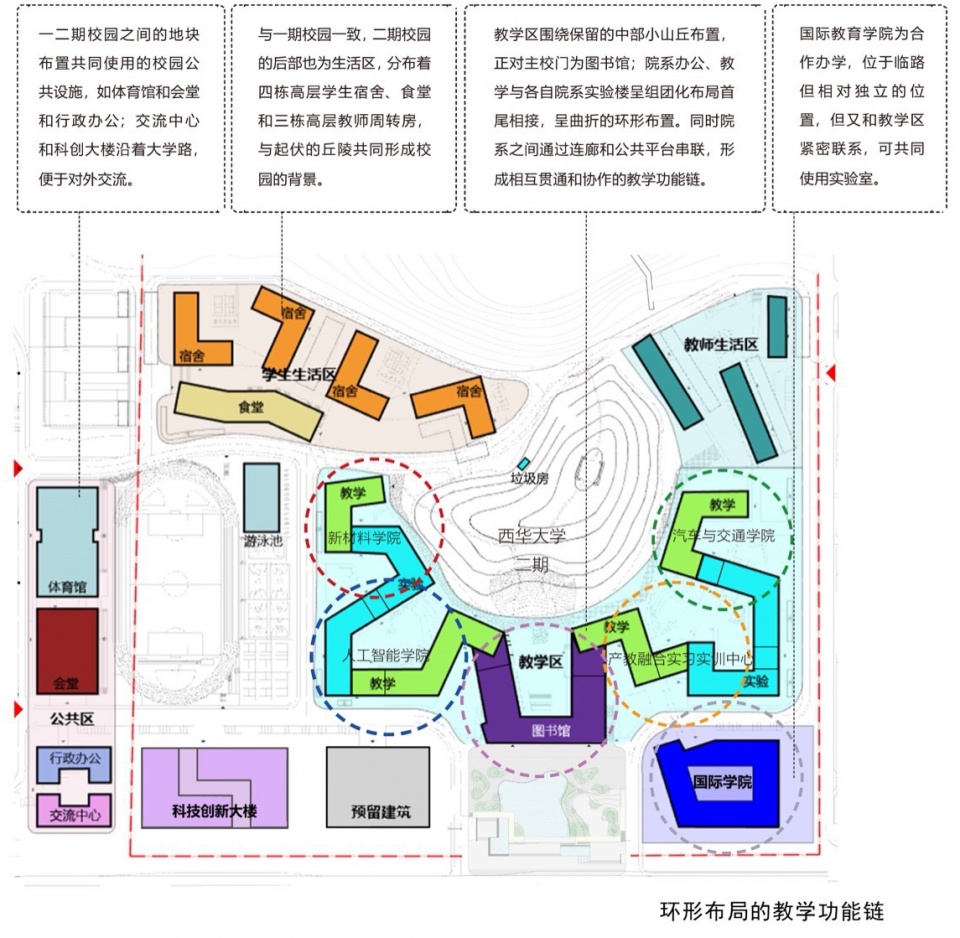
图书馆、教学实验楼首尾相接,组成校园核心教学区,围绕保留的小山丘整体上呈曲折、开放的环形布置。院系办公、教学与各自院系实验楼呈组团化布局,联系紧密,同时院系之间通过连廊和公共平台串联,形成相互贯通和协作的教学功能链。独创的教育建筑功能布局方式,鼓励跨学科,跨专业的合作和交流,创造引导学术创新的校园氛围。
▼用地和退界分析,Land Use and boundary withdrawal Analysis
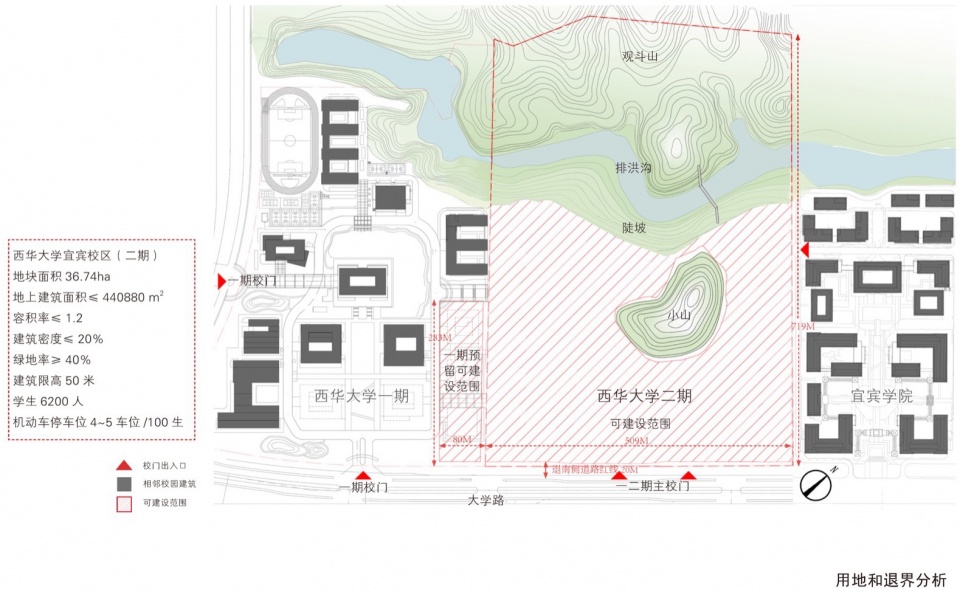
The Teaching Cluster is a series of interconnected, chained buildings revolving around the preserved hill in a sinuous form, with the library at the center and surrounded by teaching/laboratory buildings as the wings. Offices, classrooms, workshops, and laboratories for each department connect though public platform and canopied corridors to form an integrated cluster that fosters crossdisciplinarity collaboration and academic innovation.
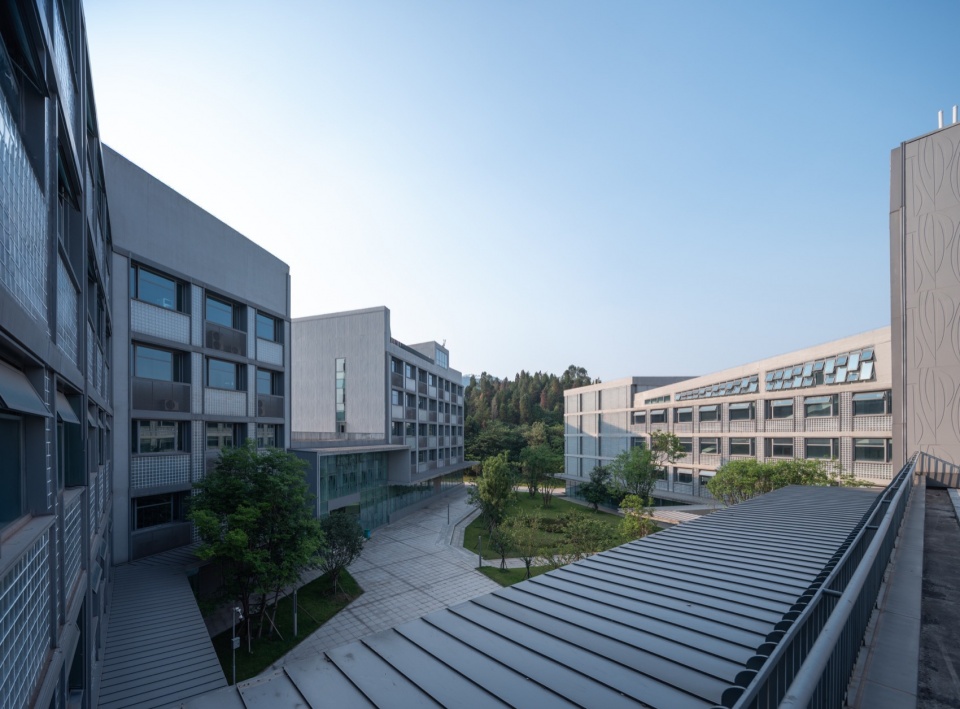
▼教学区内庭院及小山,View of a courtyard in the Teaching Cluster with the preserved hill in the back
▼图书馆半围合形成草坡舞台与小山看台,The grandstand on the preserved hill with the sloped lawn-stage enclosed by the Library
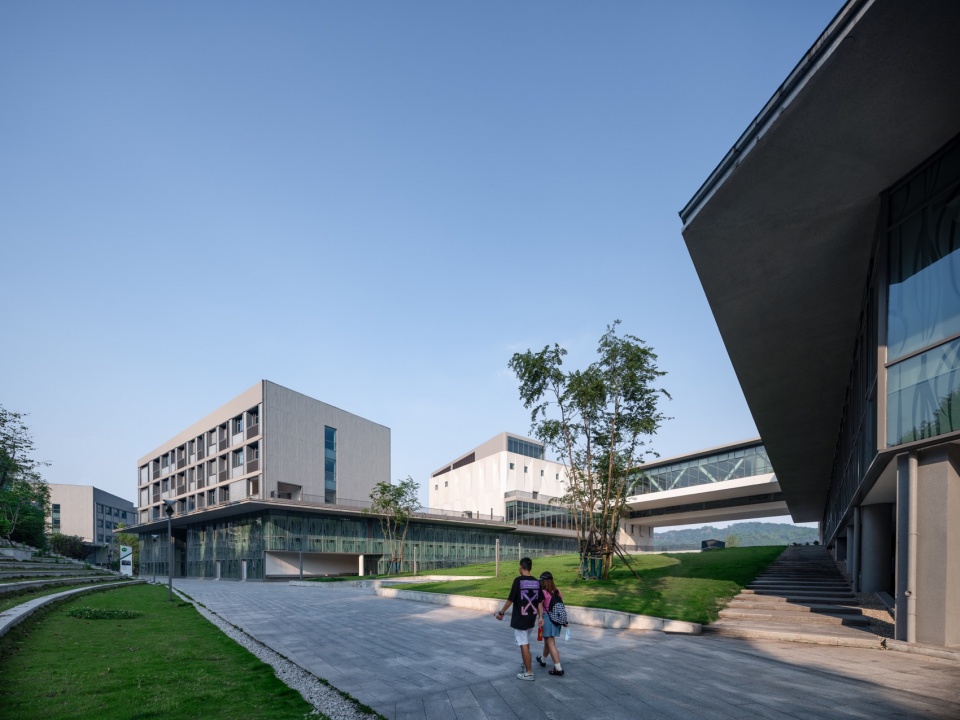
▼从小山回望图书馆门洞,Looking back at the arched entrance of the Library from the hill
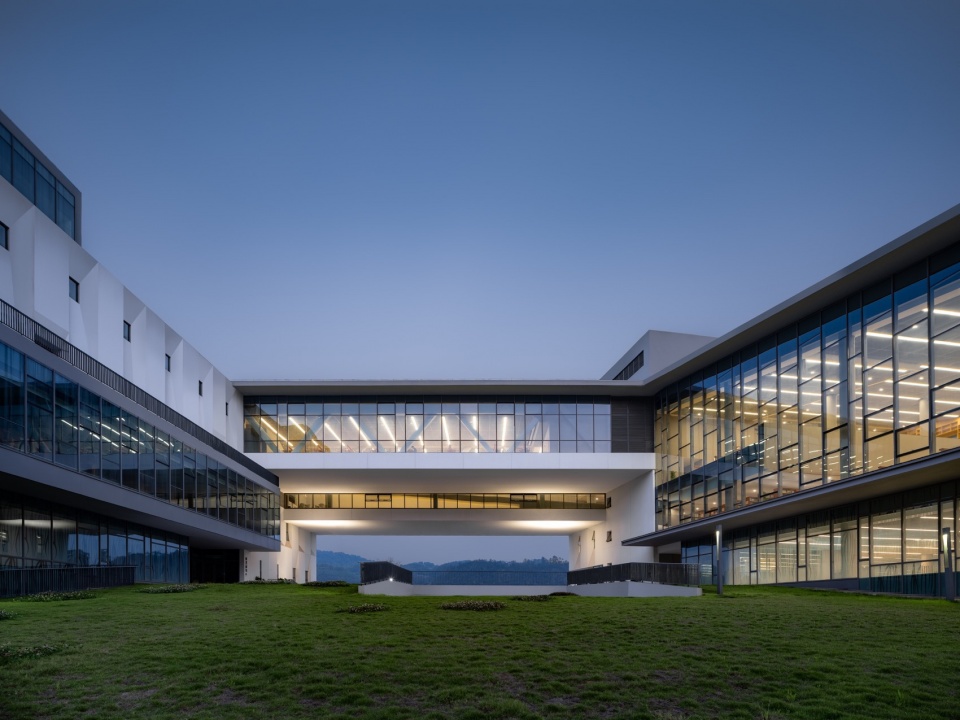
▼图书馆内部阅览空间,The reading space in the Library
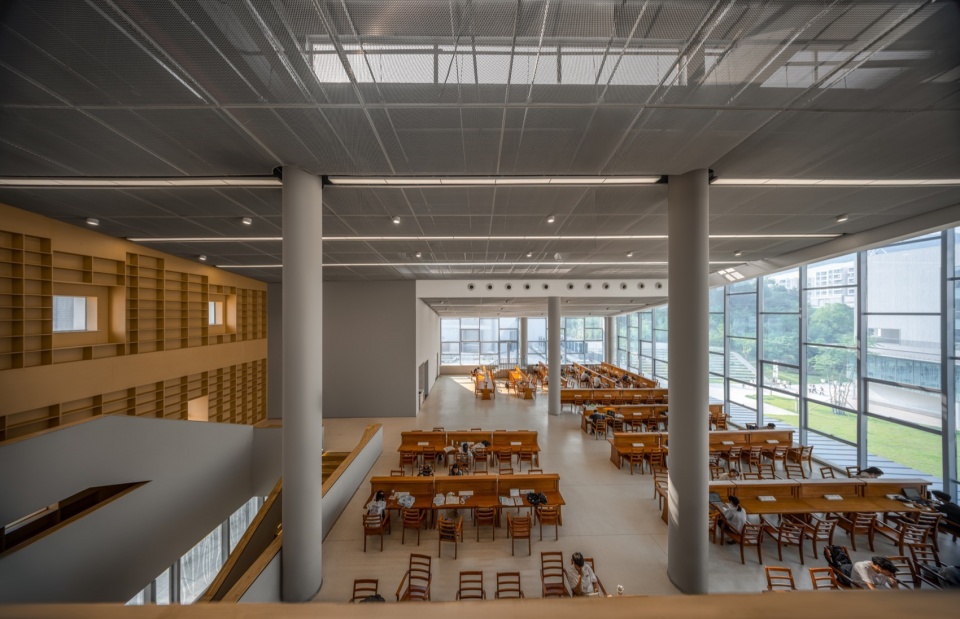
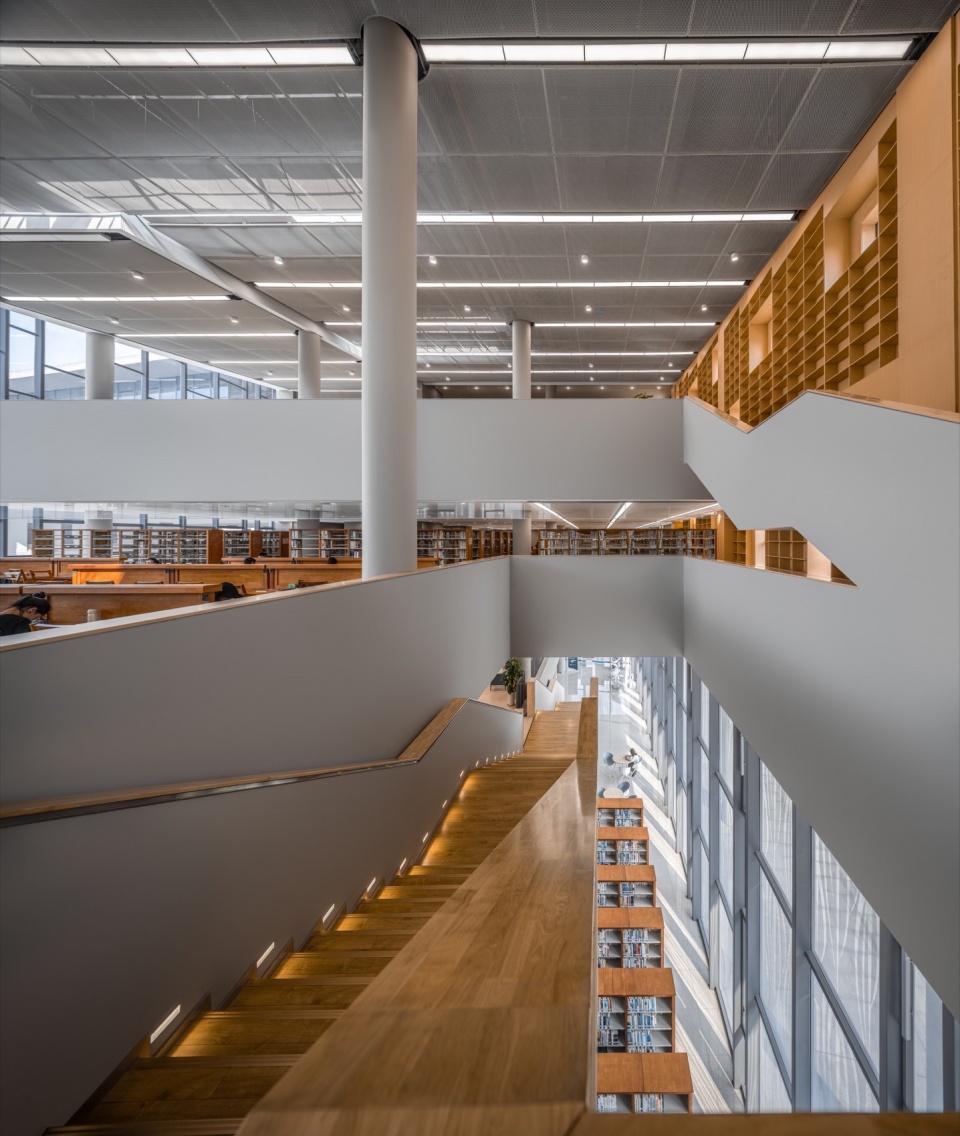
▼图书馆内楼梯,The staircase in the Library
2. 景观优先的生态校园|The Landscape-Centric Campus
新校区的整体景观围绕保留的小山丘展开,小山丘作为校园的“绿心”,向围绕四周的庭院发散和渗透,形成处处有景,开门见绿,步移景异的山水画卷。院落也吸取了川南传统建筑特色和优点,尺度宜人,不仅有小气候调节功能,而且营造了一个无顶的公共活动空间。视线穿过校门前广场和图书馆巨型门洞,跨过大台阶“开门见山”,近观小山丘,观远观斗山,形成一条含蓄的景观“精神中轴线”。
▼景观布局分析,Landscape Layout Analysis
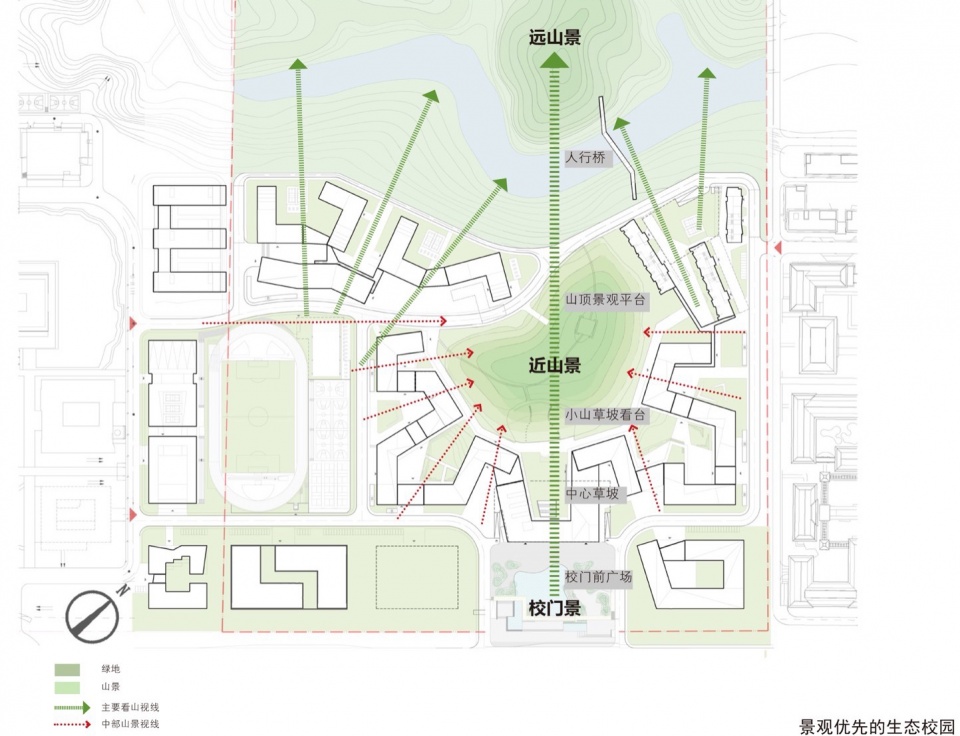
Green spaces in the new campus pivots around the preserved hill as the heart and radiate into the courtyards of the surrounding buildings to create scenic views across the campus. Courtyard design incorporates Southern Sichuan architectural traditions, offering microclimate moderation to these exterior gathering spaces. Portal-shaped library allows the preserved hill in the back to be seen through its grand stairways and large-span reading spaces, creating an imaginary axis with the campus buildings and the preserved hill as the foreground and the Guandou Mountains as the backdrop.
▼从图书馆门洞“开门见山”,View of the preserved hill through the portal-shaped Library
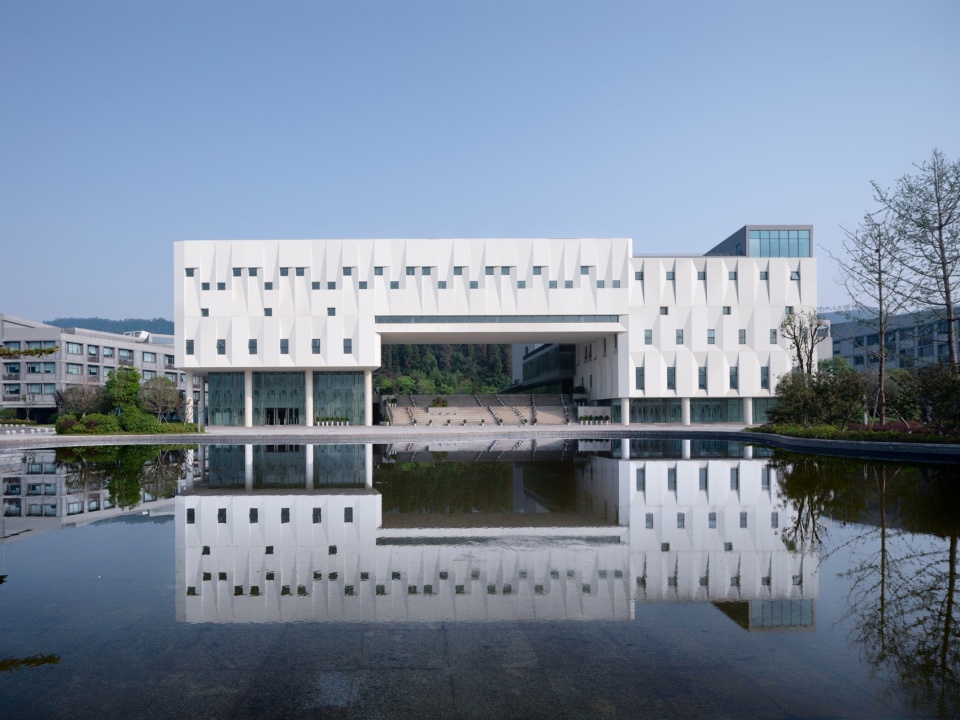
▼图书馆门洞与大台阶,
The arched entrance and terraced steps of the Library
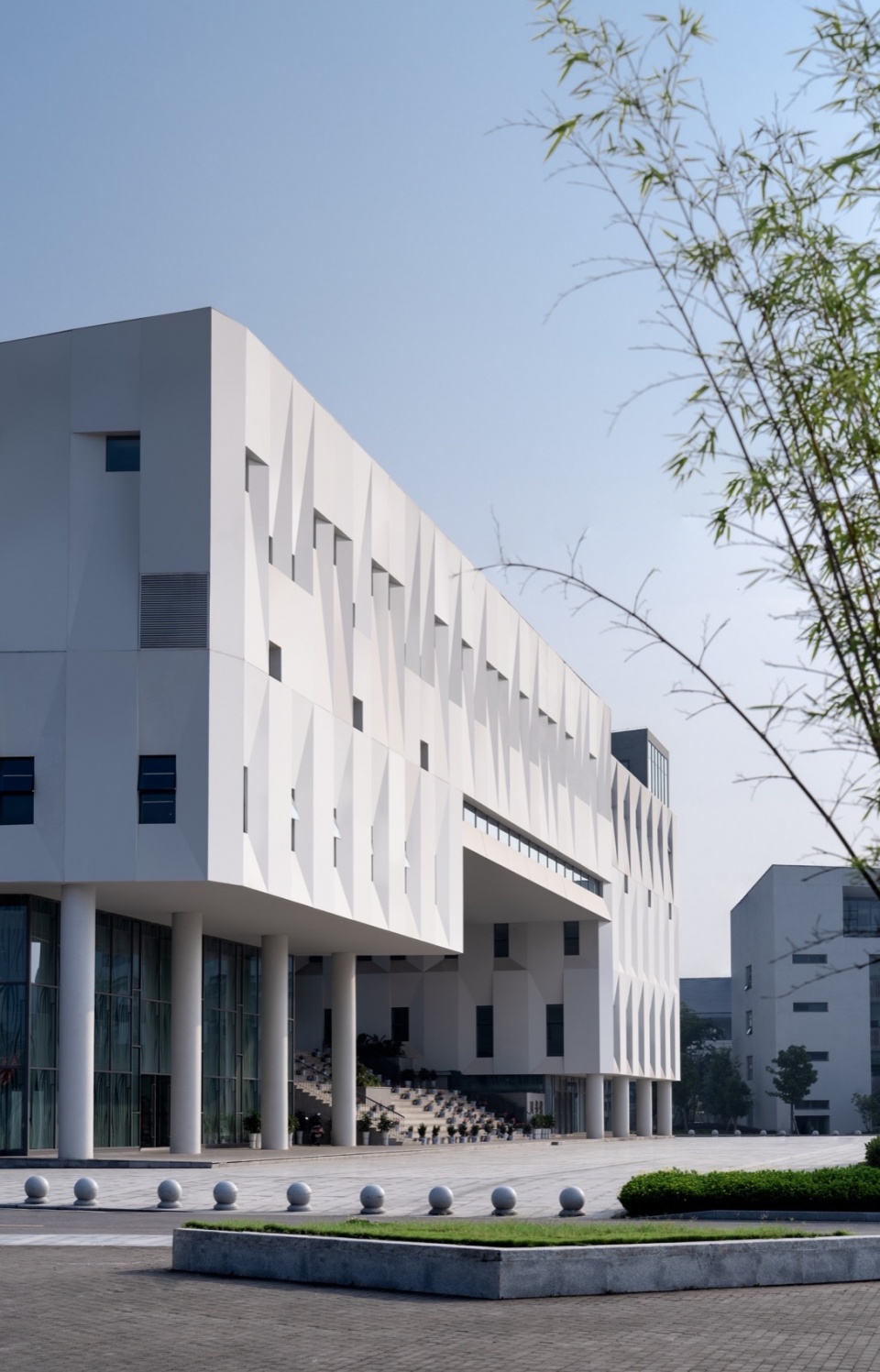
▼教学实验楼外侧挑檐,The overhanging eaves of buildings in the Teaching Cluster
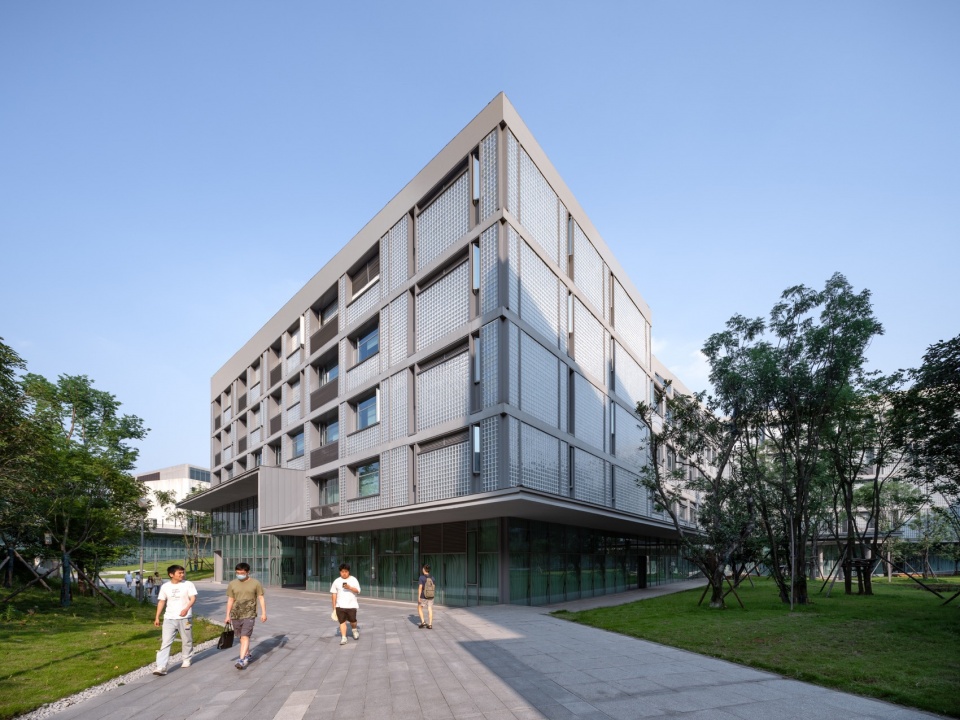
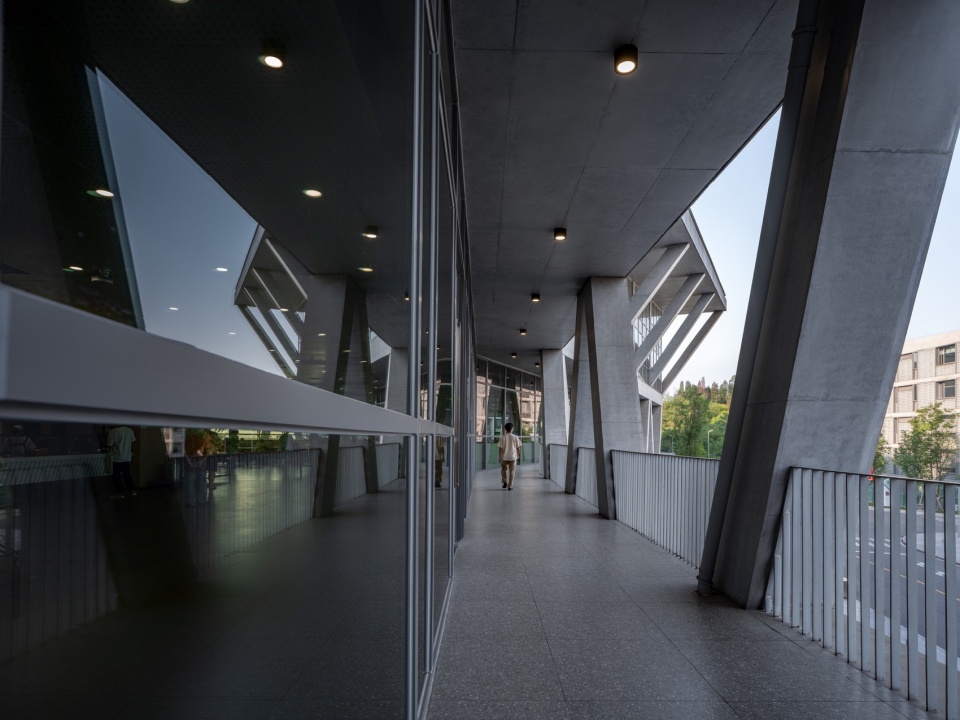
▼教学区内由架空和挑檐形成风雨连廊,Continuous, canopied walkway in the Teaching Cluster encourage all-weather travel
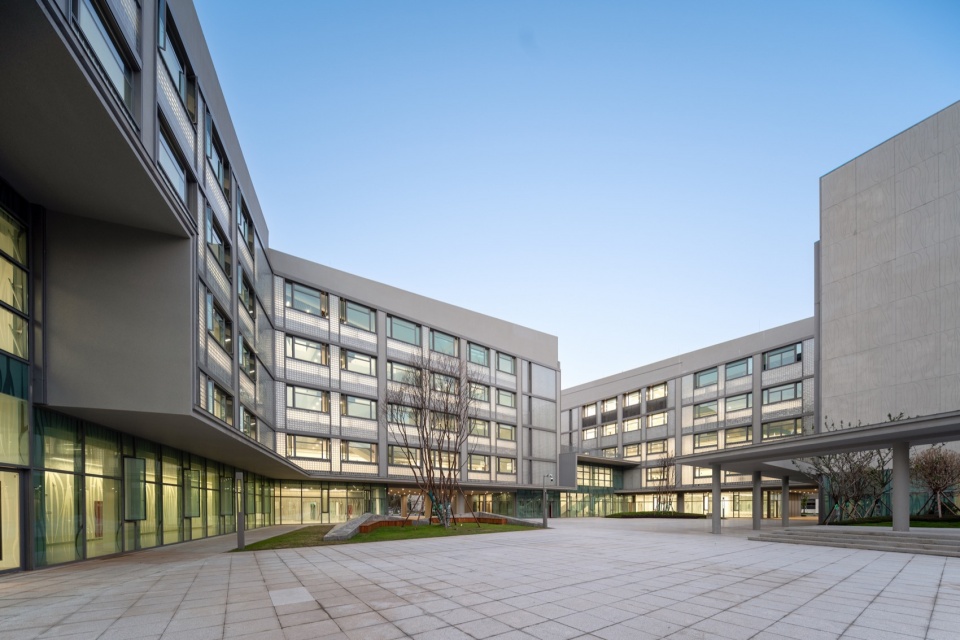
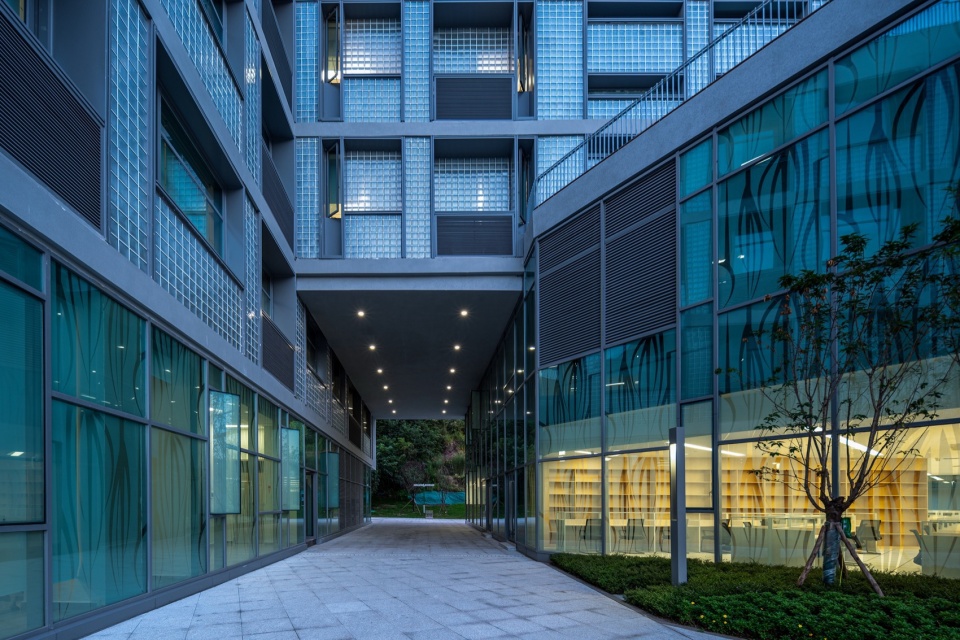
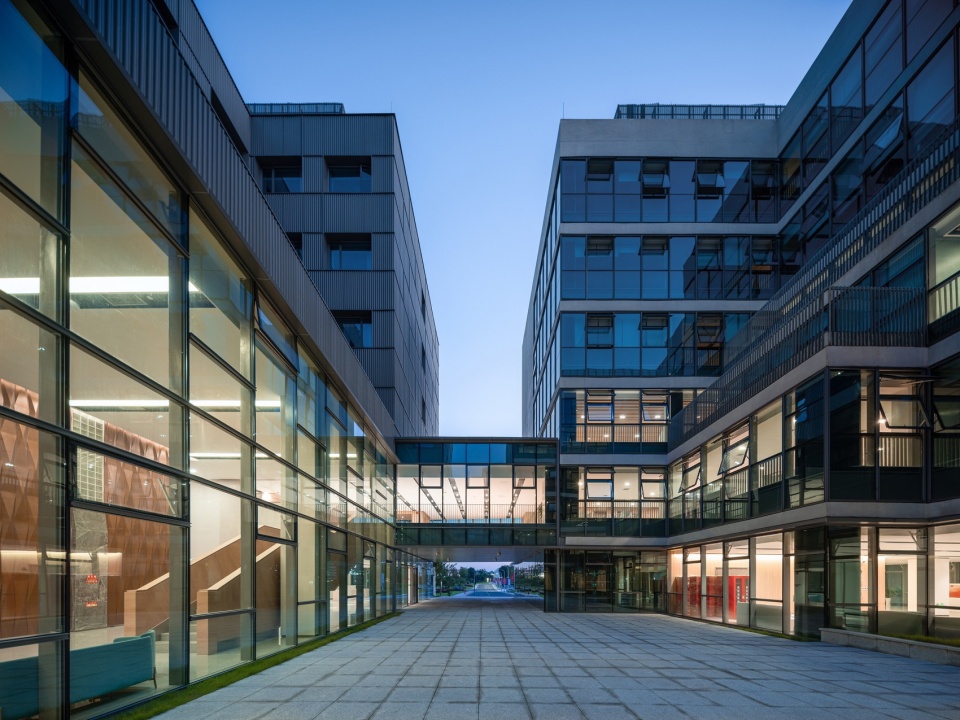
▼教学区过街楼夜景,玻璃砖与油樟叶图案丝网印玻璃的立面组合,The night view of the overpass building in the Teaching Cluster features façade materials of glass bricks and silk-screened glass with camphor tree leaf pattern
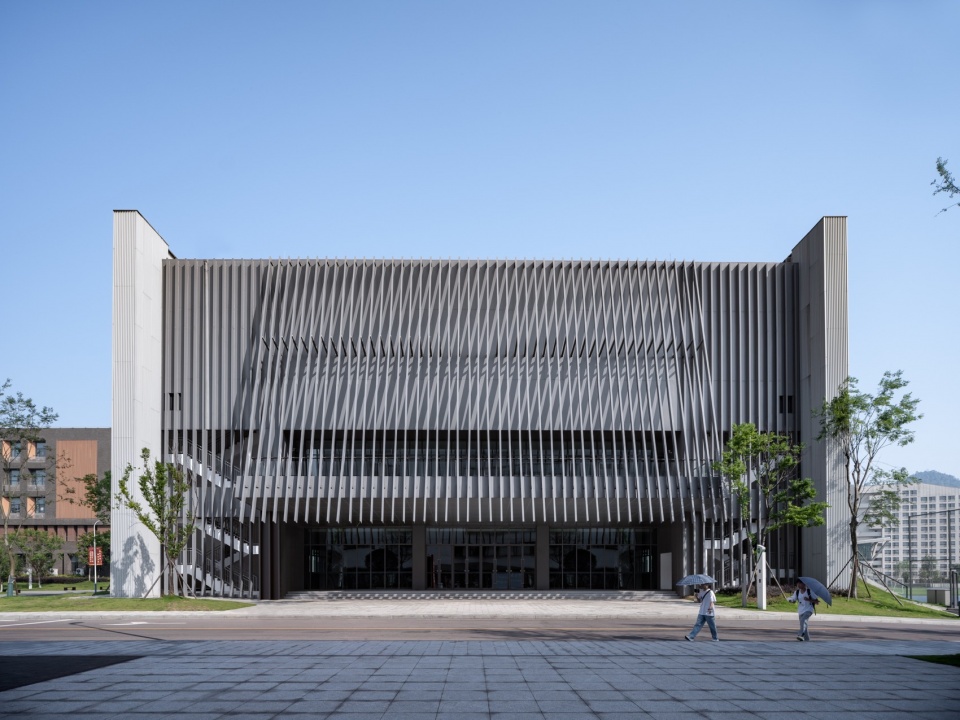
▼礼堂入口,Entrance to the Auditorium
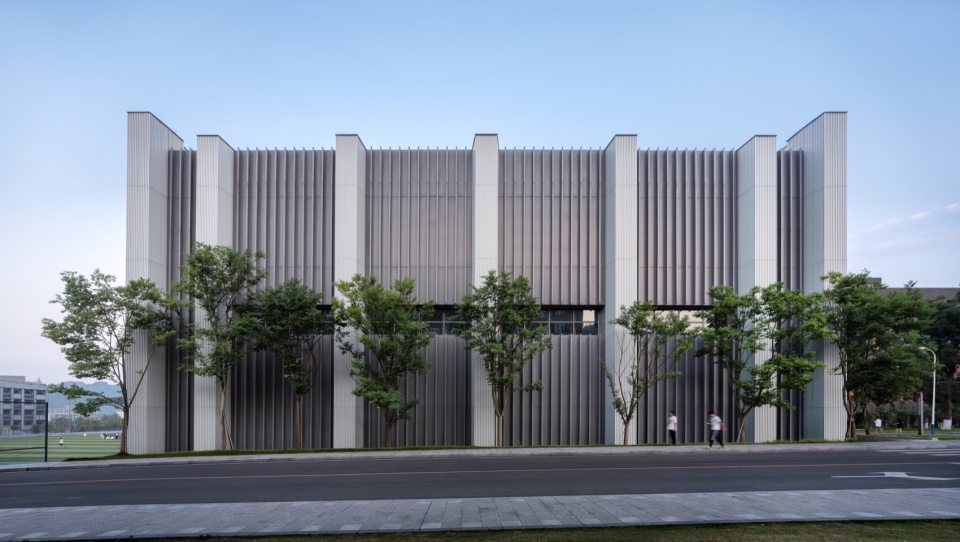
▼礼堂体育馆立面采用金属长城板,The façade of the Auditorium/Gymnasium Building consists of metal decking
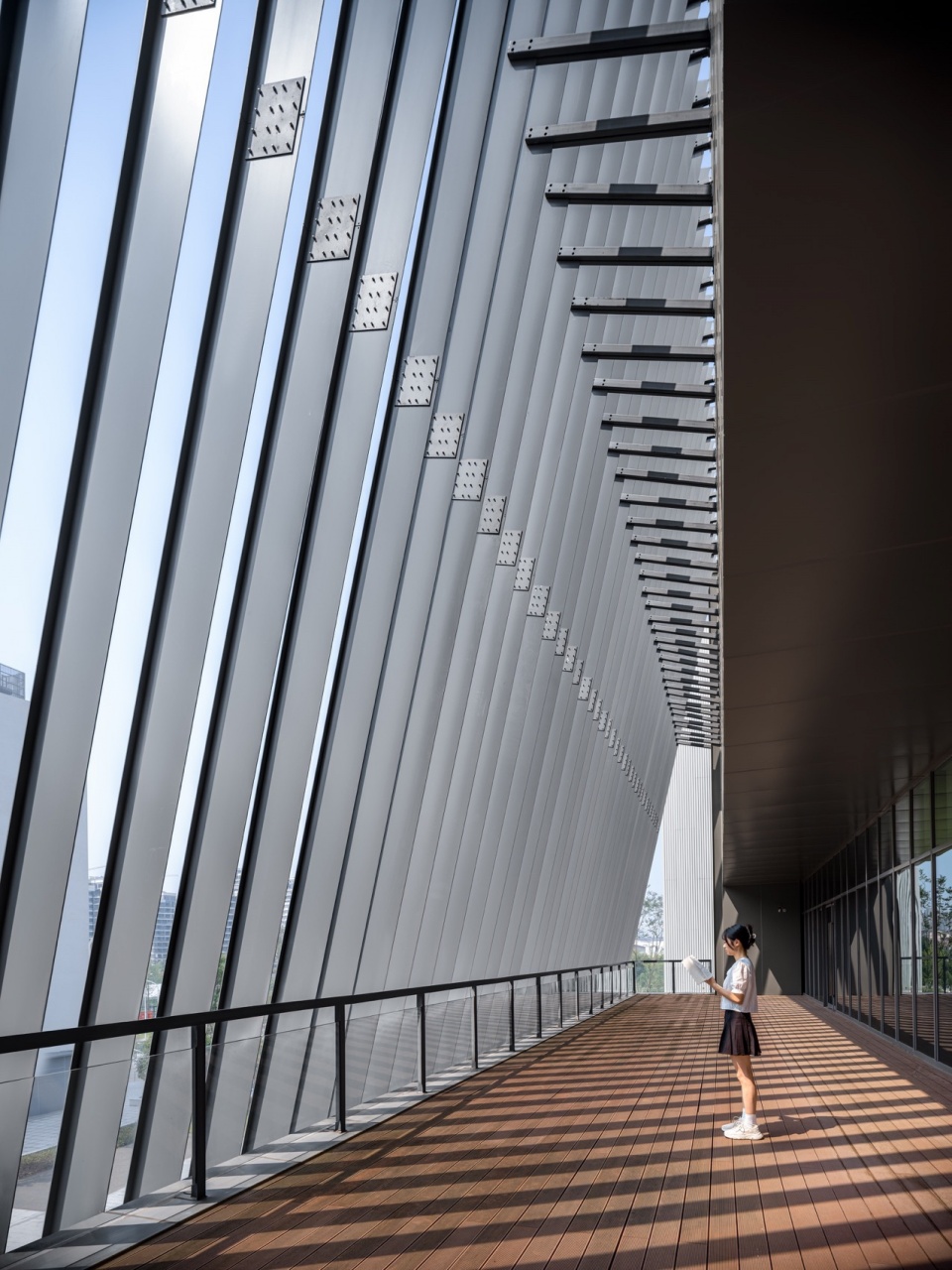
▼礼堂二层平台,The second floor platform of the Auditorium
3. 架空穿行的人文关怀|The Walkway System
校园的交通组织与一期校园路网整体衔接。 教学区内部通过多处底层架空,穿插形成丰富的步行道路系统,并与环中部小山的步行道连接。风雨连廊串联起整个教学区,无论日晒还是下雨,师生们都可以漫步校园,有了便捷的步行交通,避免了常规校园的人车冲突、广场和道路使用率不高、校园乱停车等问题。连廊作为校园活力纽带,激发更多的校园交流活动,并在行进之中体验美丽的生态景观长卷。
Elevated first floors at certain locations in the Teaching Cluster allow for the placement of a complete, uninterrupted pedestrian network that bridge the buildings – in the form of canopied walkways that made possible for all-weather travels – with the preserved hill in the centre. Serving as scenic viewing routes and catalysts for communication, these convenient walkways help to reduce problems such as vehicle-pedestrian conflicts, low usage on school squares and roads, and unauthorized parking. The traffic system of Phase II joins the road network of Phase I.
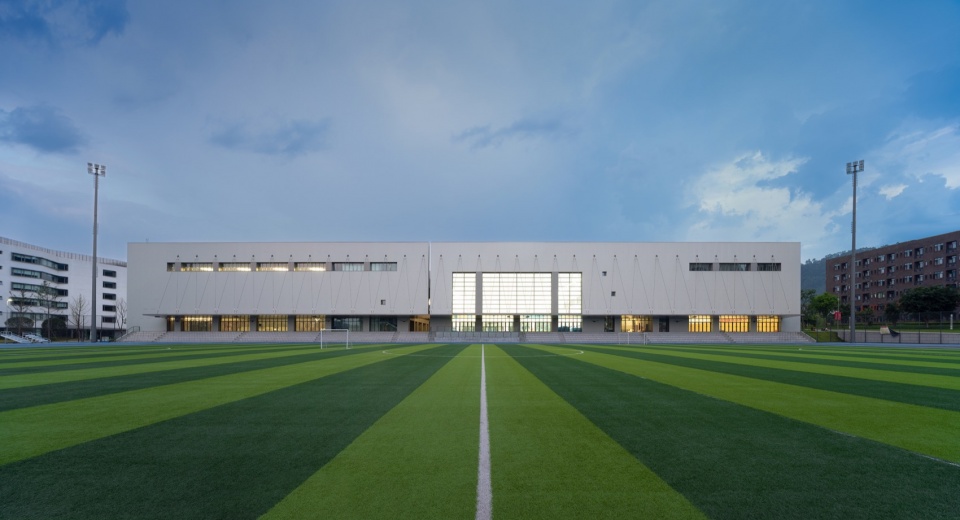
▼体育馆,Gymnasium
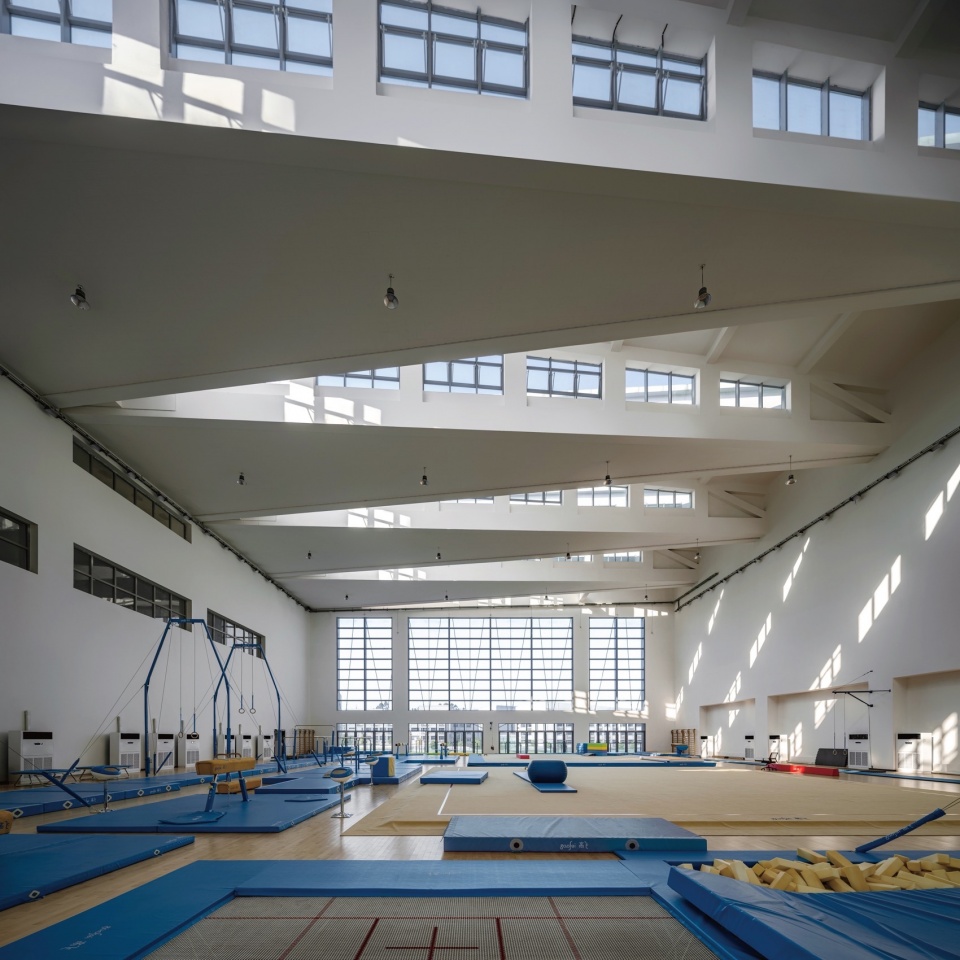
▼体育馆室内,Interior view of the Gymnasium
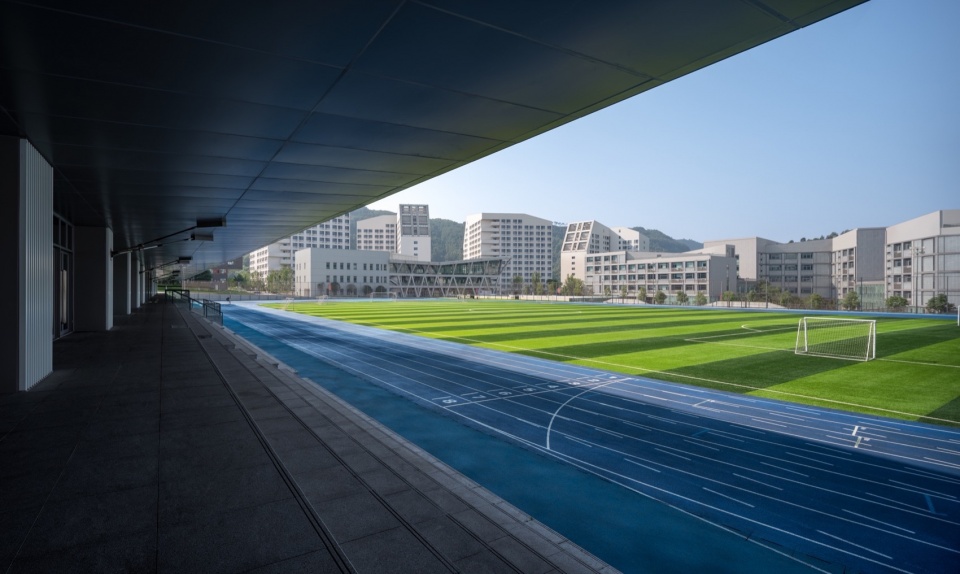
▼从体育馆挑檐下看教学区和生活区组合形成校园,整体起伏的轮廓特征呼应山形背景,View under the eaves of the Gymnasium, with the Teaching Cluster, Living Quarter, and mountains in the back
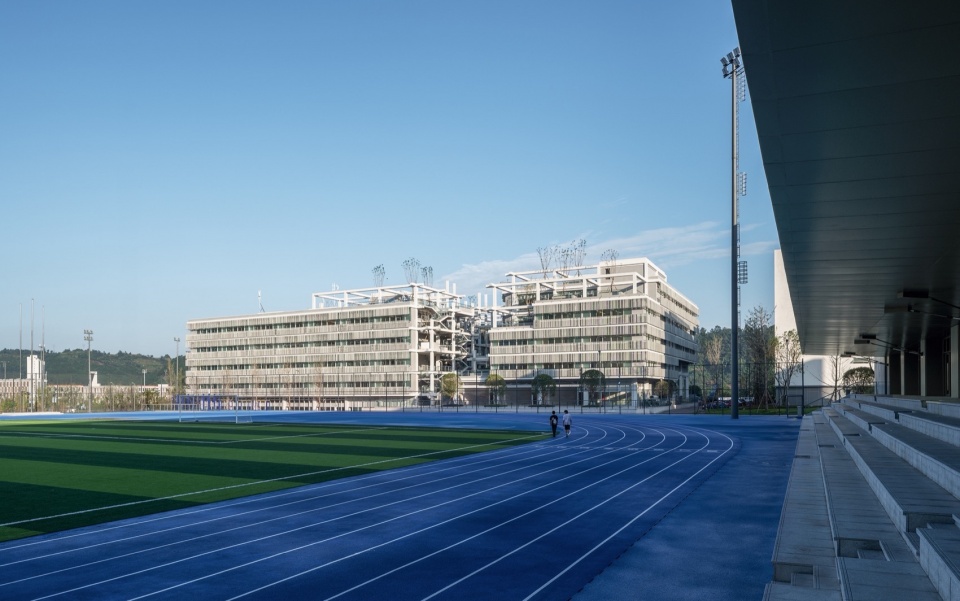
▼从操场看科创楼,View of the Science and Technology Innovation Building from the sports field
▼科创楼采用L型铝合金格栅立面,The Science and Technology Innovation Building adopts an L-shaped aluminum alloy grille façade
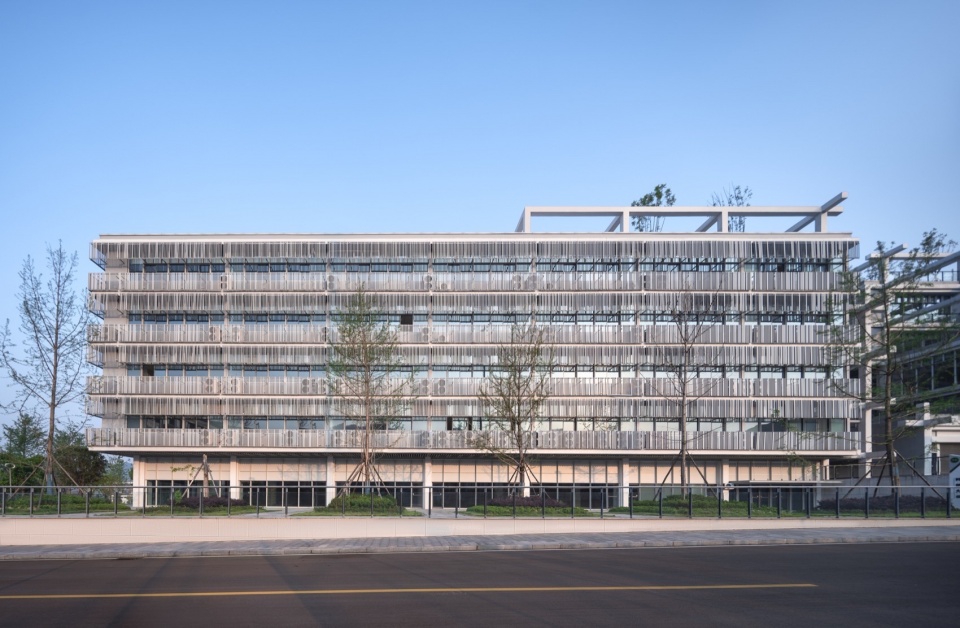
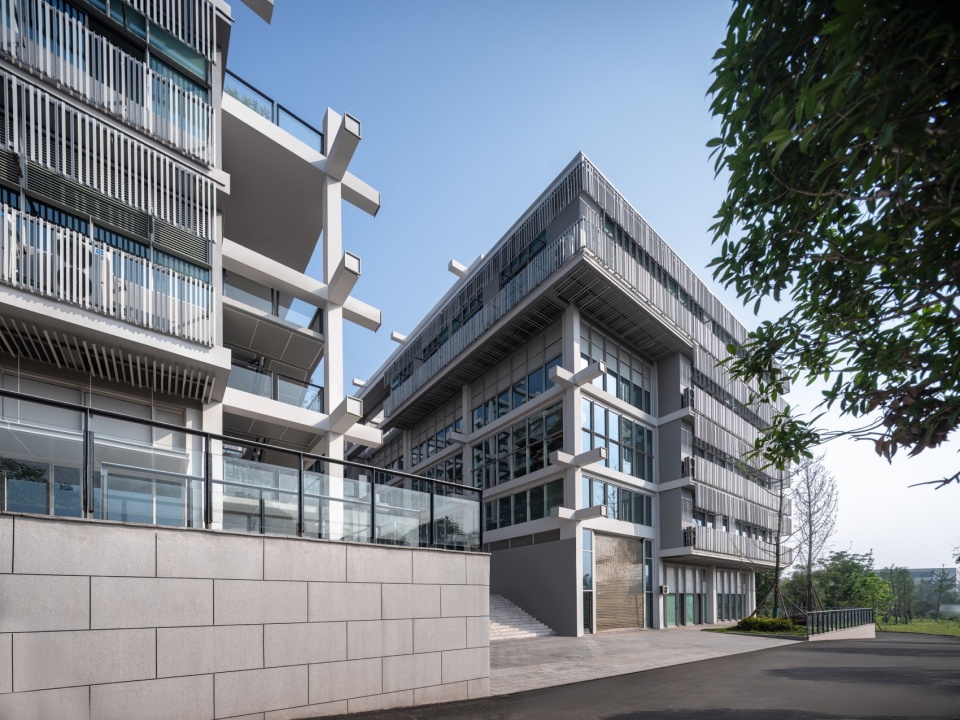
▼科创楼内院入口,The entrance to the courtyard of the Science and Technology Innovation Building
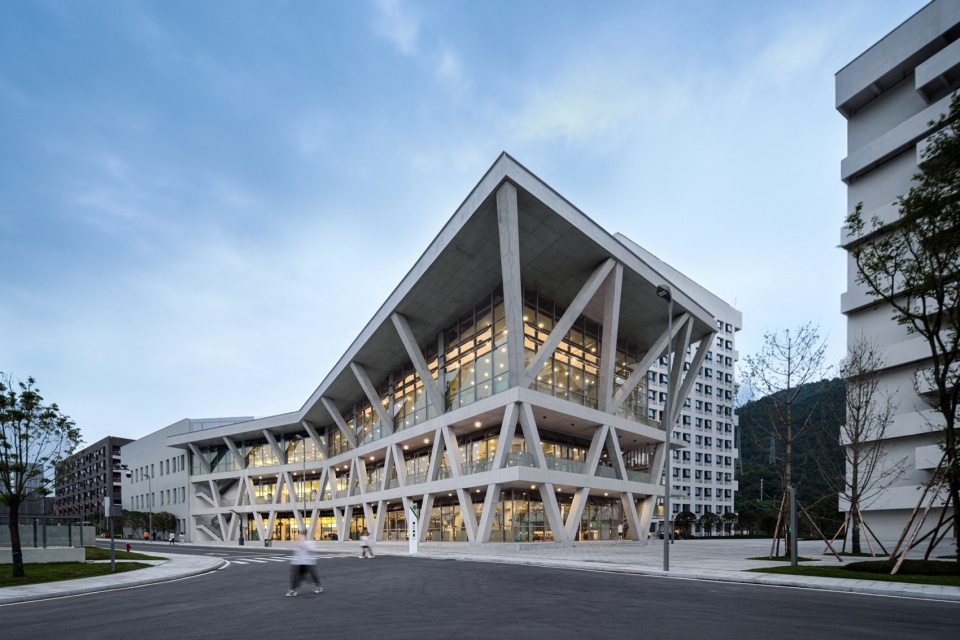
▼食堂的清水混凝土V型柱,The V-shaped columns in exposed concrete surround the Cafeteria
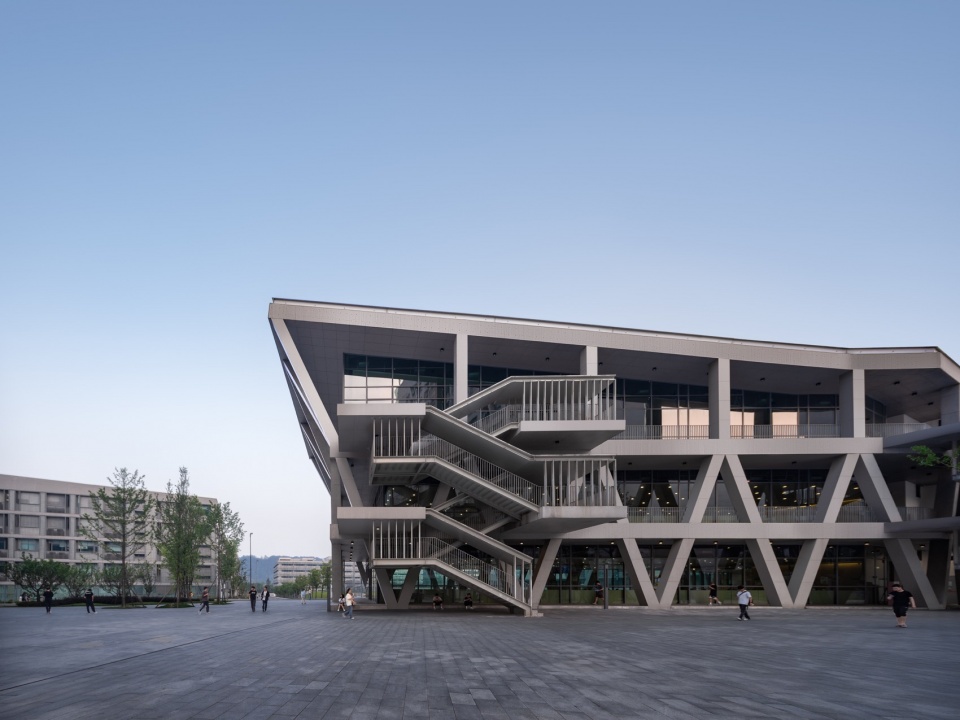
▼食堂北侧立面,North façade of the Cafeteria
▼食堂外廊,Semi-outdoor corridor of the Cafeteria
4.科技建筑的历史情怀|Technological Architecture with Historical Sensibility
建筑采用雕塑感的自由坡型屋顶,既呼应自然山地背景,又能改善日照条件,高低组合形成校园整体起伏的特征。单体建筑设计着重突出“现代工艺感”。西华大学前身为四川工业学院,一直立足于时代最先进的工业技术研究和教育。二期校园内的五大学科设置(汽车、材料、机械、土木、电气)是制造业的基石,因此在建筑材料上我们选择了精细化的现代工业制造成果,选取了玻璃砖、丝网印刷玻璃、浅灰色印花GRC板、铝合金波纹板和水包砂仿石漆作为主要外墙材料。立面图案因地制宜的选择宜宾特有的市树——油樟的图案进行雕刻和印花。在绿化树木的掩映下,真实与象征图案若隐若现,虚实相生,方整简洁的建筑更好地融入校园的自然美景中。
The sculptural, sloping roof of the buildings in the campus echo the mountainous context while optimizing sunlight exposure. Architectural form of the buildings reflects “modern industrial aesthetics” in honor of the school’s pioneering research in industrial technology. Since the major departments in Phase II (Automobile, Material Science, Mechanical Engineering, Civil Engineering, and Electrical Engineering) are considered cornerstones of modern manufacturing, the buildings’ façade materials are also designed to feature precision-engineered elements: glass blocks, screen-printed glass, faux stone coating, corrugated aluminum plates, and light gray patterned GRC (Glassfibre Reinforced Concrete) panels. Façade GRC panels with patterns derived from the camphor tree (Yibin’s city tree) are displayed among the vegetated landscape, softening the buildings appearance into natural environment.
▼行政楼,Administrative Building
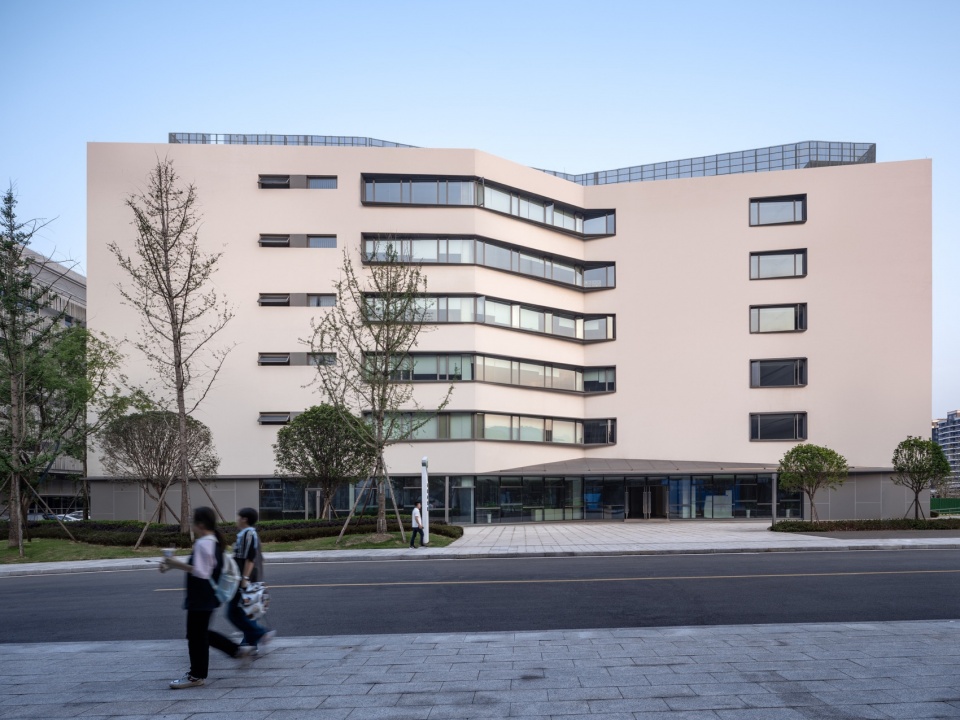
▼行政楼及交流中心,Administrative Building (right) and Exchange Center (left)
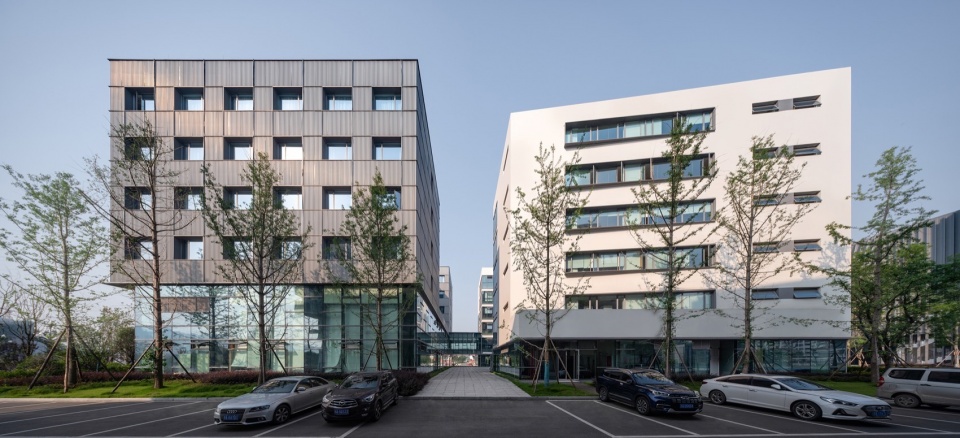
▼行政楼及交流中心内院夜景,Night view of the courtyard of the Administrative Building and the Exchange Center
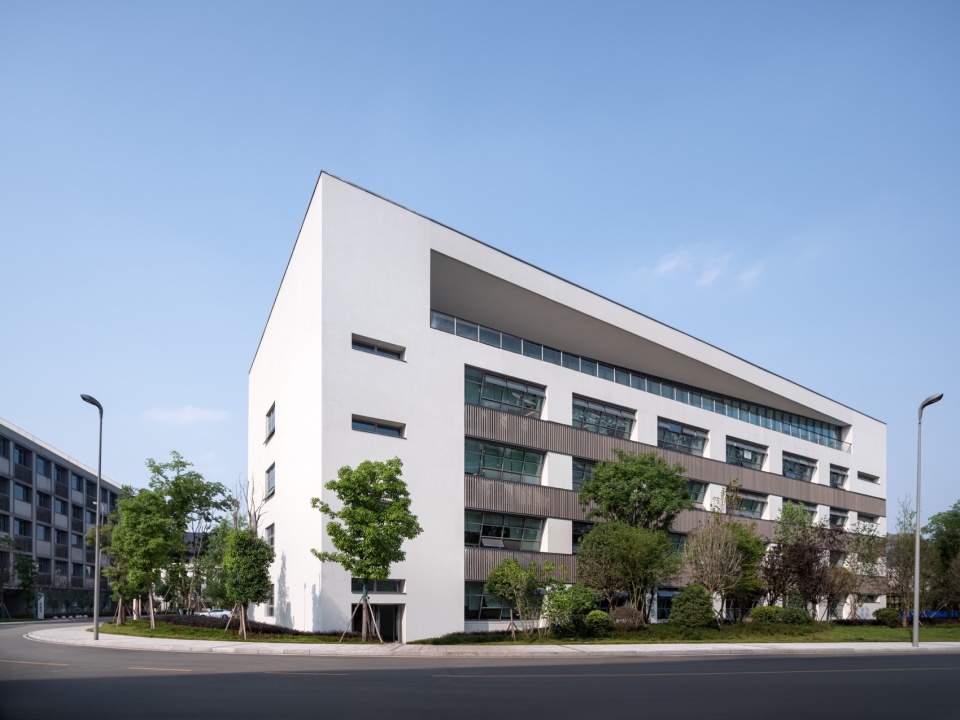
▼国际教育学院,International Education College
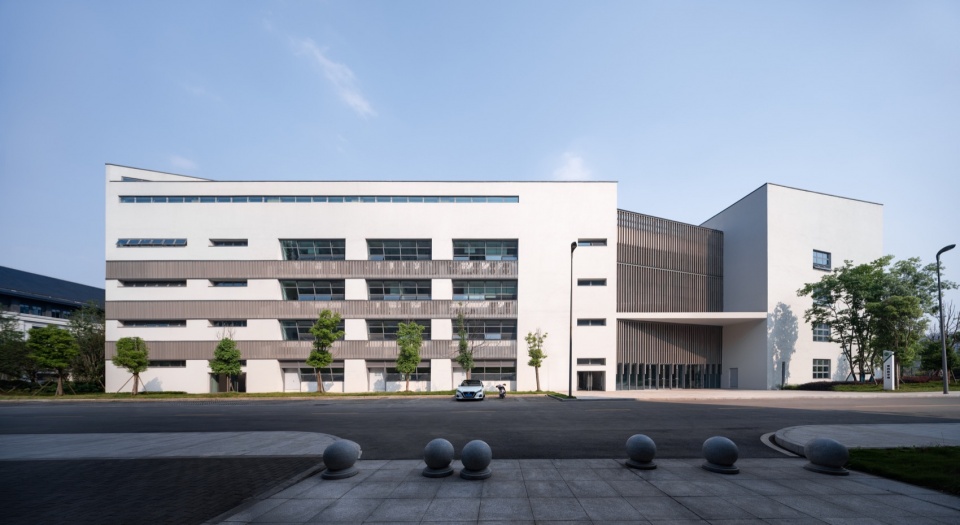
▼国际教育学院外墙采用涂料和灰色陶棍百叶,The exterior walls of the International Education College are composed of paint and grey terra cotta louvers
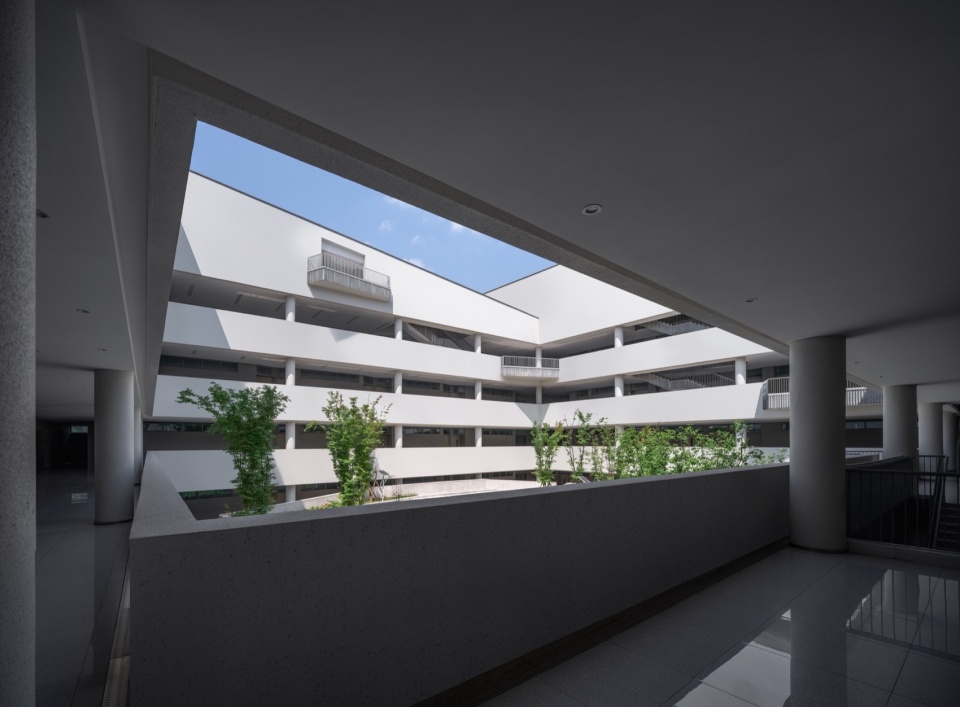
▼国际教育学院回廊,Corridor of the International Education College
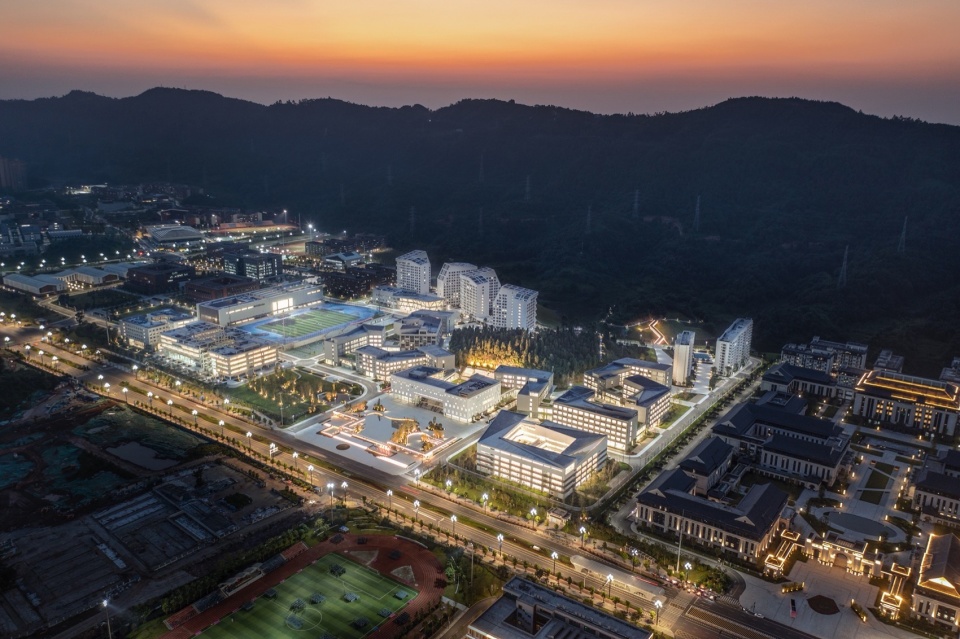
▼夜景,Night view
▼功能布局分析,Functional Layout Analysis
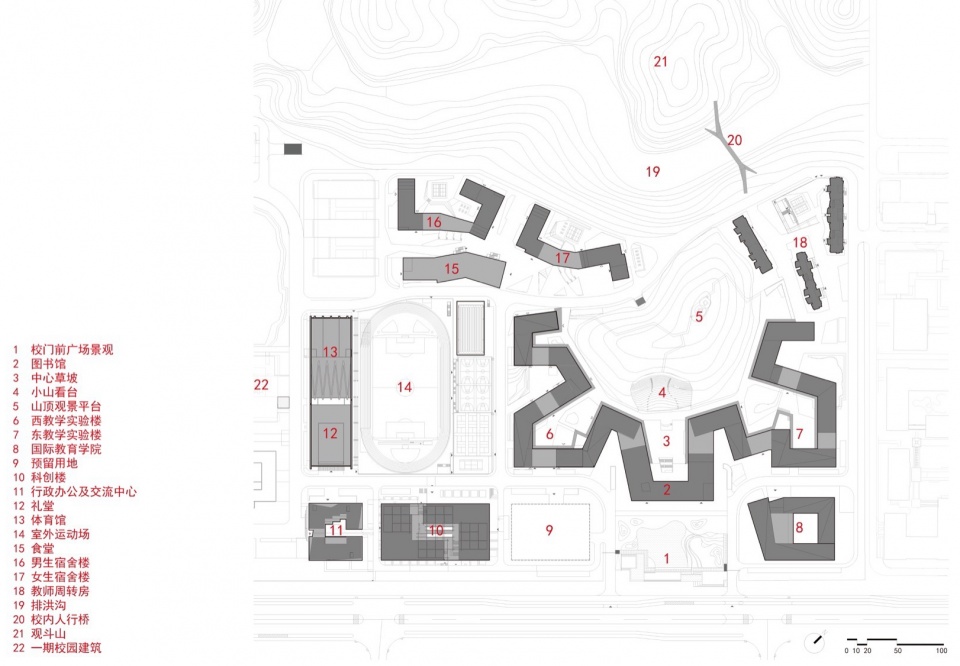
▼总平面,Site plan
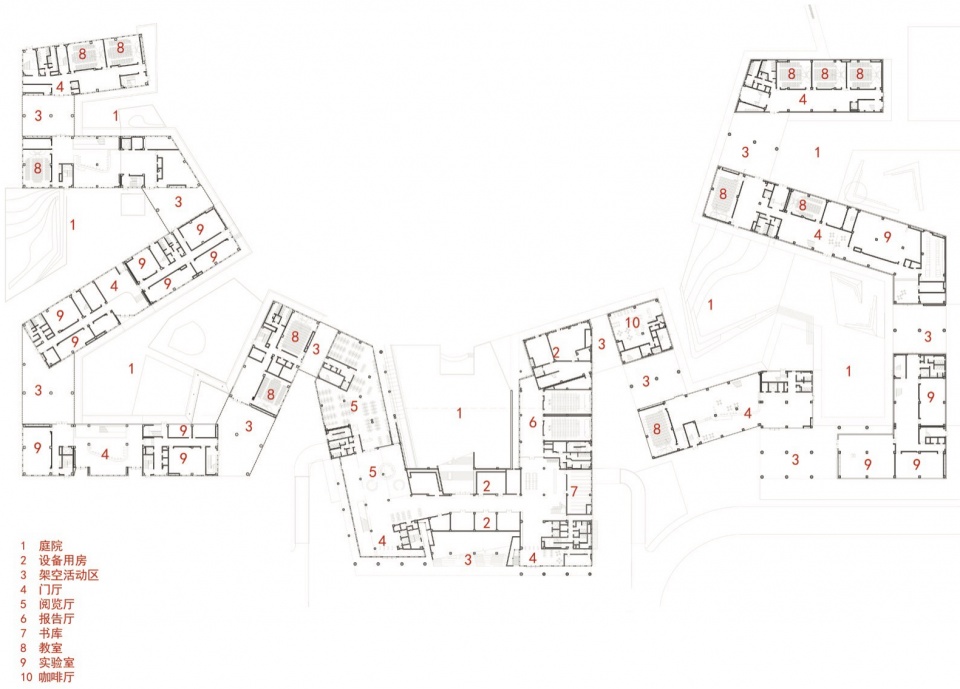
▼教学区一层平面,Teaching Cluster 1st floor plan
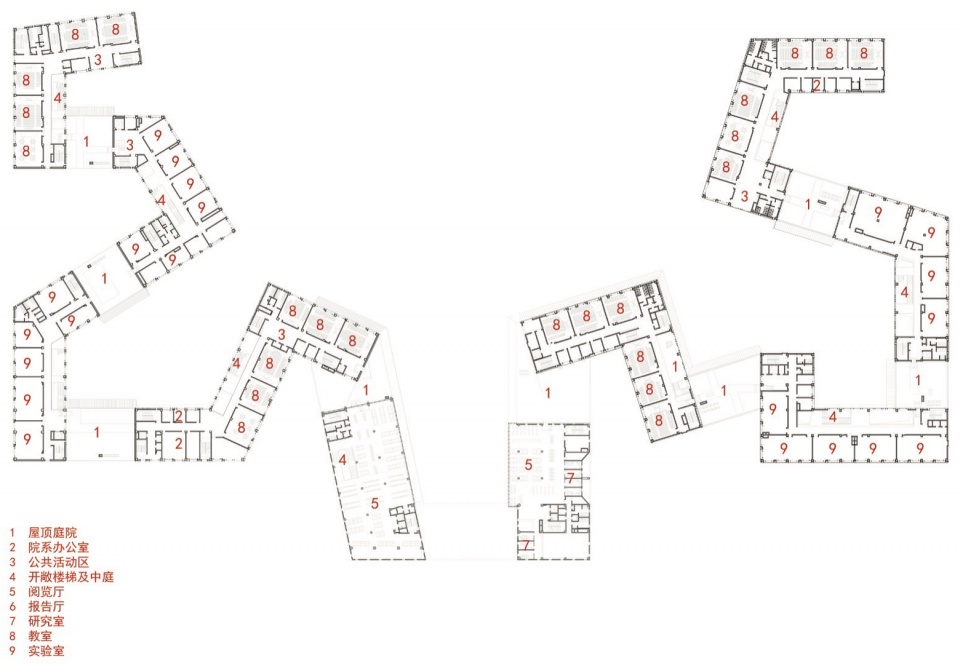
▼教学区三层平面,Teaching Cluster 3rd floor plan
项目信息
Project Info
Client: Yibin Science and Education Industry Investment Group Co., Ltd.
Location: Yibin University Town, Yibin City, Sichuan Province, China
Architectural Design: Atelier FCJZ
Principal Architect: Yung Ho Chang
Atelier FCJZ Design Team: Huang Shuyi, Cheng Yishi, Zhang He, Liang Xiaoning, Jiao Huimin, Long Bin, Liu Chao, He Zelin, Meng Yao, Simon Lee
Construction Documents Design: No.3 Architectural Design Institute of Tongji Architectural Design (Group) Co., Ltd.
Architecture: Wang Wensheng, Shi Wei, Zhao Chenghong, Zhong Qiang, Tao Kuangyi, Tang Yajie, Zhang Fan, Tang Lu, He Lingfang
Structure: Ruan Linwang, Jin Gang, Meng Chunguang, Geng Yaoming, Ju Wei, Guo Yang, Ma Dongya, Li Jiguo, Zhou You, Wen Chao, Wang Songshuo, Gu Feng, Zhou Chaojun, Tian Chunyang
Plumbing (PE): Feng Wei, Huang Beirong, Wang Heng, Shen Jiayu, Wang Run
HVAC: Zeng Gang, Yao Sai, Qi Dongsheng, Xu Huan, Zhou Peng, Song Yuan, Yuan Yin
Electrical (EE): Wang Jian, Cheng Qing, Chen Yiqing, Wang Qing, Liu Long, Fu Mingmin, Chen Wei, Liu Yongqiang, Sun Li’an, Wu Yifan, Qu Lei, Zheng Jianfeng, Ma Weinan, Shao Qizhen, Gu Wei, Liu Xiyuan
Landscape: Lu Weihong, Wang Zhun, Zhai Lina, Yan Xiaowen
Civil Engineering (CE): Shen Yu, Wang Yang, Tan Yu, Lin Ying, Qiao Jingyu, Song Xin, Duan Hongliang, Yu Feng
Site Representative: Yan Xudong
Site Area: 367,400㎡
Building Area: 224,648㎡ (newly-built part of Phase II), 26,254㎡ (extension part of Phase I)
Design Period: 2020.01 – 2021.03
Construction Period: 2020.09 – 2021.11
Completion Time: 2021.11