上海交通大学学生服务中心 / 曾群建筑研究室
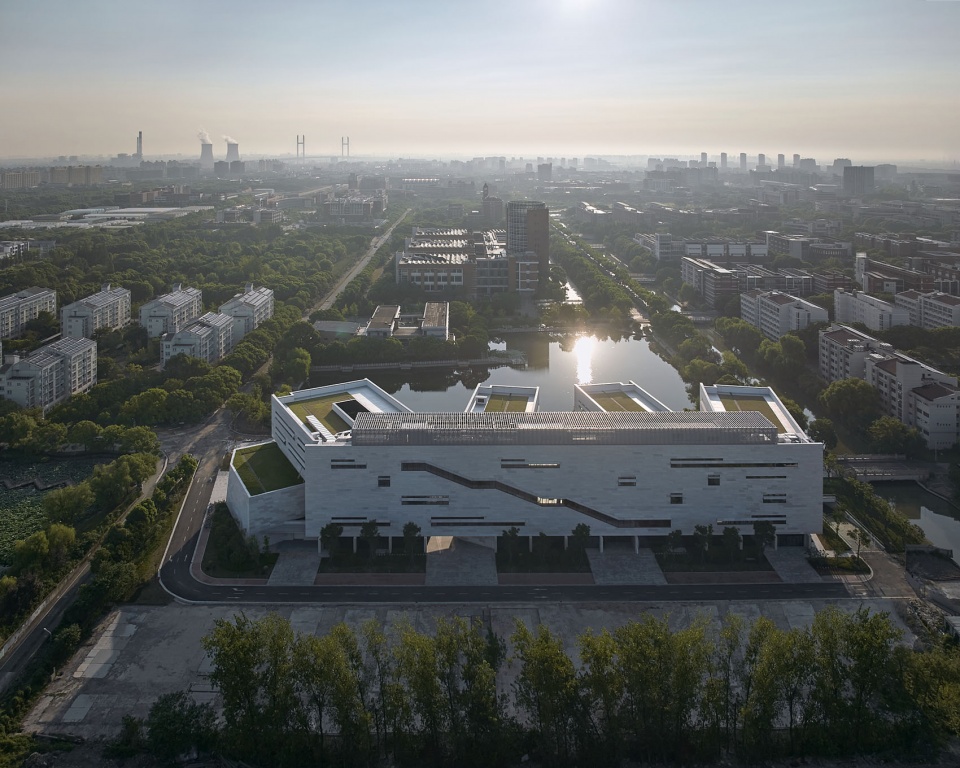
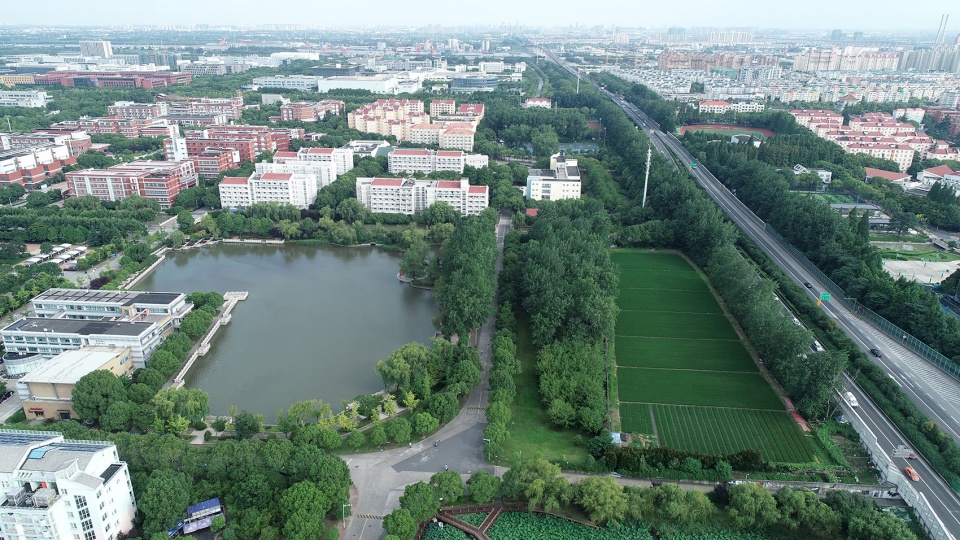
“以学生为本”作为当代高校重要发展理念的形势下,学生中心成为近年来高校建设一个新的重要类型,这是一个位于校园边缘的建筑,项目原本并不在最初的校园规划中,只能应时选中一块基地,南北长东西窄,西侧已经贴临校园的边界,背靠城市高速干道,而东边则紧邻景观湖面,绿色亲水。相对于教学科研等功能建筑充足整齐的用地,这个基地具有某种天然的“边缘”属性。如何回应这个“边缘”地带的特质,发掘其内在潜力成为设计的关键。
Under the contemporary educational philosophy that places “student-centeredness” as a core principle in universities, the student center has emerged as a significant new building type on campuses in recent years. This particular project sits at the edge of the campus. Originally not part of the university’s initial master plan, it had to be accommodated on a site chosen as opportunities allowed—long and narrow, running north to south. To the west, it already brushes against the campus boundary, backing onto a busy urban expressway; to the east, it neighbors a scenic lake with lush, water-close greenery. Unlike the ample, orderly land reserved for academic and research functions, this site carries an inherent quality of being at the “edge.” How to respond to the character of this marginal zone and unlock its hidden potential became the key to the design.
▼建筑与场地协调,Building and Site in Harmony
背景 Background
上海交大有着浓厚的理性基因以及强大的科学创造力,闵行校区则是地处郊区、发展迅速的新校园。校园有着统一整体的规划,主要建筑群落已经建成,以灰色和砖红色为主要建筑基调,跟许多近二十年来快速建成的校园建筑高度类似,而我们希望通过新的建筑植入,探索校园、城市、自然、科学以及人之间的关系,给这个顶尖学府的校园带来新的空间语言和活力。项目为闵行校区服务于师生办事、咨询、活动、演出等学习和生活事务的综合空间,同时也是师生交流沟通的共享平台,我们希望通过大量漫游式自主活动空间的设置,促进不同专业的学术交流与思维碰撞,与主体功能空间串联互通,兼顾公共性与独立性的同时,激发校园活力。
▼大校园环境下的基地区位,Site Location within the Broader Campus Context
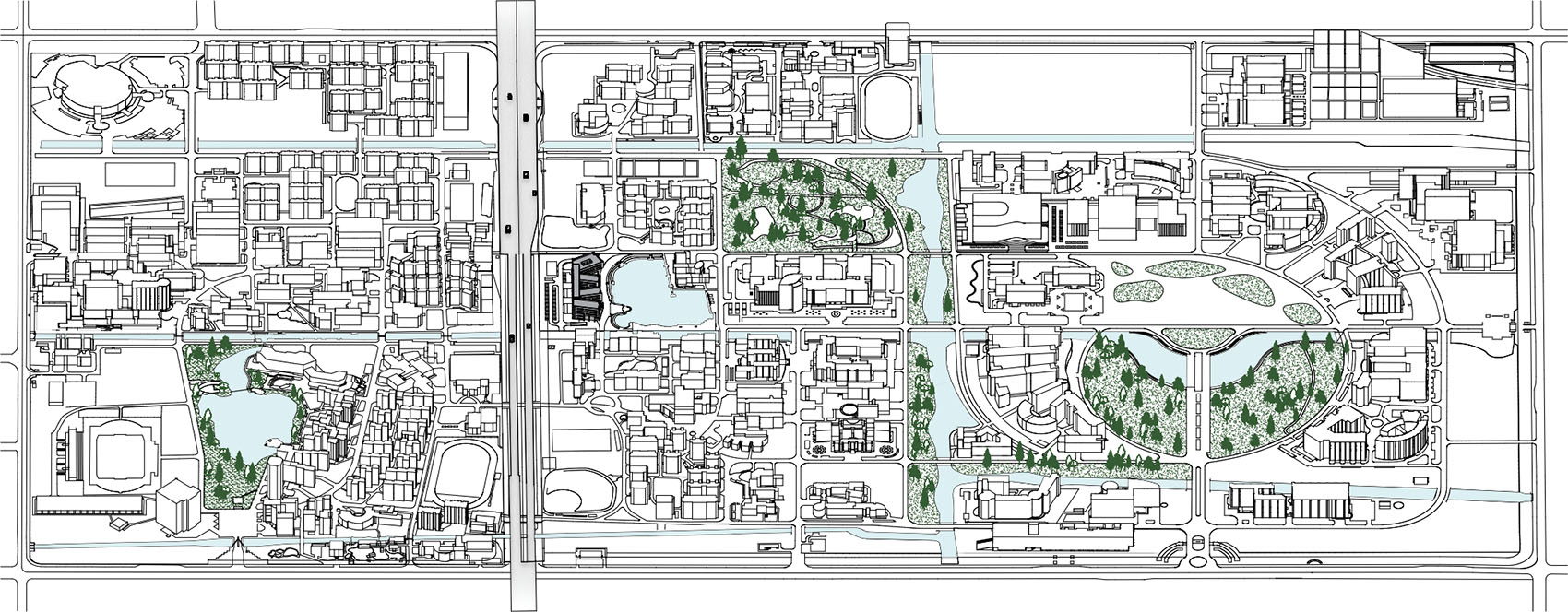
Shanghai Jiao Tong University has a deeply rational character and a strong tradition of scientific creativity. The Minhang campus, located on the suburban fringe, is a rapidly growing new campus. It follows a unified master plan, with most of its main building clusters already completed—dominated by gray and brick-red tones, much like many other campus buildings rapidly erected across China over the past two decades. Yet, through the insertion of new architecture, we hope to explore the relationships between campus, city, nature, science, and people, bringing a fresh spatial language and new vitality to this premier university. The project serves as a comprehensive hub within the Minhang campus for students and faculty to handle administrative matters, seek advice, participate in activities, attend performances, and engage in various daily learning and living needs. It also functions as a shared platform for interaction and exchange between students and teachers. By incorporating a wealth of meandering, freely accessible spaces, we aim to foster academic cross-pollination and the clash of ideas across different disciplines—connecting seamlessly with the main functional areas while balancing public accessibility with a sense of independence, ultimately injecting new energy into campus life.
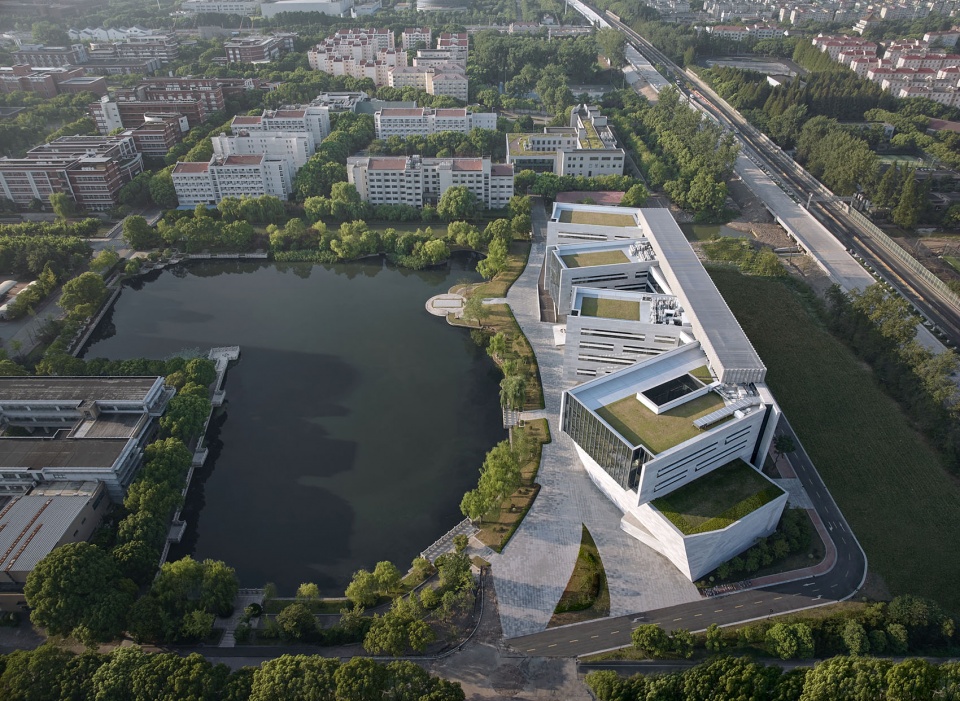
▼项目鸟瞰,Project Aerial View
边缘与边界 Fringe and boundary
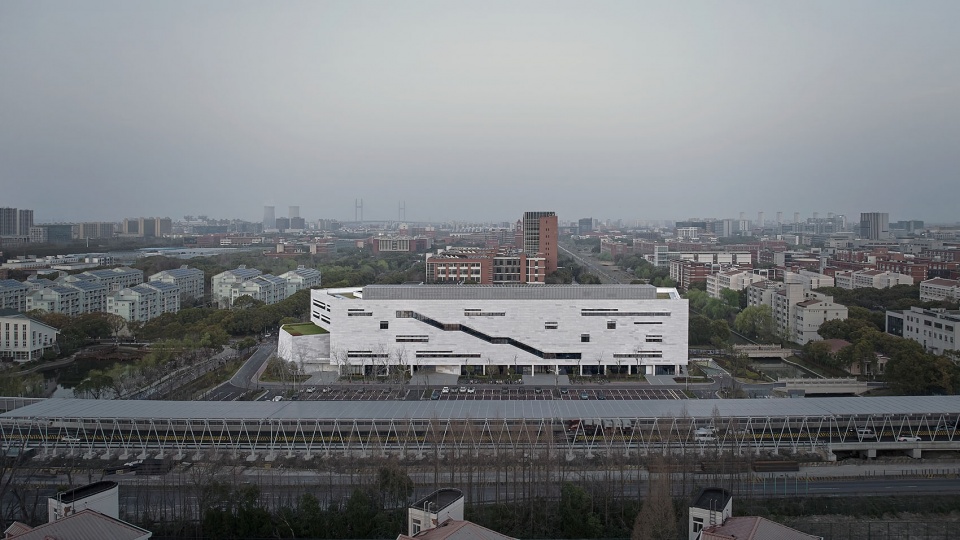
基地具有某种天然的“边缘”属性,在东西两侧有着截然不同的风景:西侧是城市基础设施,东侧是自然景观,西侧是直线、快速、机器和瞬时的,东侧是柔和、缓慢、生机和闲适的。我们用不同的“边界”策略来建立设计理念:在西侧,建筑边界是简单的直面,平行于高速路,五层高的立面相对封闭,功能设置了公共交通空间和辅助用房,隔绝了高速车流带来的喧嚣嘈杂,少量的开窗顺应楼梯和平台的行动线路,使得中庭依然可以一窥城市风景。同时,从高速干道开车快速通过时,我们可以看到一个的类似城市基础设施的建筑,简洁拙朴,成为校园的一个标志。
▼基地原始环境,Original Site Environment
▼整体布局策略,Overall layout strategy
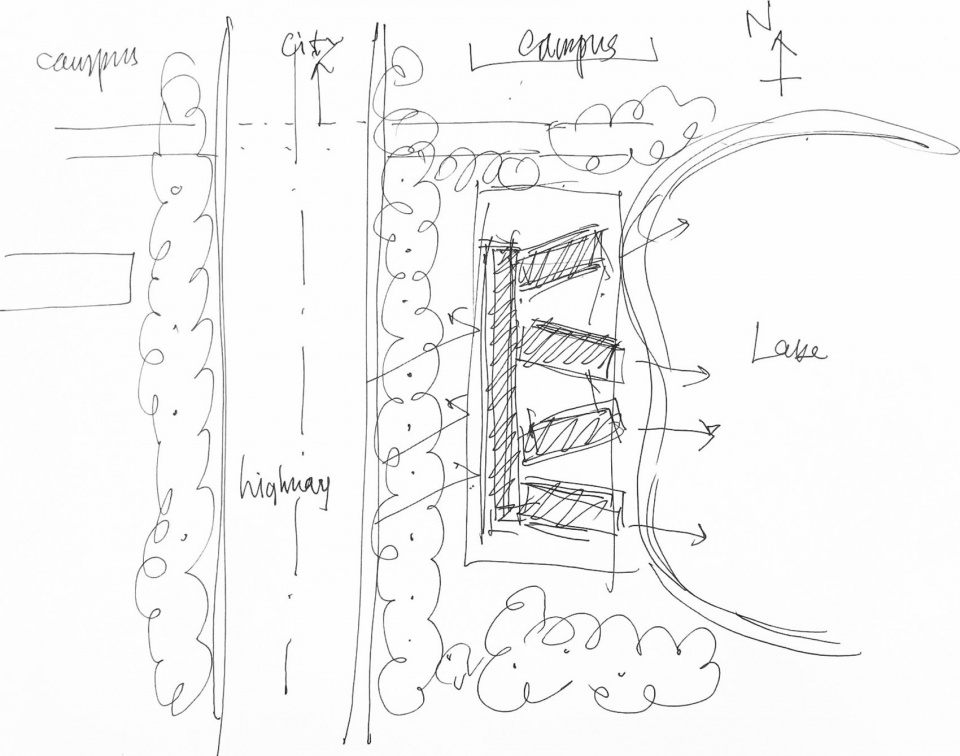
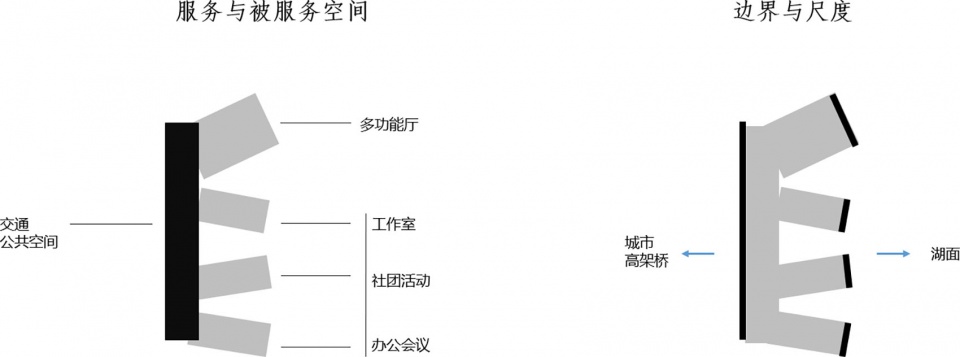
The site has an inherent “edge” quality, with two strikingly different landscapes on its east and west sides: to the west lies urban infrastructure; to the east, natural scenery. The west is linear, fast, mechanical, and instantaneous; the east is soft, slow, alive, and leisurely. We developed our design concept through different “boundary” strategies. On the west side, the building edge is a simple, straight facade running parallel to the expressway. The five-story elevation is relatively enclosed, housing public circulation spaces and support rooms—shielding the interior from the clamor of high-speed traffic. A few carefully placed windows follow the movement paths of stairs and landings, allowing the atrium to still catch glimpses of the city beyond. At the same time, when driving past quickly on the expressway, the building reads as something akin to urban infrastructure—simple, unpretentious, and quietly iconic for the campus.
▼西侧边界,West Side Boundary
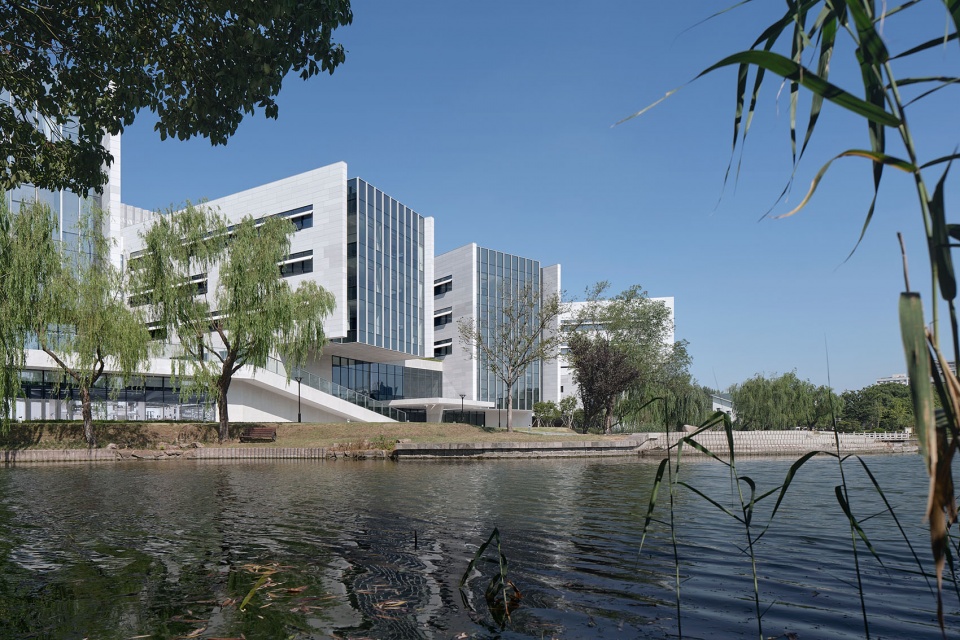
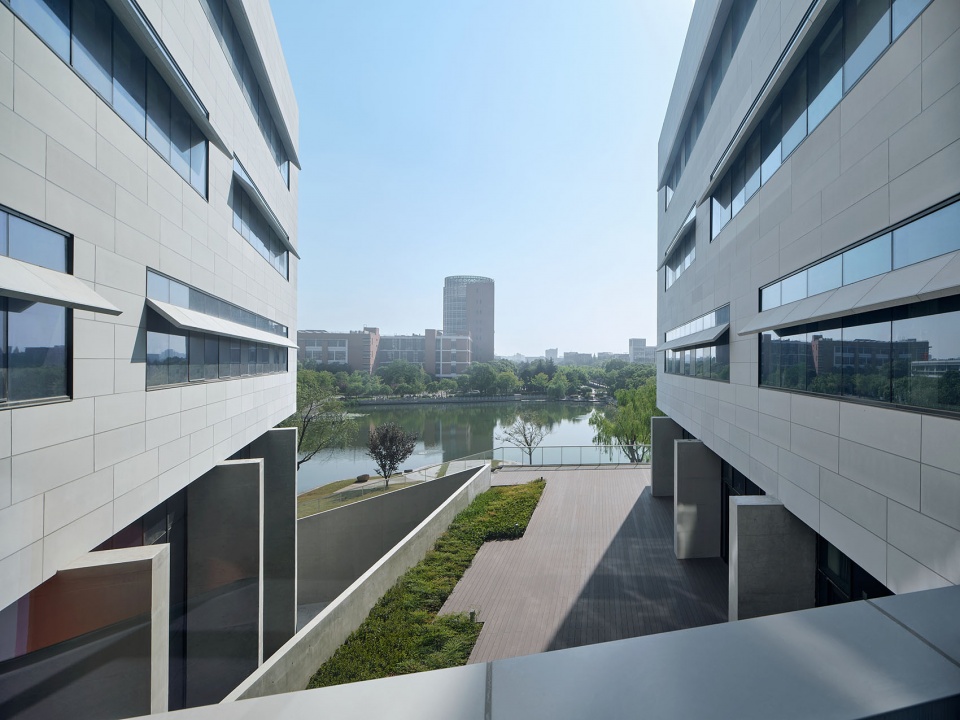
东侧边界则是不规则的指状型,“手指”伸向湖面,与曲折的湖岸产生良好的对话,将湖景引入院子,同时解决了因基地南面面宽过窄带来的采光和通风问题。东侧布置了主要的功能性活动空间,是学生交流活动的场所,采用更通透轻松的立面形式,与西侧的厚实立面形成两种不同的表情。
The east side boundary, by contrast, takes an irregular, finger-like form. These “fingers” reach out toward the lake, engaging in a pleasant dialogue with the meandering shoreline, drawing lake views into the courtyard, while also resolving the lighting and ventilation issues caused by the narrow southern frontage of the site. The east side houses the main functional activity spaces—places for student interaction and events—with a more transparent and relaxed facade treatment, presenting a distinct expression from the solid, thick facade on the west.
▼东侧边界,East Side Boundary
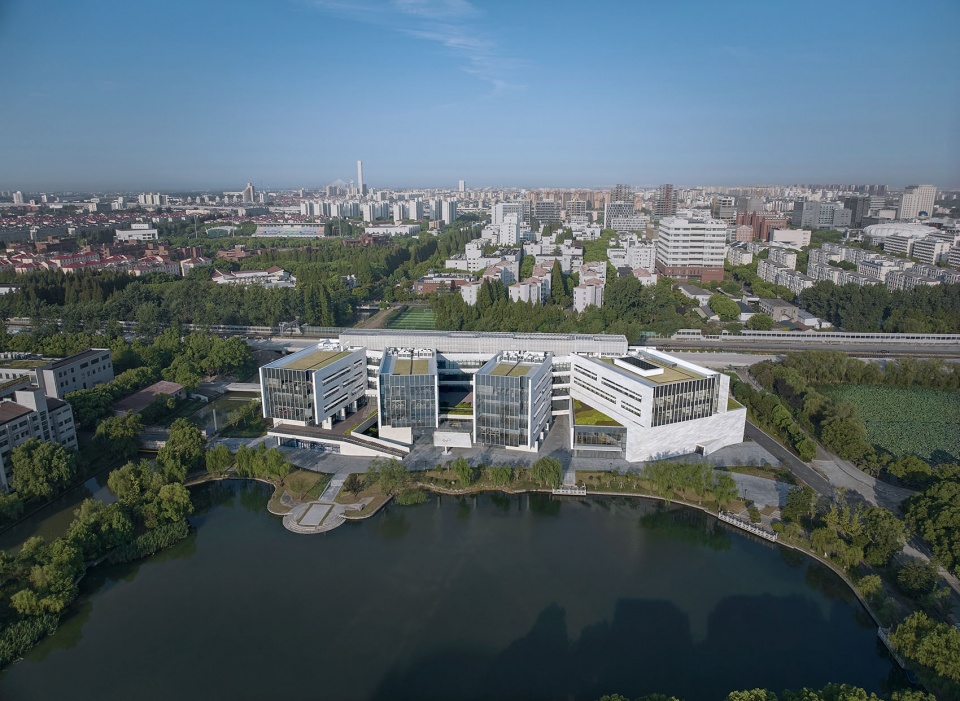
▼建筑的两个边界不同的处理策略,Contrasting Strategies for the Building’s Two Boundaries
生成 Generation
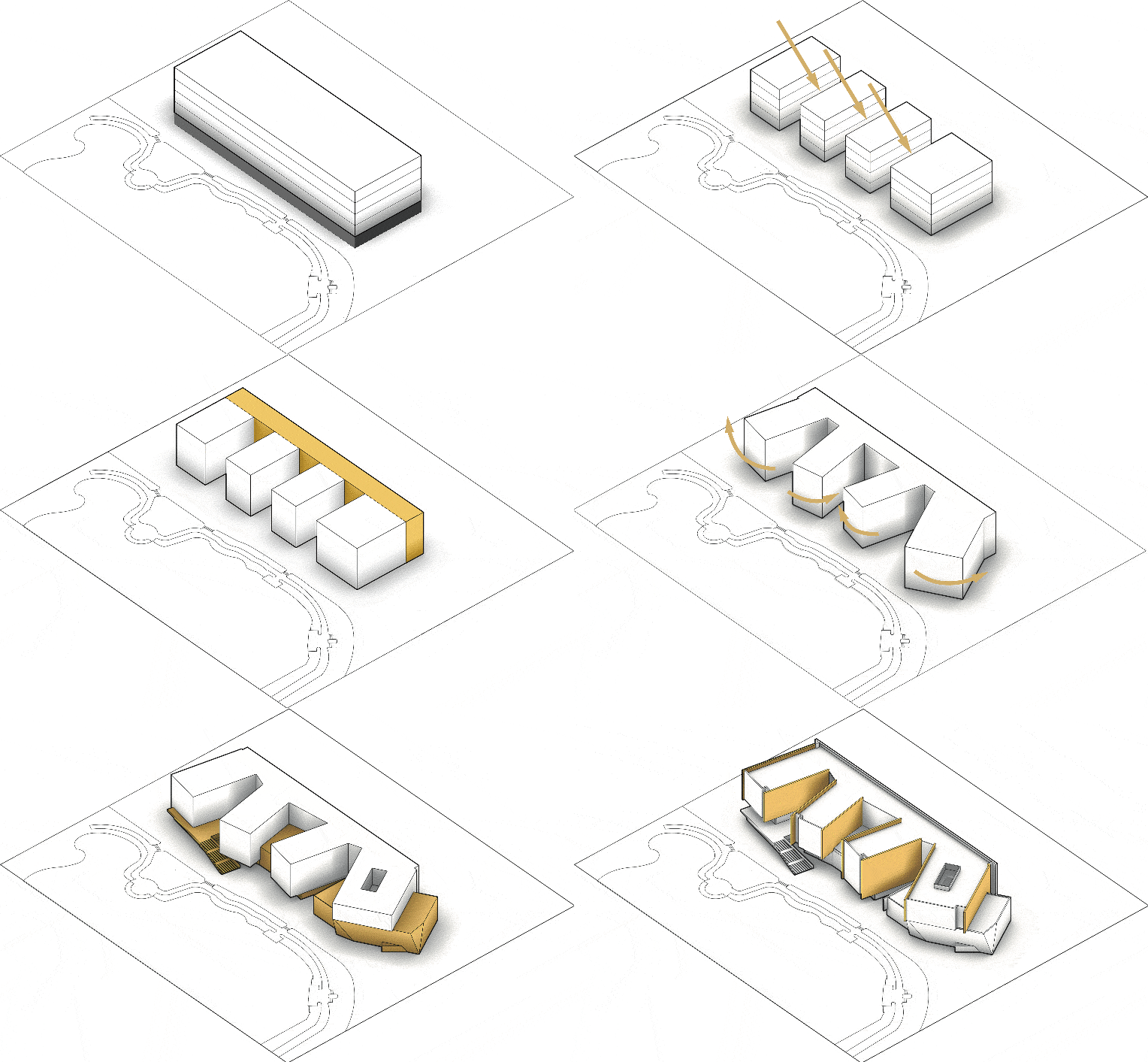
在两种不同的“边界”条件下,建筑的形态呼之欲出,形体简洁明朗而无过多矫饰。多样的功能空间在沿湖一侧井然有序的排布,最大化利用湖面景观,与自然对话,南北向的功能用房获取最佳的采光通风条件。西侧通过公共服务边庭整体串联,是高效便捷的垂直交通,也是共享交流的校园垂直社区。通过活动平台,屋顶庭院,及音乐厅等体量的置入,丰富底层建筑界面,塑造立体、开放、多层次的空间体系。
▼生成过程,Dynamic Generation Process
▼整体剖视,Overall Section View
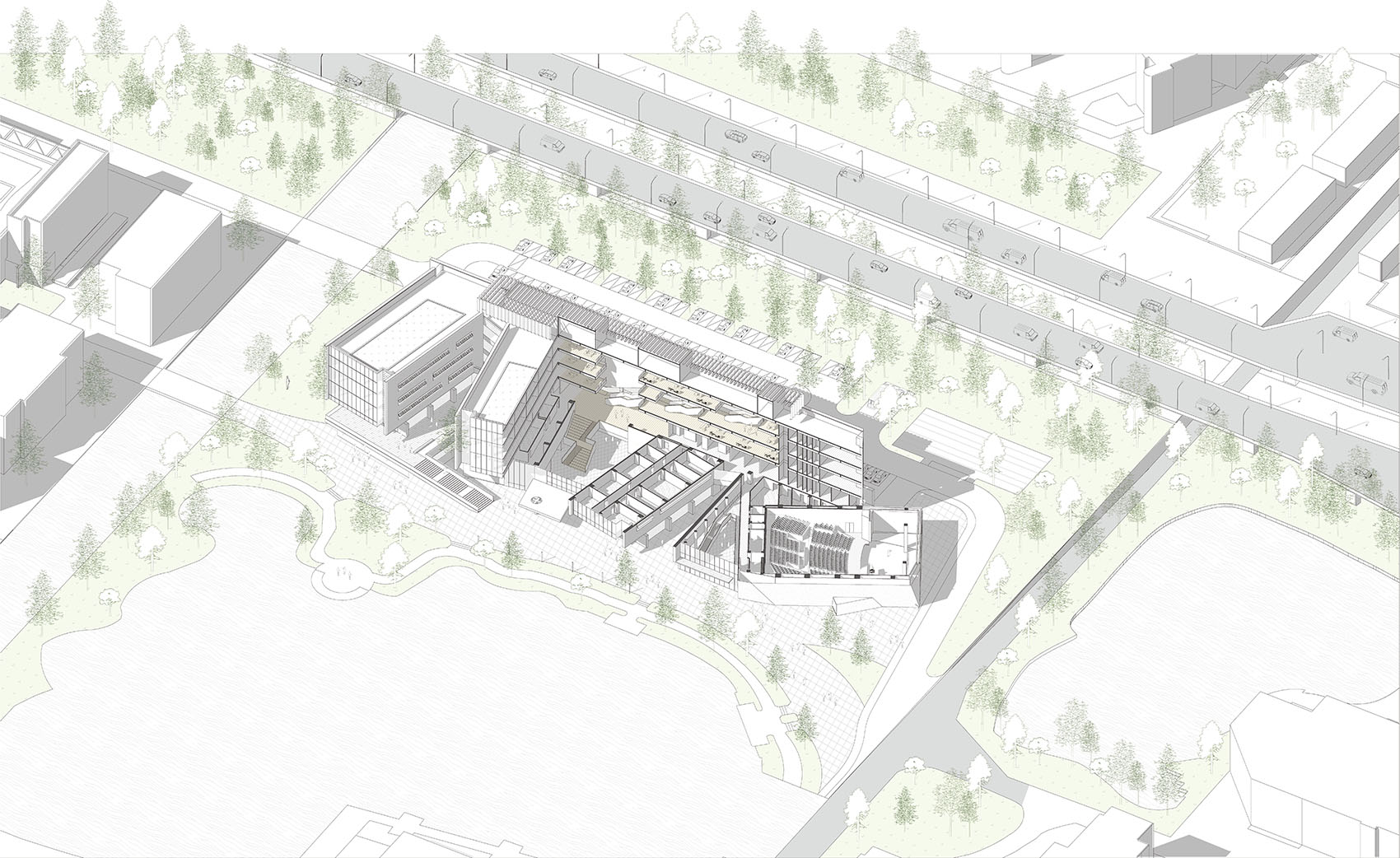
Under these two distinct “boundary” conditions, the building’s form emerges naturally—clean, clear, and free of excessive ornamentation. The diverse functional spaces are arranged in an orderly manner along the lakeside, maximizing views of the water and engaging in a dialogue with nature, while the north-south oriented rooms benefit from optimal lighting and ventilation. On the west side, everything is linked together by a public service side atrium—an efficient vertical circulation system that also functions as a vertical campus community for sharing and interaction. Through the insertion of activity platforms, rooftop courtyards, and the volume of the concert hall, the ground-level building interface is enriched, shaping a three-dimensional, open, and multi-layered spatial system.
▼外观概览,Exterior overview
表情 Expression
建筑在东西侧呈现出不同的表情。一面硬朗,一面柔和;一面厚实,一面开放;一实一虚。
The building presents two distinct expressions on its east and west sides. One side is hard and unyielding, the other soft and gentle; one side thick and solid, the other open and transparent; one solid, one void.
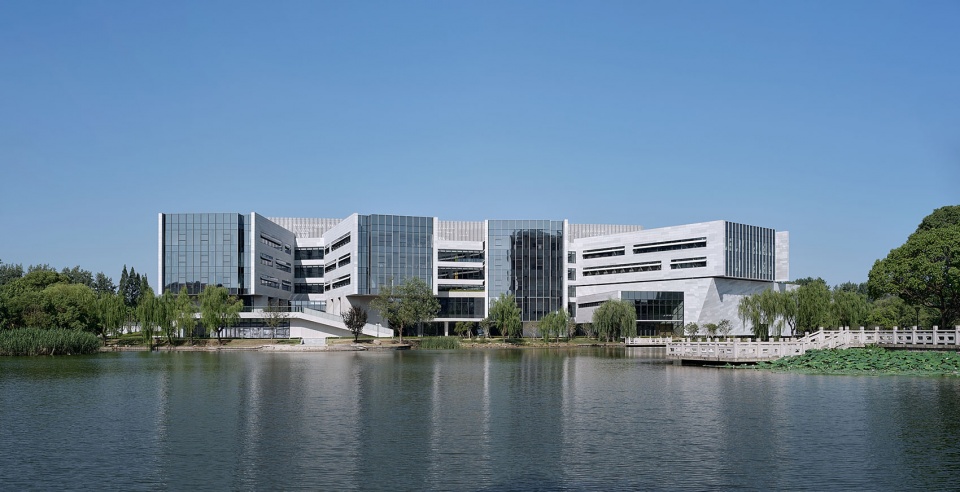
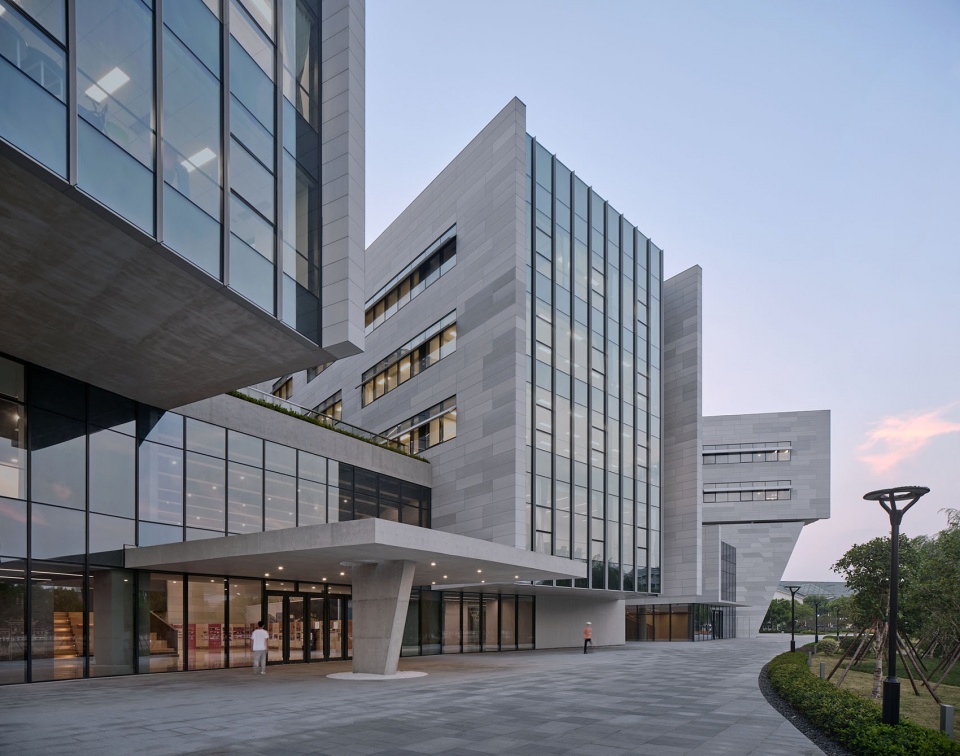
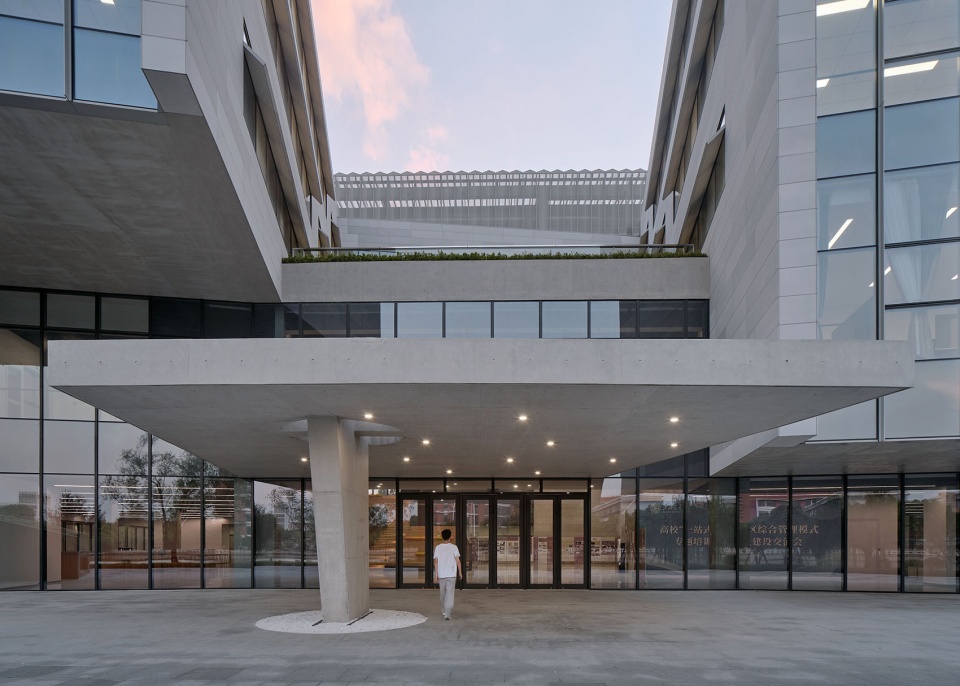
▼沿湖开放的立面,Open Facade along the Lake
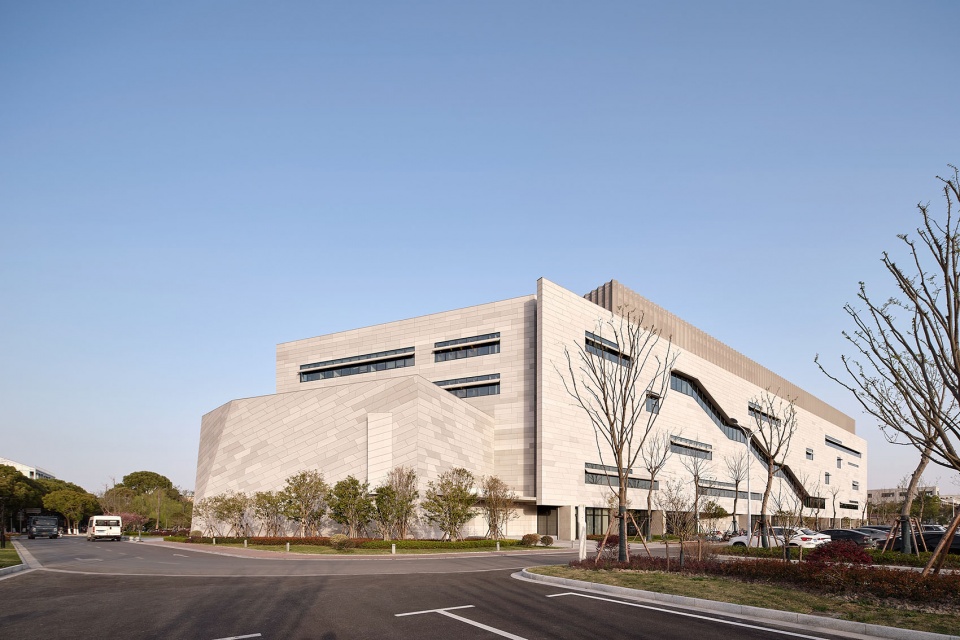
▼沿城市高速路厚实的立面,Solid Facade along the Urban Expressway
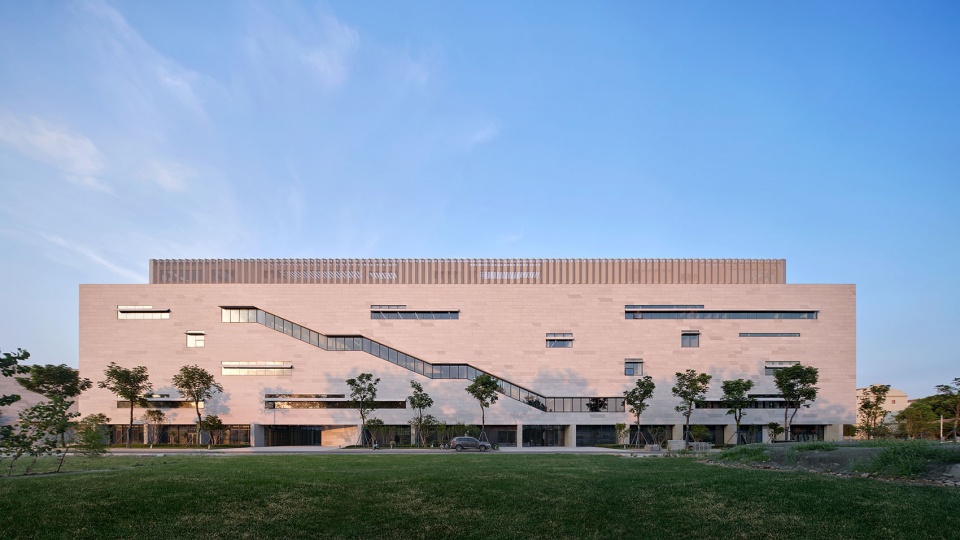
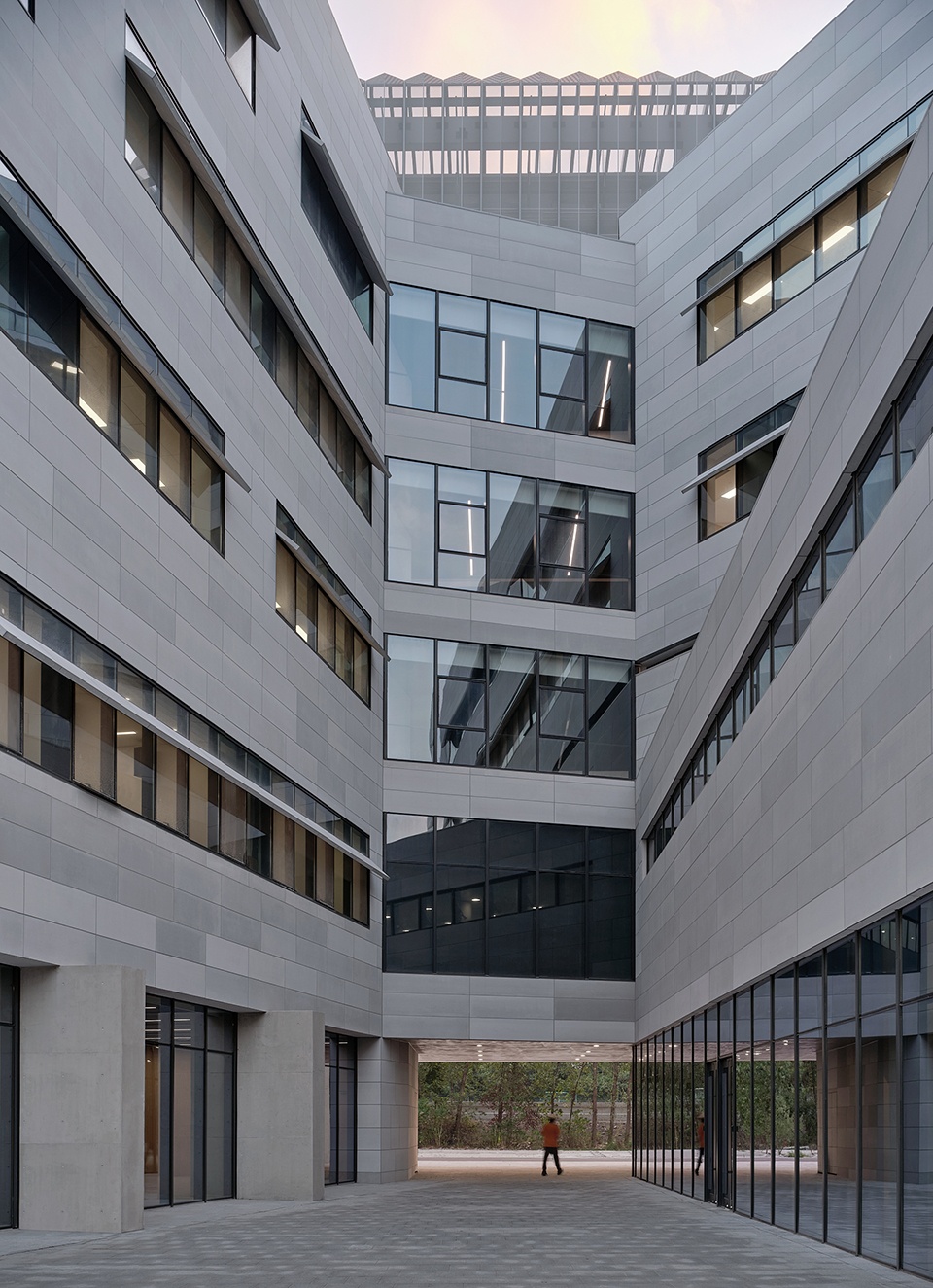
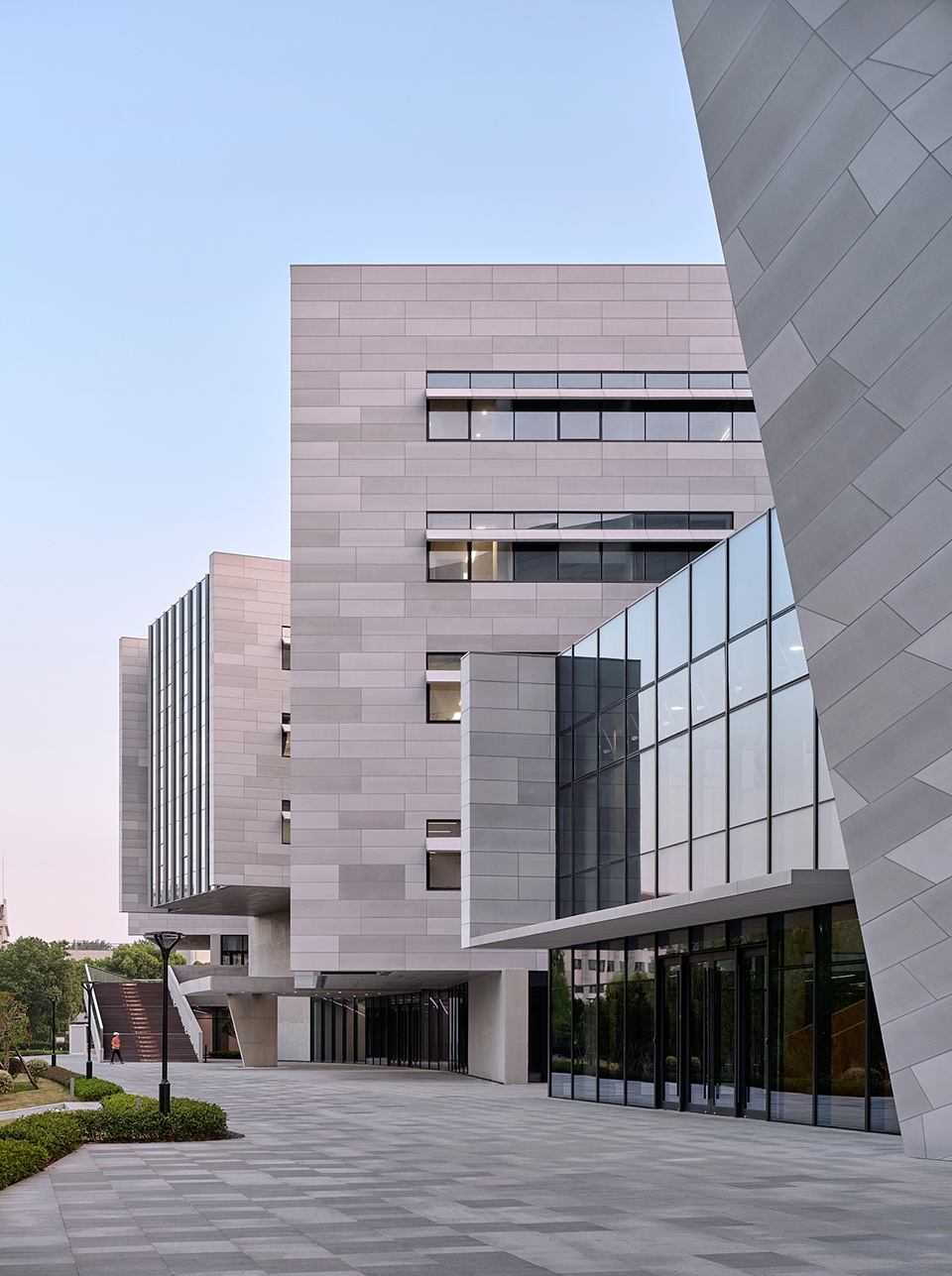
外立面主材选用了水泥纤维板和清水砼,以质朴、素雅的质感表达交大浓厚的理性基因和务实求真的精神气质。东侧通过大面的玻璃幕墙消解室内外的边界,建筑与景观互相渗透。片墙的形式语言强化了对湖景的开放性,建筑形式统一而不失个性。
The main exterior materials are cement fiberboard and fair-faced concrete, whose unpretentious, understated texture reflects SJTU’s deep rational DNA and pragmatic, truth-seeking spirit. On the east side, large glass curtain walls dissolve the boundary between inside and outside, allowing the building and landscape to interpenetrate. The formal language of the slab walls reinforces openness to the lake view, resulting in a building that is both unified and distinctive.
▼水泥纤维板与玻璃幕墙形成的丰富立面,
A Richly Textured Façade of Cement Fiberboard and Glass Curtain Wall
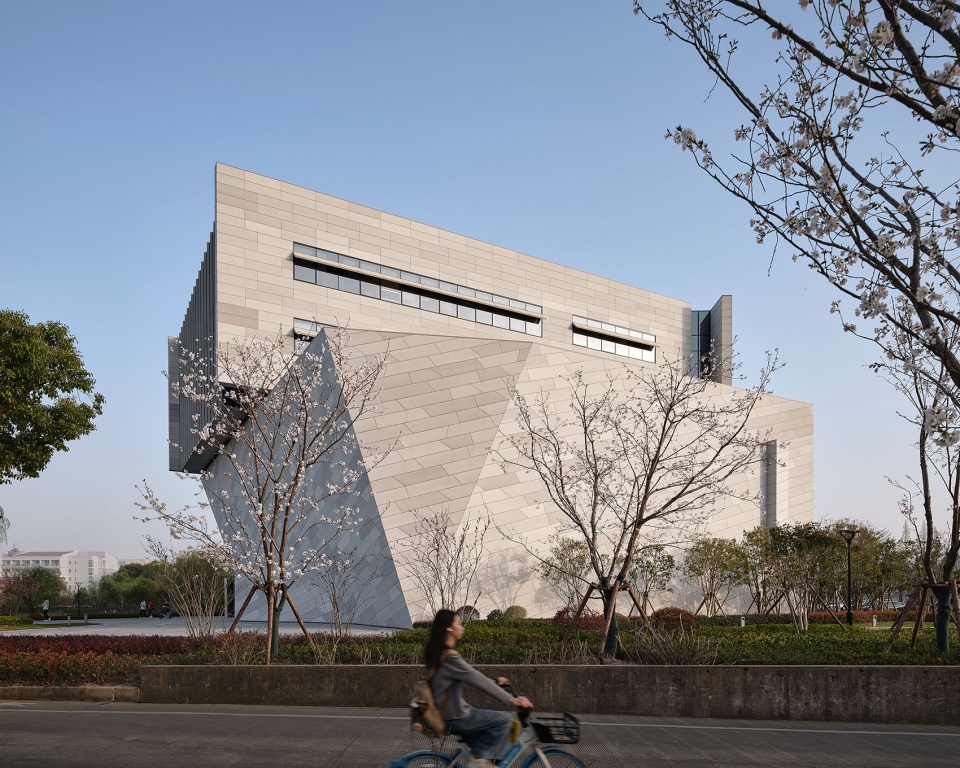
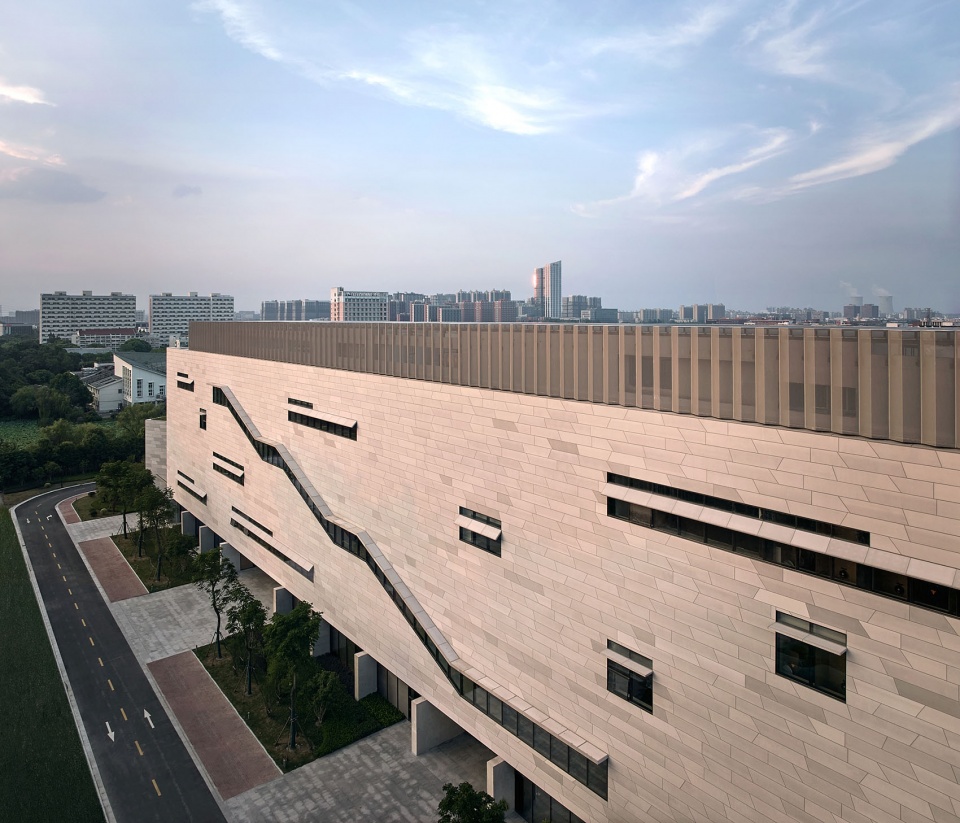
西面的“实”与东面的“虚”形成对比,厚实的立面简洁拙朴而又富有力量感,斜四边形拼贴排布的纤维板构成丰富的立面“微表情”,建筑成为校园内一个新的标志。
The contrast between the west’s “solidity” and the east’s “void” is striking. The thick west facade is simple, unpretentious, yet powerfully expressive. The diagonally staggered arrangement of fiber cement panels creates a rich “micro-expression” across the surface, making the building a new landmark on campus.
▼丰富立面近景,A Richly Textured Façade Close View
空间 Space
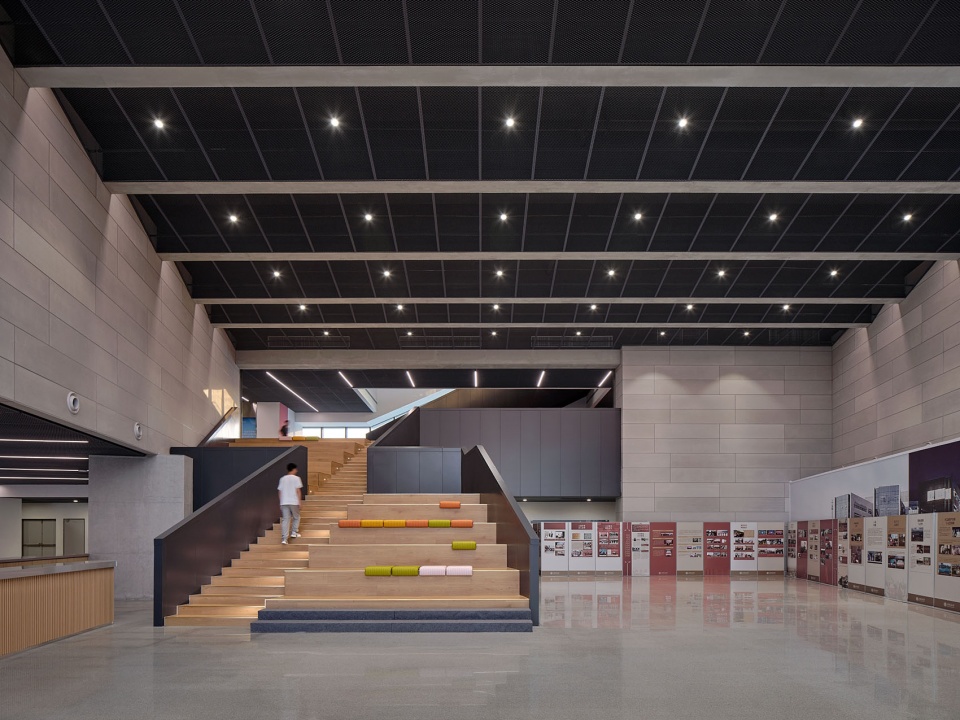
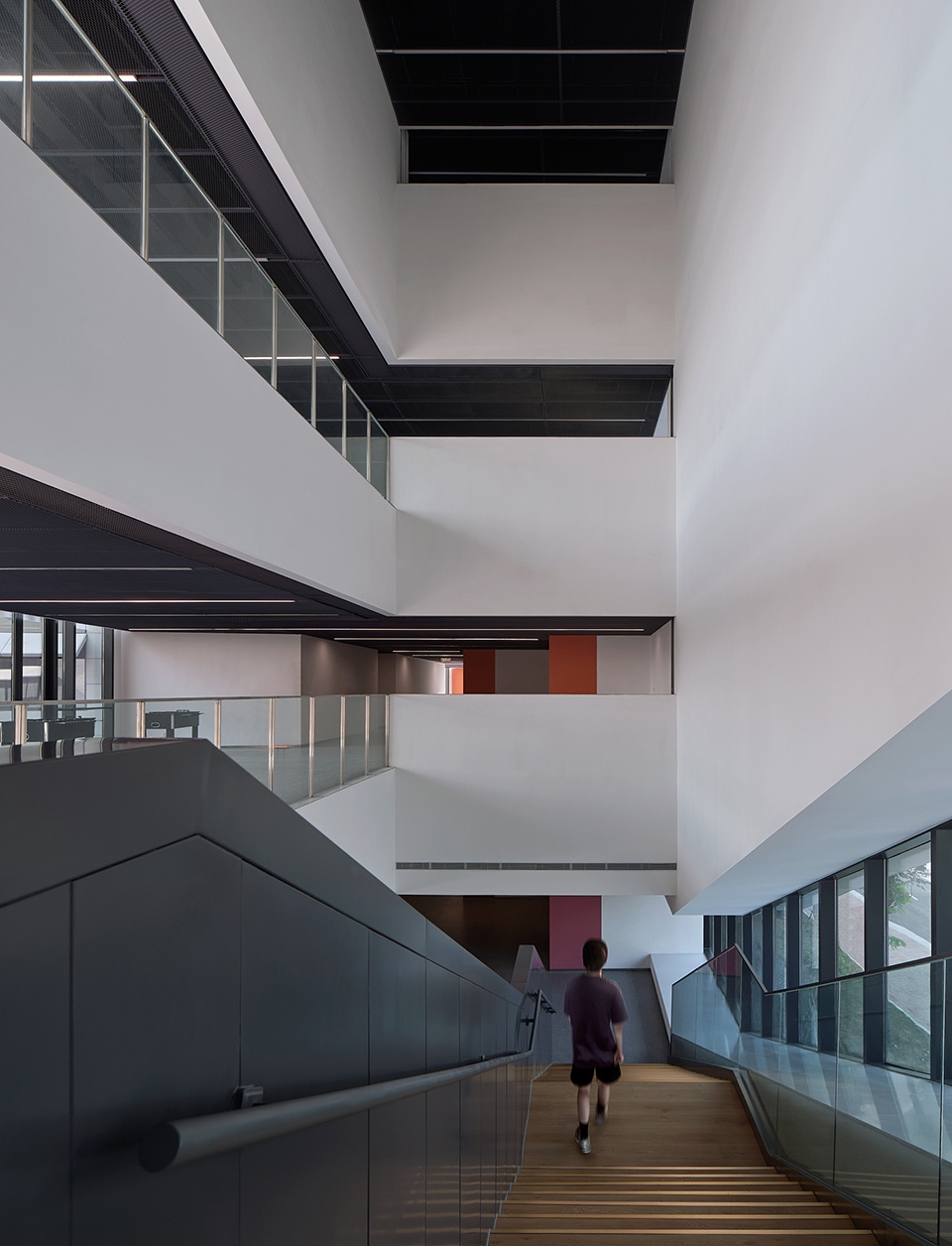
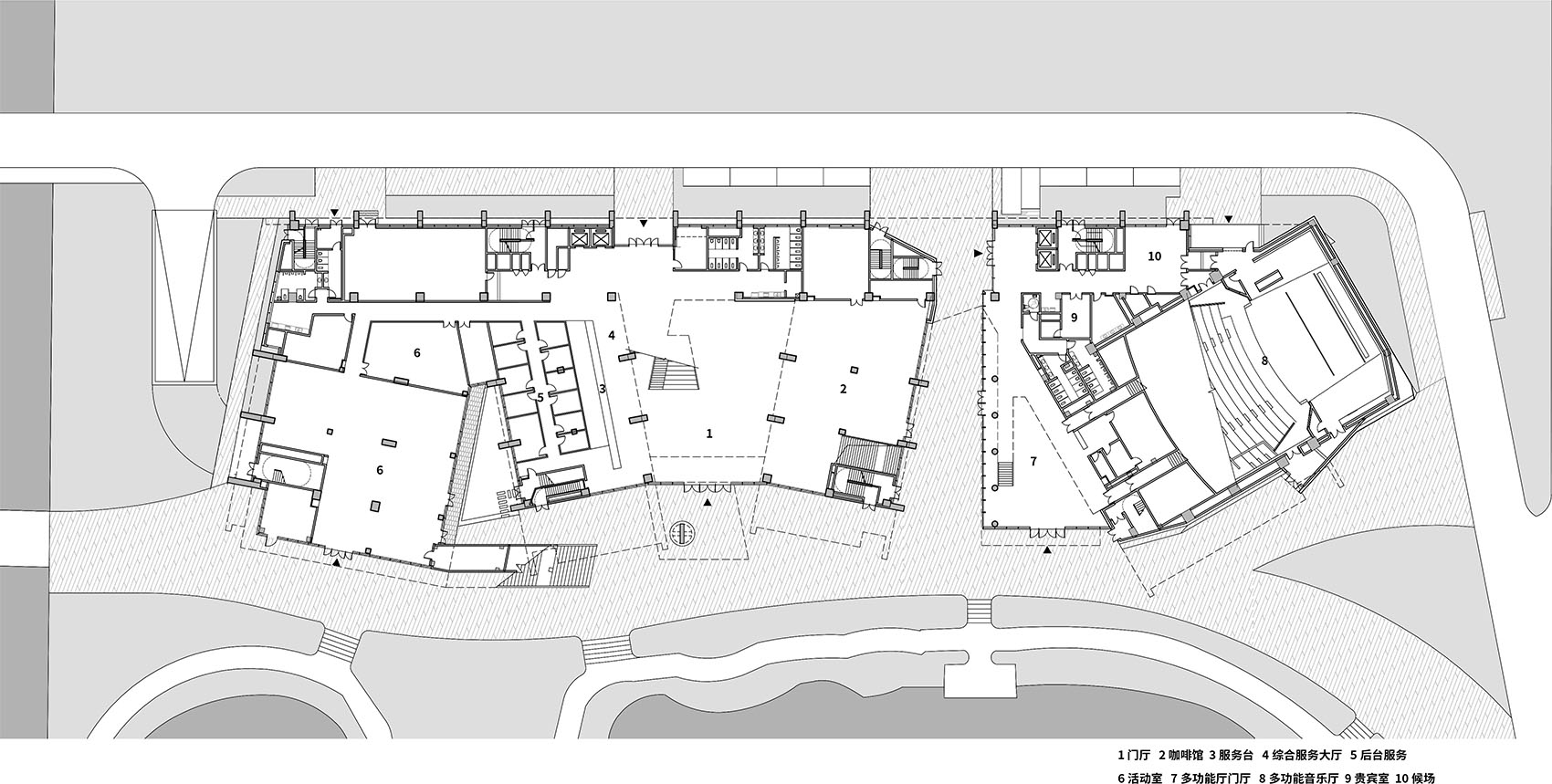
门厅与办事大厅,自助大厅相通,形成一门式综合服务大厅,开放式空间设计形成便利的办事流线,也为举办各类活动提供了丰富的可能。大台阶自然地将人流引入二层及共享边庭,形成连续的公共空间体系。共享边庭的处理延续建筑外部的整体性,立面开窗顺应楼梯走势,空间与立面完美契合,自主活动空间的适当留白给学生二次改造提供想象空间。
The entrance hall connects seamlessly with the service hall and self-service hall, forming a one-stop comprehensive service hub. The open-plan design creates convenient circulation routes for handling business while also offering rich possibilities for hosting various events. A grand staircase naturally guides people up to the second floor and the shared side atrium, establishing a continuous public space system. The design of the side atrium continues the overall coherence of the building’s exterior; windows are placed to follow the path of the stairs, achieving a perfect harmony between space and facade. Thoughtful blank spaces within the freely accessible activity areas leave room for students to reinterpret and personalize them in the future.
▼综合大厅连续的空间,Continuous Space of the Comprehensive Hall
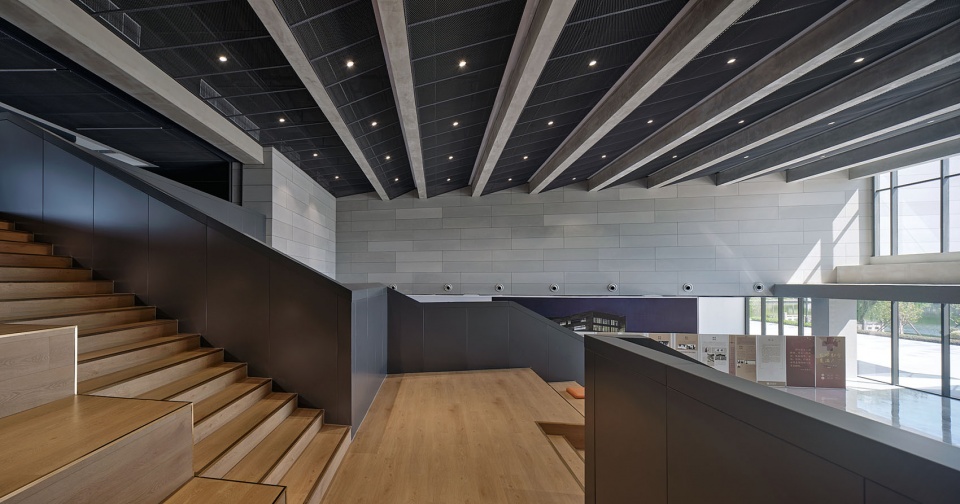
▼连续贯通的边庭楼梯及层间平台,The Continuous Side Atrium Staircase and Interfloor Platforms
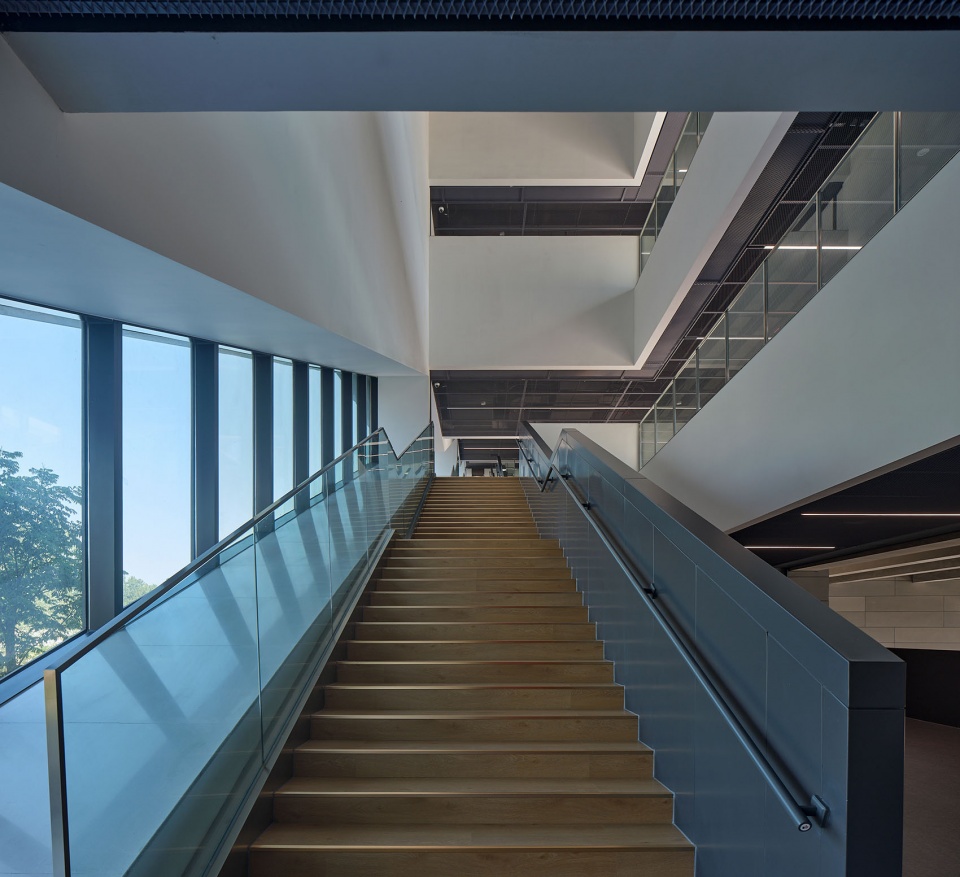
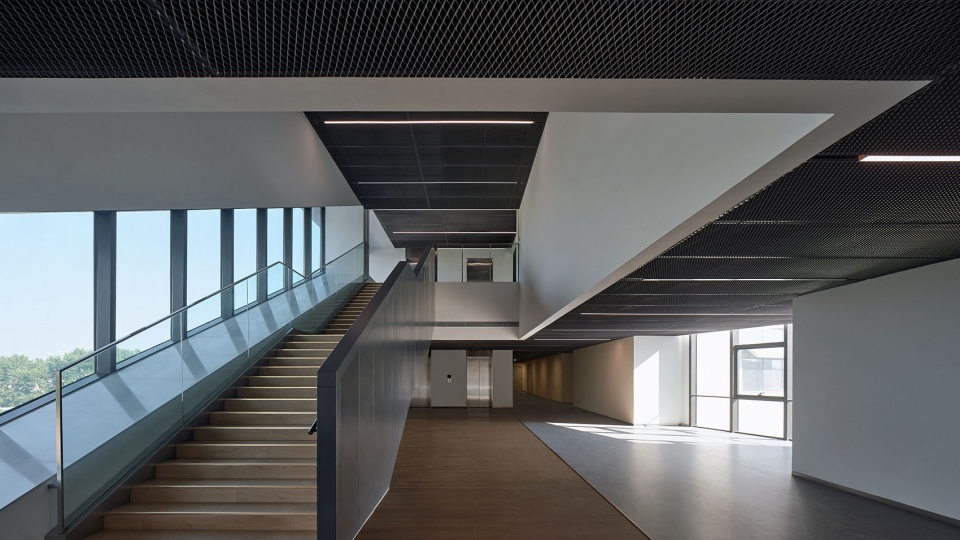
▼连续贯通的边庭楼梯及层间平台,
The Continuous Side Atrium Staircase and Interfloor Platforms
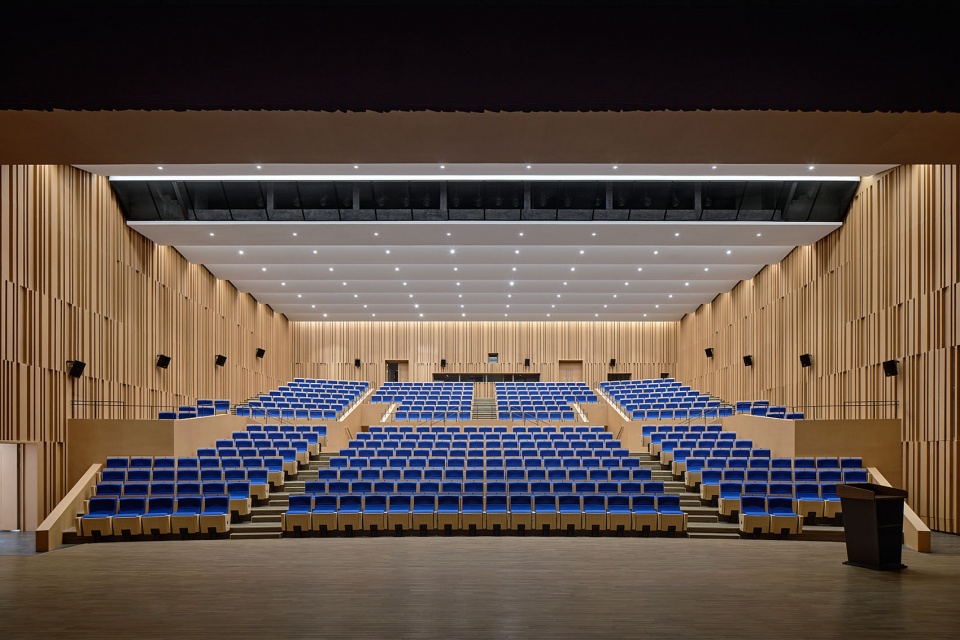
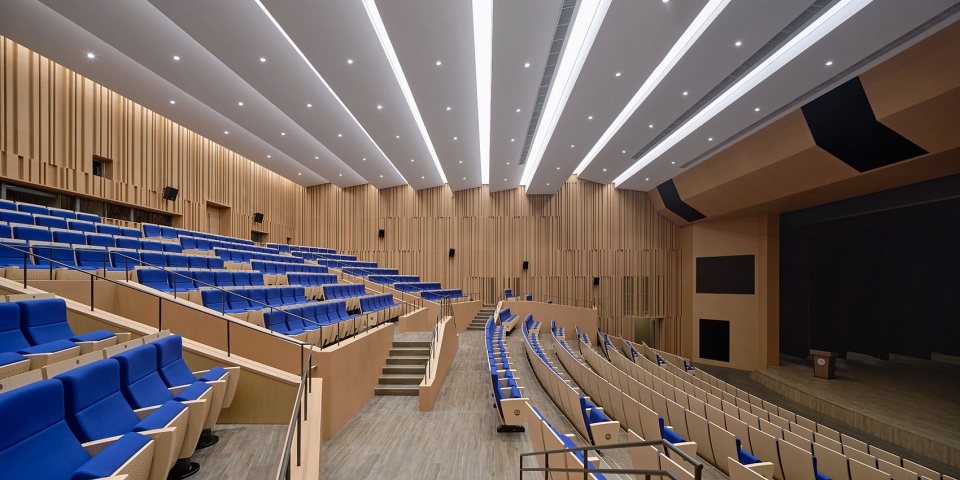
多功能音乐厅可由一层,二层分别进入,专业级的声学及舞台设计使其能满足会议、音乐、放映、舞台剧等多种使用需求。
The multi-purpose concert hall is accessible from both the first and second floors. With professional-grade acoustics and stage design, it can accommodate a wide range of needs—from conferences and concerts to film screenings and theatrical performances.
▼可满足多功能使用的音乐厅,Multi-Purpose Concert Hall
结语 Conclusion
设计重新塑造了校园新的边界,诠释了阻隔与开放、喧嚣与安静、界定与自由的意义,也重新定义了人工与自然、城市与校园的关系。
The design reshapes a new edge for the campus, interpreting the meanings of separation and openness, clamor and quiet, definition and freedom, while redefining the relationship between the artificial and the natural, and between the city and the campus.
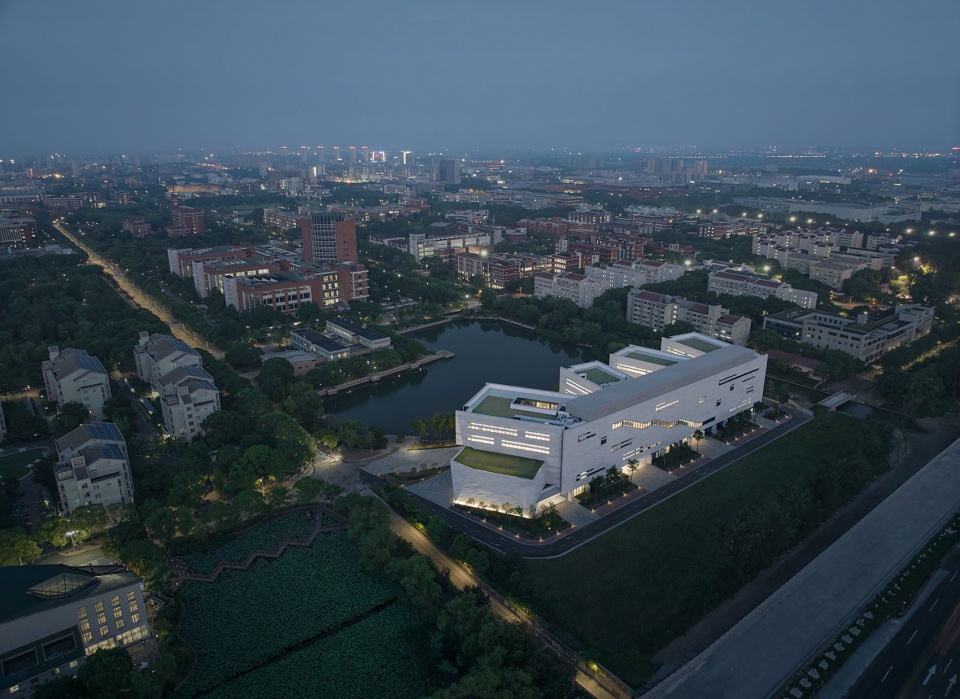
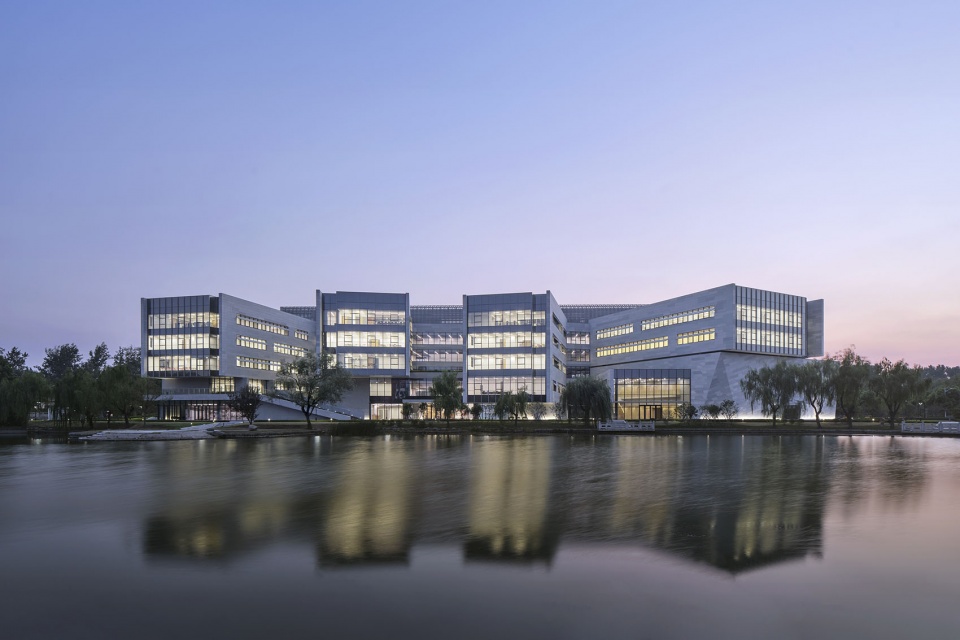
▼从高速路角度的整体夜景,Overall Night View from the Expressway
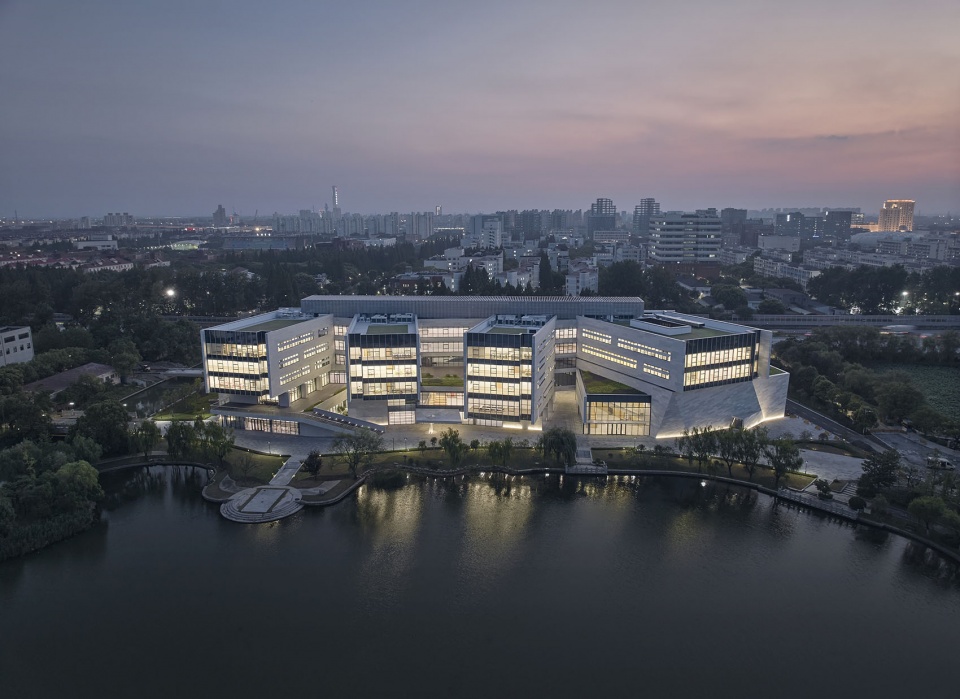
▼湖对岸视角,建筑与景观相互交融,Architecture and Landscape Blending from the Opposite Shore
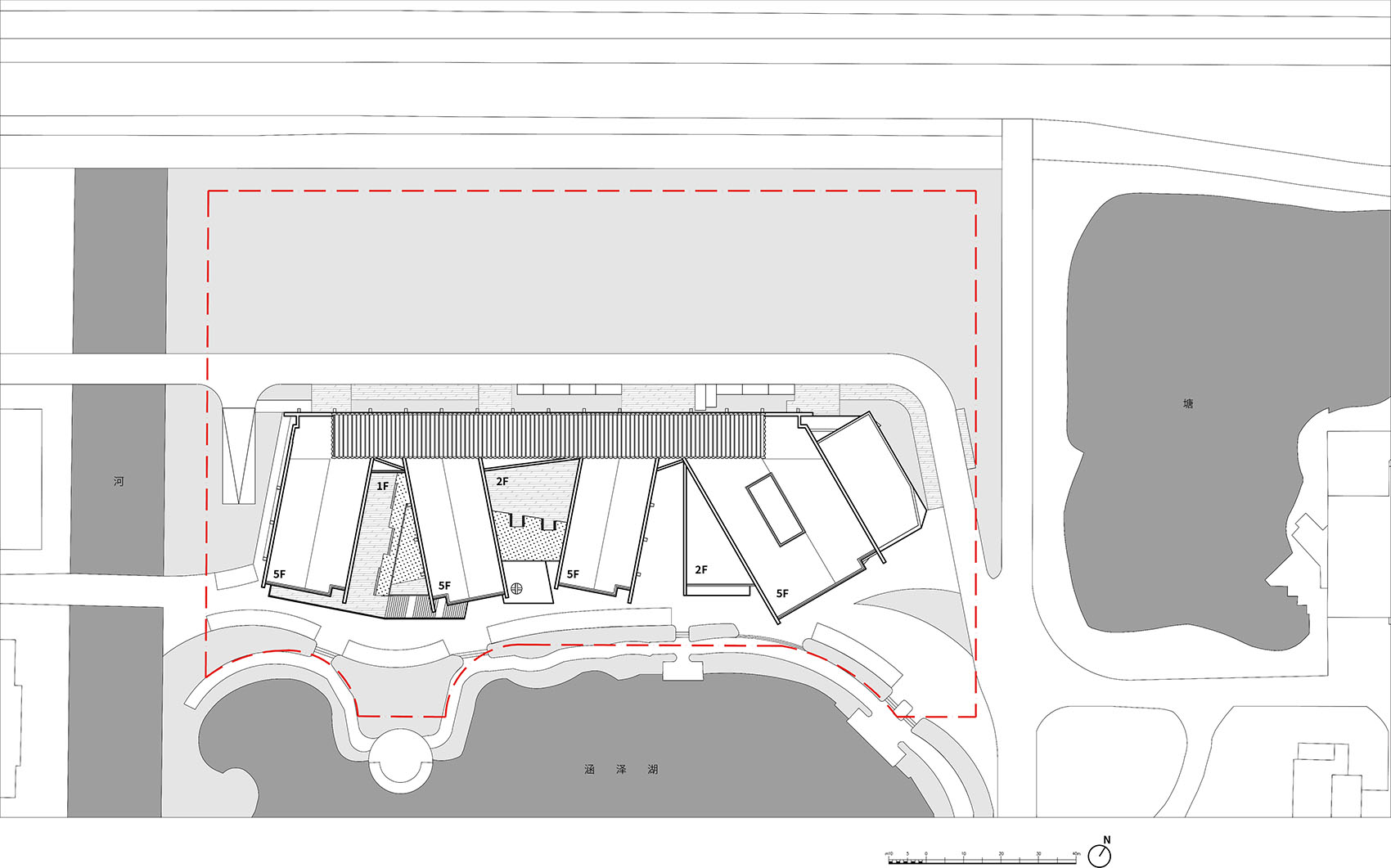
▼总平面图,General layout plan
▼一层平面图,First floor plan
▼二层平面图,Second floor plan
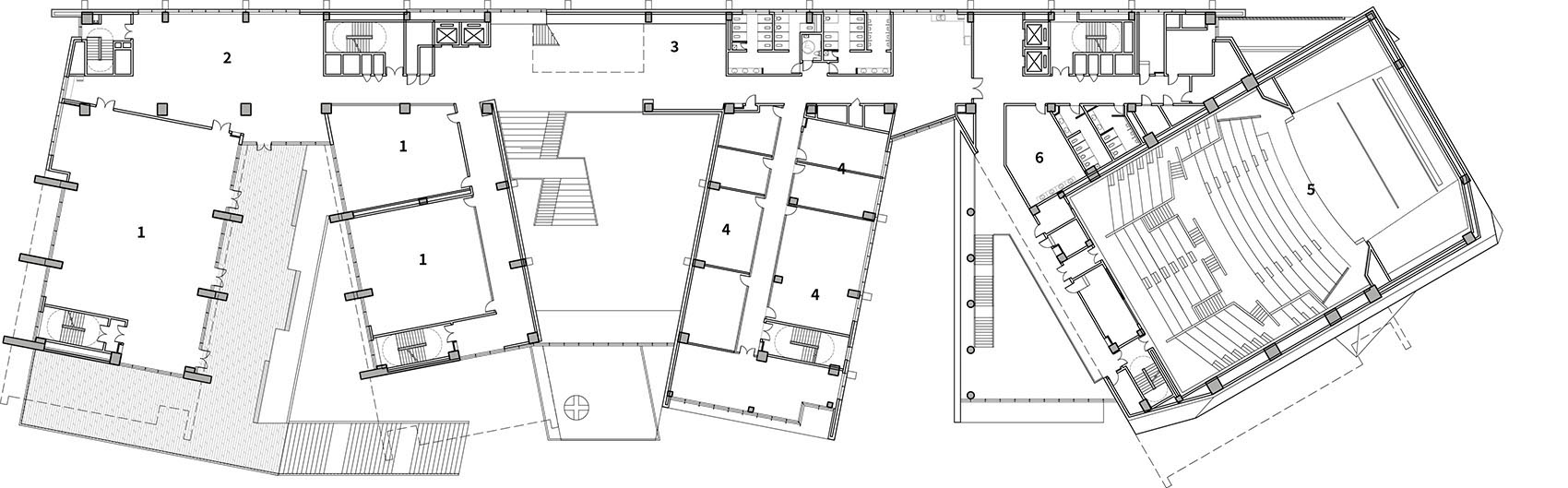

▼三层平面图,Third floor plan
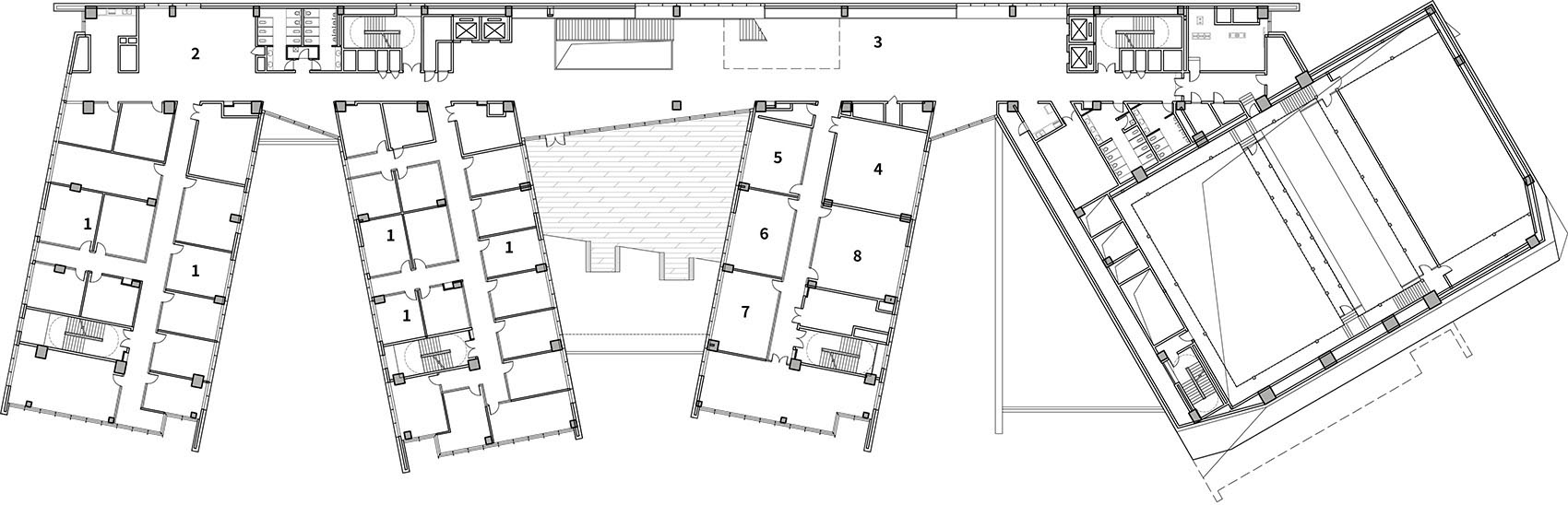

▼四层平面图,Fourth floor plan
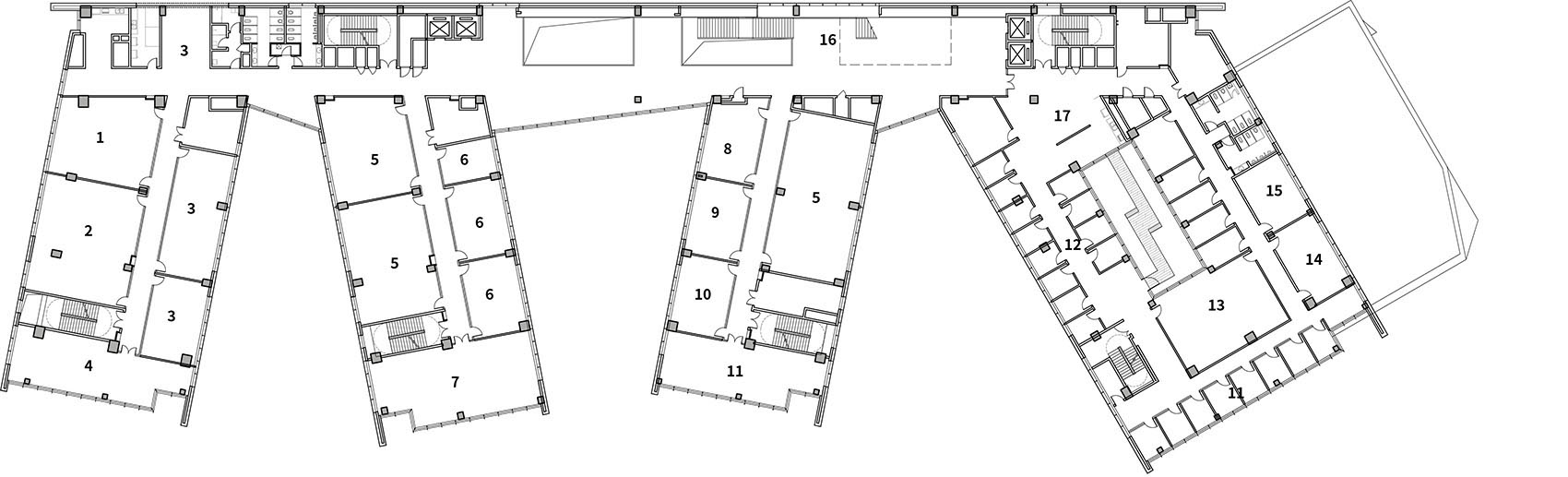

▼五层平面图,Fifth floor plan
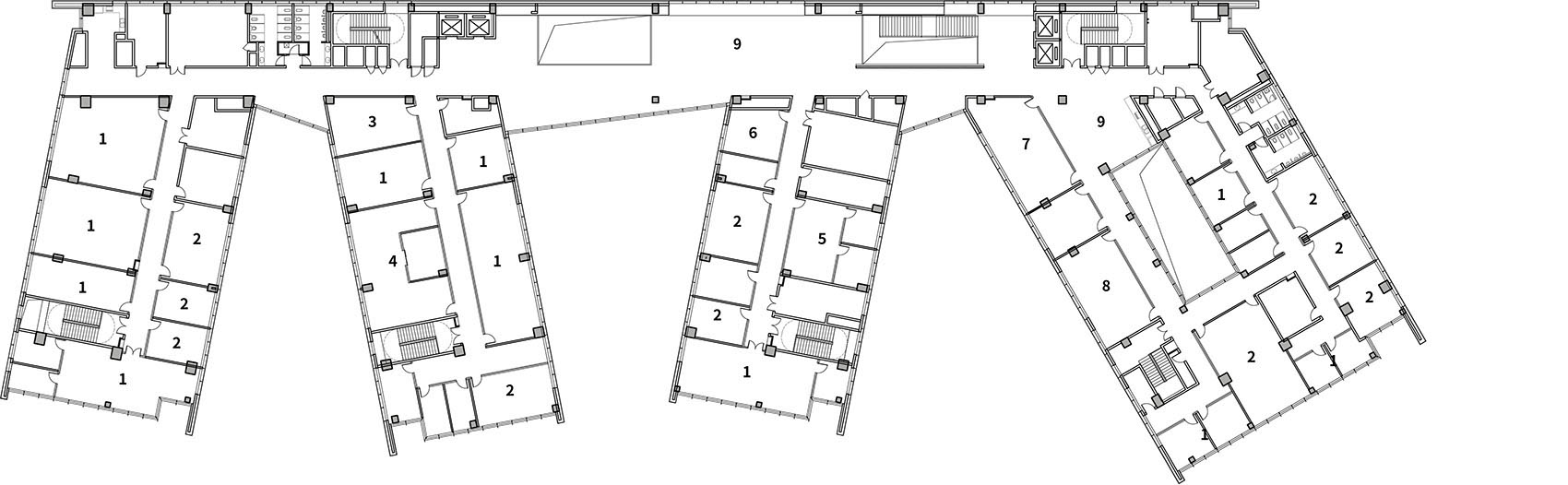

▼剖面图,Section
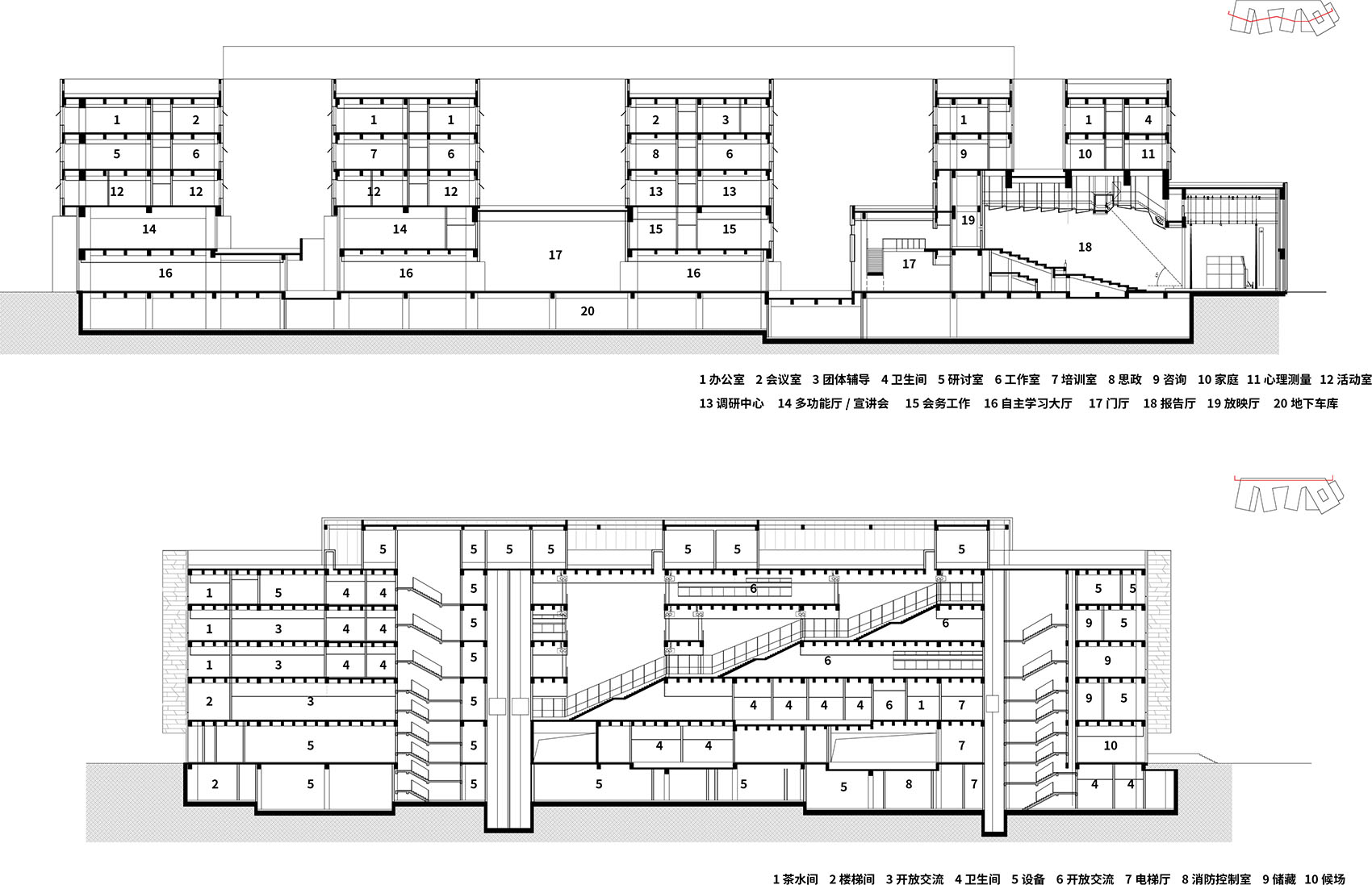
项目信息
Project Information
Project Name: Shanghai Jiao Tong University Student Service Center
Location: Minhang District, Shanghai
Client: Shanghai Jiao Tong University
Project Directors: Zeng Qun, Wu Min
Architectural Design: Li Rongrong, Xie Tianyuan, Yang Yuhan
Structural Design: Hong Wenming, Zhong Yuren, Li Guang, Mao Pengcheng, Geng Liuxun, Bin Zhiqiang
Plumbing Design: You Bolin, Wei Junyu
HVAC Design: Bian Zheng, Su Zhou
Electrical Design: Shi Guoping, Zhu Yicong, Xu Jiandong, Liu Chenxin
Interior Design: Li Rongrong, Xie Tianyuan
Landscape Design: Li Rongrong, Xie Tianyuan
Site Area: 19,400 m²
Floor Area: 24,400 m²
Design Period: 2019–2020
Completion Year: 2025
Architectural Photography: Zhang Yong
Text and Graphics Editor: Li Rongrong
Drawing Compilation: Zhou Xiao